
An Alternative News Aggregator
News of the Day
“Glory to God in the highest heaven, and on earth peace to those on whom his favor rests.”
- Luke 2:14
J.D. And Usha Vance Welcome A New Baby Into The Vice Presidential Family
 Vance has been at the forefront of a pro-kids campaign for years, and he and his wife are taking their own advice.
 WATCH: Spanish World Cup Hero Ferran Torres Wears 'Make Spain Great Again' Hat in Victory Parade
On Sunday, the cameras were on Spain's Ferran Torres, as he scored the goal that delivered "La Roja" their second World Cup championship. On Monday, the cameras were on him again, for a very different reason.
The post WATCH: Spanish World Cup Hero Ferran Torres Wears ‘Make Spain Great Again’ Hat in Victory Parade appeared first on Breitbart.
43 Days And Counting: Apathetic Americans Are About To Be Blindsided By A Major League Wake Up Call
 I really don’t understand the tremendous apathy that I am witnessing right now. Everyone can see that commercial oil inventories are rapidly being depleted. As I discussed yesterday, the global oil market had about 400 million barrels of excess inventory before the war, and now we have “close to nothing”. But at least we still have the Strategic Petroleum Reserve, right? Yes, that is true, but that is being rapidly depleted as well. In fact, when you add the dwindling commercial oil inventors in the U.S. to the oil that is left in the Strategic Petroleum Reserve, we only have 43 days of supply remaining…
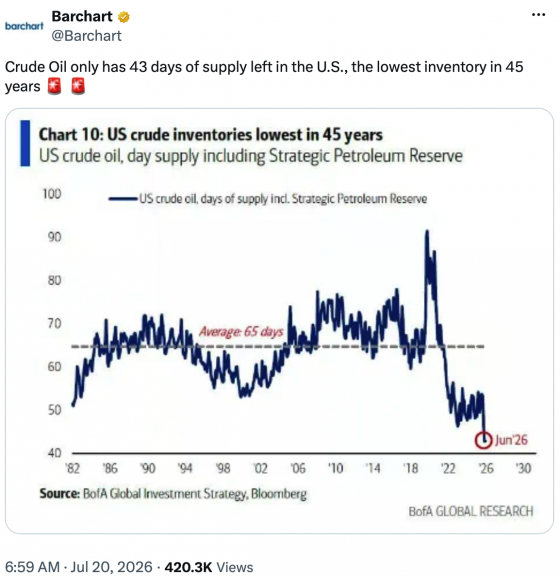
This doesn’t meant that 43 days from now we will be totally out of oil.
What it does mean is that our buffer is almost entirely gone.
Once it is entirely gone, as a society we will be forced to use less oil than we normally do.
Gasoline prices will likely rise until we see enough “demand destruction” to bring overall demand into balance with existing supply levels.
And that will likely start happening some time around the beginning of September.
Of course it is entirely possible that this could occur even sooner than 43 days from now.
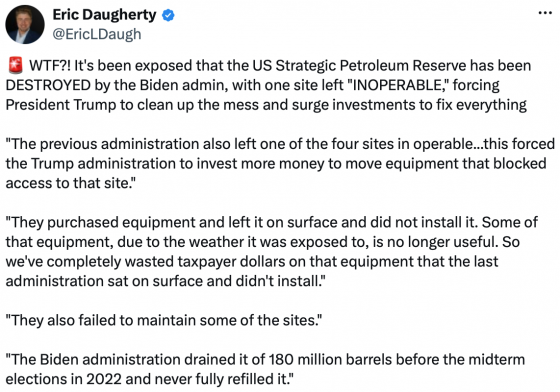
Thanks to the negligence of the Biden administration, one of the four major underground storage sites for the Strategic Petroleum Reserve is apparently “inoperable” at this point…
The extreme incompetence that we have been witnessing in recent years absolutely horrifies me.
Let us hope that there is enough oil that we can actually access in the Strategic Petroleum Reserve to get us through this crisis.
But I don’t think that there will be.
The war in the Middle East just continues to intensify, and now the Houthis have announced that they will be blocking Saudi vessels from traveling through the Bab el-Mandeb Strait…
Houthi militants in Yemen on Monday declared a maritime embargo against Saudi Arabia effective immediately, threatening to exacerbate the oil supply disruption triggered by Iran’s attacks on tankers in the Strait of Hormuz.
The Houthis have repeatedly threatened to close the Bab el-Mandeb Strait during the U.S.-Iran war. The strait is a choke point for commercial ship traffic that connects the Red Sea to the Gulf of Aden and global markets.
This is a major bombshell.
Much of the oil that the Saudis used to send through the Strait of Hormuz had been going through the Bab el-Mandeb Strait instead…
The Saudis have diverted million of barrels of oil per day through a pipeline to an export terminal on the Red Sea. Those exports have acted as a crucial relief valve for global oil markets during the U.S.-Iran war.
A closure of Bab el-Mandeb would block in those barrels, exacerbating the disruption triggered by Iran’s attacks on tankers in Hormuz.
So what is Saudi Arabia going to do now?
We have never seen the Strait of Hormuz and the Bab el-Mandeb Strait closed simultaneously, and this could send the price of oil into the stratosphere…
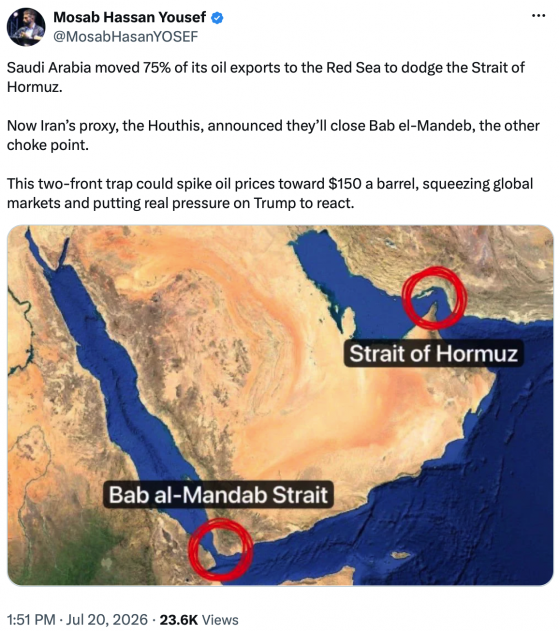
Virtually nothing has been moving through the Strait of Hormuz since late last week, and now the Iranians are really cracking down.
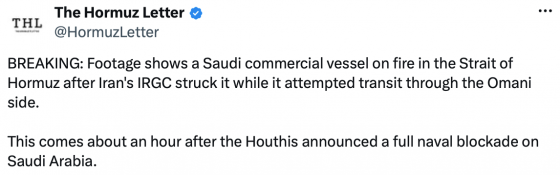
Just a little while ago, the Iranians attacked a Saudi vessel that was attempting to sneak through the Strait…
Prior to that, two Greek-owned tankers were “hit by projectiles” that came from Iran…
One of two Greek-owned tankers hit by projectiles in the Strait of Hormuz has been abandoned by its crew after fire was reported on the vessel.
The crew was rescued by a tugboat after abandoning the Maltese-flagged Kavomaleas owned by Greece’s Dynacom Tankers.
The only way to stop Iran from attacking commercial ships with missiles and drones would be to send in ground troops.
And that is not going to happen any time soon.
So the global oil crisis is only going to get worse.
Already, the average price of a gallon of gasoline in the United States is back above four dollars…
With the resumption of the war with Iran, gas has returned to a national average of $4 a gallon this week. Gas prices had started coming down after the U.S. and Iran agreed to a peace deal, which brought stability to the market. Then, as everyone with an IQ over 70 expected, that all fell apart as Iran continued to violate the agreement. Nevertheless, we did have a few weeks of gas prices coming down.
“The price is a national average, meaning drivers in some states have been paying well over $4 a gallon for a while now, while others pay less. Prices vary between states due to factors ranging from nearby supply to differing tax rates,” reports the far-left Associated Press. “People around the world are also dealing with high gas prices as a result of the war.”
Of course this is just the beginning.
Gasoline prices will go much higher than this.
Meanwhile, electricity rates have risen 18 percent in just 18 months…
From Trump’s inauguration in January 2025 to April 2026, the most recent month for which government data are available, residential electricity rates have risen by an eye-watering 18 percent.
Sadly, it appears that electricity prices are poised to accelerate even more…
Nationally, utilities in the second quarter of 2026 “asked state regulators to approve $9.2 billion in rate hikes, up 26% from the $7.3 billion in rate increase proposals filed in the same period last year,” reports Utility Dive.
Virtually every form of economic activity requires energy.
So when energy becomes more expensive, the cost of living goes up for everyone.
Our entire way of life depends on cheap energy.
That era is over.
In the short-term, rising prices will put an enormous amount of stress on American families.
And the outlook beyond the short-term is extremely bleak.
We really have reached a major turning point in human history.
The apocalyptic war that is unfolding in the Middle East is going to radically change all of our lives.
Most Americans are still very apathetic for the moment, but a major league wake up call is coming, and it is going to be very painful.
Michael’s new book entitled “10 Prophetic Events That Are Coming Next” is available in paperback and for the Kindle on Amazon.com, and you can subscribe to his Substack newsletter at michaeltsnyder.substack.com.

About the Author: Michael Snyder’s new book entitled “10 Prophetic Events That Are Coming Next” is available in paperback and for the Kindle on Amazon.com. He has also written nine other books that are available on Amazon.com including “Chaos”, “End Times”, “7 Year Apocalypse”, “Lost Prophecies Of The Future Of America”, “The Beginning Of The End”, and “Living A Life That Really Matters”. When you purchase any of Michael’s books you help to support the work that he is doing. You can also get his articles by email as soon as he publishes them by subscribing to his Substack newsletter. Michael has published thousands of articles on The Economic Collapse Blog, End Of The American Dream and The Most Important News, and he always freely and happily allows others to republish those articles on their own websites. These are such troubled times, and people need hope. John 3:16 tells us about the hope that God has given us through Jesus Christ: “For God so loved the world, that he gave his only begotten Son, that whosoever believeth in him should not perish, but have everlasting life.” If you have not already done so, we strongly urge you to invite Jesus Christ to be your Lord and Savior today.
The post 43 Days And Counting: Apathetic Americans Are About To Be Blindsided By A Major League Wake Up Call appeared first on The Economic Collapse.
Dad Whose Wife And Kids Are Away Arrives At Church 3.5 Hours Early

SPRING HILL, TN — Local dad Dave Tibbets, whose wife and children were visiting relatives out of state, reportedly arrived at church at 6:00 AM on Sunday, a full 3.5 hours before the 9:30 AM service was scheduled to begin.
An Uncomfortable Change in Perspective
 I would strongly suggest interested readers or researchers to go back and look carefully at the very public comments from Senate Intelligence Community Vice-Chairman Mark Warner, as they relate to the seizure of Fulton County, GA, election records. What you might notice forms the background of an uncomfortable change in perspective. In nearly all of […]
The post An Uncomfortable Change in Perspective appeared first on The Last Refuge.
Pages
Rune Hammer Feeds
