
An Alternative News Aggregator
News of the Day
“Glory to God in the highest heaven, and on earth peace to those on whom his favor rests.”
- Luke 2:14


Wake Up, America: The DSA’s Rising Influence Threatens Public Safety
As we approach the 2026 midterm elections, Americans concerned about public safety must confront a growing and dangerous trend: the increasing influence of the Democratic Socialists of America within the Democratic Party.
While the DSA markets itself as a movement for “economic justice,” its platform includes abolishing police, closing prisons, and opening national borders–policies that would dismantle the institutions that keep our communities safe.
For decades, the DSA’s impact on national politics was limited. But according to Brookings, the 2026 cycle has produced a series of high‑profile wins by candidates aligned with or adjacent to the DSA’s far‑left ideology, including victories in swing‑state primaries.
In fact, of 282 DSA-supported candidates in local, state legislative and congressional races, DSA candidates won 43.6% (123) of the time. This surge has alarmed many centrist Democrats who fear that nominating candidates far outside the mainstream could cost the party winnable seats–and more importantly, put public safety at risk.
The DSA’s official platform calls for defunding and ultimately abolishing police and prisons, freeing incarcerated individuals, and eliminating immigration enforcement. These are not fringe ideas–they are central to the organization’s stated goals.
And their influence is spreading.
One of the most consequential Senate races in 2026 is unfolding in Maine, where Democrat Troy Jackson is challenging Republican Sen. Susan Collins. Jackson has earned endorsements from progressive and far‑left activists, and his rhetoric mirrors core DSA positions.
Following a fatal ICE shooting in July, Jackson called ICE “a rogue agency” that “needs to be dismantled because they give us nothing in this country but heartache and racism.” This is not a minor policy disagreement–it is a call to eliminate federal immigration enforcement entirely. Jackson’s campaign messaging is pushing Maine toward the DSA’s anti‑police, anti‑ICE agenda.
Meanwhile, Collins continues to support law enforcement and has urged the Department of Homeland Security to improve safety protocols while maintaining necessary enforcement operations. Polling now shows the Collins and Jackson race a virtual dead heat.
On Oct. 12 The Washington Times reported that Sen. Bernie Sanders, the de facto leader of the socialist movement, campaigned for Jackson while touting a far‑left wish list: free health care, child care, and college for all, funded by massive taxes on billionaires. But he left out the radical far-left positions on police, prisons, and open borders.
In Michigan, Democrat Abdul El‑Sayed–not formally a DSA member but widely viewed as aligned with the far‑left wing–won the Democratic nomination for Senate. Brookings notes that his victory represents one of the most significant wins for the insurgent left in a major swing state.
El‑Sayed faces Republican Mike Rogers, a retired FBI agent with a strong law‑and‑order record. The contrast could not be sharper.
El‑Sayed has faced scrutiny for past remarks, including his response to the March attack on Temple Israel in suburban Detroit. While condemning the attack, he added that “hurt people hurt people” and “violence always begets violence”–comments critics say minimize criminal responsibility and echo the DSA’s tendency to blame society rather than offenders.
Rogers, by contrast, has built his career on supporting law enforcement, counterterrorism, and strong public‑safety policies.
The dangers of far‑left sanctuary‑city policies were on full display in a recent ICE shooting in the Bronx. According to an Oct. 12 article in The Washington Times, DHS officials said the suspect–Oscar Bergal–had a long criminal history and was “emboldened” by sanctuary policies that encourage resistance to arrest.
Homeland Security Secretary Markwayne Mullin stated plainly: “Sanctuary politicians create an environment for criminal activity to thrive.”
Yet New York City Mayor Zohran Mamdani, a DSA‑aligned official, demanded Bergal’s release and insisted: “Immigrant New Yorkers belong here. ICE does not.”
This is the real‑world consequence of the DSA’s anti‑enforcement ideology: criminals shielded, officers endangered, and communities left vulnerable.
The Washington Times recently reported that President Donald Trump is “a victim of his own success on crime rates,” as crime has fallen so sharply that it has faded from the national conversation.
The numbers comparing the 20 months Trump has been in office with the end of 2024 are striking. The homicide rate is down 16% (4.9 → 4.1 per 100,000); violent-crime arrests up 90%; foreign-terrorist arrests up 38%; and all 10 FBI Most Wanted fugitives have been captured.
And an August FBI report shows violent crime fell 9.3% in 2025, the largest one‑year decline since at least 1936, when the bureau began tracking national crime trends.
These gains were achieved through strong policing, robust federal enforcement, and pro‑law‑enforcement policies–the very policies the DSA seeks to dismantle.
If DSA‑aligned candidates gain power, these hard‑won gains could evaporate, returning America to the disastrous “defund and defame the police” era of 2020–2021 when crime was rampant and criminals acted with impunity.
The DSA’s growing influence is not just a political trend–it is a direct threat to public safety. Its platform would eliminate the institutions that protect Americans from violent crime, terrorism, human trafficking, and dangerous drugs.
This November, voters must understand what is at stake.
The safety and security of our country depend on rejecting candidates who embrace abolitionist, anti‑police, and anti‑enforcement policies–and supporting leaders who defend law enforcement, uphold the rule of law, and protect our communities.
Wake up, America. Our future depends on it.
We publish a variety of perspectives. Nothing written here is to be construed as representing the views of the Daily Signal.
Two Weeks Before the Midterms, D.C. Sent Me Four Other People’s Ballots
Summary
- The Washington, D.C., Board of Elections sent this Daily Signal writer the mail-in ballots of four strangers.
- “It’s concerning that anyone could just take that, theoretically, and vote in my place,” one of those voters said.
- This situation is no one-off. It’s happening nationwide.
Two weeks ahead of the 2026 November midterm elections, which could change the balance of power in Congress, the Washington, D.C., Board of Elections sent me four strangers’ mail-in ballots.
This is not a one-off. It is happening to Americans across the country. Early voting has already begun for the midterms, and millions of unsecured mail-in ballots could have already been sent and submitted.
The Daily Signal decided to investigate these four ballots further. By obtaining the D.C. voter registration list, we confirmed the identities of the rightful owners and contacted one of them, a former tenant of my current residence.
D.C. Voter Says Mail Ballot Could Have Reached Wrong Hands
“It’s concerning that anyone could just take that, theoretically, and vote in my place,” said the D.C. voter who was granted anonymity to protect his privacy. The voter was registered as not affiliated with any party.
This would be a clear case of voter fraud, a felony punishable by up to five years in prison.
“This is a pretty good example of how mail-in ballots can really be used to one party’s advantage, or one person’s advantage and to another person’s disadvantage,” he said, explaining that it’s the person doing his due diligence as a citizen who ultimately ends up harmed in the end.
“I think it’s pretty scary to think about how if these mail-in ballots are getting sent to the wrong addresses or people’s old addresses, I think that could have a pretty consequential impact in what’s going to be a really, really close election cycle,” he continued.
“You want to trust that people are going to do the right thing, but when it comes down to it, in a lot of these races, probably a couple of hundred votes are going to make a difference, that could be people taking someone else’s ballot and voting with it,” he said.
This voter did all the right things. He did his due diligence in exercising his right to vote. He voted in person, on Election Day, at the correct polling place. However, no one told him that in D.C., all voters are automatically sent a mail-in ballot for every election. A few months later, when the voter moved to a new address within the district, he didn’t think about updating his address on his voter registration because he lived in the same district.
“I would have liked to have had the option to sign up for a mail-in ballot, rather than just being blindly sent one,” he told the Daily Signal.
“I’m personally not a huge fan of the mail-in-ballots because I think this happens a lot,” the voter continued.
“Voter security is obviously a pretty big topic this election cycle, and so I think we’re seeing firsthand just how mail-in ballots especially, can really be a cause of concern in an area where people can definitely manipulate,” he said, referring to mail-in ballots.
The Wide-Open Door to Election Fraud
This situation is far from unique. People across America are receiving mail-in ballots at their home addresses, addressed to strangers. At the same time, people’s ballots are being placed in the hands of strangers, allowing a wide-open door for election fraud.
“You can find others in your same situation [with] these mail-out states all over the country,” Ken Cuccinelli, former Virginia attorney general and current chairman of the Election Transparency Initiative at The Heritage Foundation, told the Daily Signal.
Two weeks out from Election Day, Cuccinelli says there is no way to ensure votes are secure, emphasizing the need to secure the election on the front end.
“It is a completely unsecured election. They’re virtually inviting you to vote all those ballots,” Cuccinelli told me, referring to the four ballots I received.
“This unbelievably disastrous abandonment of security of ballots is being repeated in maybe a dozen states,” he said.
California, Colorado, Hawaii, Nevada, Oregon, Utah, Vermont, and Washington are all states that mail ballots to voters every election cycle, regardless of whether they want one or not. Even if you update your address and re-register to vote, there is no way to ensure a state’s secretary of state or election board will update the voter roll.
Cleta Mitchell, founder and chairman of the Election Integrity Network, says that once you are added to the voter rolls, it is nearly impossible to remove someone because they are so rarely checked.
“We need to return to in-person voting. That should be the default, in-person voting. The default should never be remote voting. That should be the exception, and then you can establish guardrails around that to manage the exception. What no one can manage is this massive unsupervised voting,” she told the Daily Signal.
Voting Rights Should Share No Party Lines
“All these concerns about the elections are shared by Democrat voters and unaffiliated voters. The voters, the general public, agrees with us,” Mitchell continued.
“We’re not the extremists. It’s the Democrat members of Congress, the Democrat elected officials, and the left wing advocacy groups. They’re the ones who are the outliers. The American people want to be able to trust that the elections are accurate and that they are transparent. I think the public gets sick of the quote glitches and errors.
“The Left likes the mess,” Cuccinelli said, “because it’s to their strategic advantage that there be a mess.”
The Washington, D.C., Board of Elections did not respond to multiple requests for comment from the Daily Signal. I have also submitted a civil rights voting violation claim with the Department of Justice, and the outcome is pending.
An Immigration Ruling With Teeth—If It Holds Up
Sometimes a consequential immigration decision turns not on a new act of Congress or a ruling by the Supreme Court, but on whether an agency finally gives existing statutory language its full effect. That is the promise of Matter of A-V-O-, a Sept. 17 ruling by the Board of Immigration Appeals. The board concluded that an aggravated felony conviction can do more than make an alien removable: It can also make that person inadmissible as an immigrant because the conviction permanently forecloses citizenship.
That could prove quite helpful to the Department of Homeland Security. But promising precedent is not the same thing as a settled enforcement policy, much less a final judicial victory. How DHS uses this decision in charging cases—and whether the federal courts of appeals sustain it—will determine whether its promise becomes practice.
The underlying facts are common and hardly a model of respect for American law. The respondent, a Nicaraguan citizen, entered the United States on a visitor visa in 1996 and overstayed. She was ordered removed in absentia in 2004, but later successfully reopened her immigration proceedings in 2019. In 2020, she was convicted in federal court of using an unauthorized access device and aggravated identity theft, receiving prison sentences of eight months and 24 months, respectively.
She disputed whether her crimes crossed the statutory threshold for an “aggravated felony” involving fraud or deceit: losses exceeding $10,000. Her argument concentrated on the fact that she spent $3,450.42 to purchase five cellular phones. But the government identified total losses of $345,100.14, and the trial judge ordered restitution in that amount, jointly and severally with her co-defendants.
The Board of Immigration Appeals rejected her attempt to make the one transaction stand for the whole offense. Applying the Supreme Court’s circumstance-specific approach, the board found the restitution amount tethered to her convicted conduct. The phone purchase was an example, not the totality of her culpability. And sharing responsibility for restitution with co-defendants did not eliminate her own responsibility for the loss. The aggravated-felony removal charge stood.
The more consequential question was what follows from that classification. Immigration law distinguishes between removability and inadmissibility. An alien’s eligibility for removal does not, by itself, resolve whether that person can obtain lawful permanent residence through adjustment of status and an available waiver.
The board’s new interpretation adds clarity to a separate statutory obstacle.
The reasoning proceeds through a chain of statutory provisions. Naturalization generally requires good moral character. An aggravated felony conviction permanently bars the required finding of good moral character.
Section 212(a)(8)(A) of the Immigration and Nationality Act, meanwhile, makes an immigrant permanently ineligible for citizenship inadmissible. Critically, Congress defined ineligibility for citizenship to include not only certain military-service-related bars, but also permanent debarment under “any section” of the Immigration and Nationality Act or another act.
The board read that catchall to mean what it says. A conviction for an aggravated felony makes a person permanently unable to satisfy the naturalization requirements and falls within that definition and, consequently, the citizenship-related ground of inadmissibility.
The Board of Immigration Appeals specifically overturned one of its previous decisions: a Matter of Kanga, a 2000 board decision limiting the provision to military service evasion. The board also declined to follow a similarly restrictive 1969 administrative decision. Those precedents relied on legislative history, statutory context, and concerns about how a broader interpretation would affect other provisions and waiver eligibility.
The new decision’s answer is refreshingly direct: Adjudicators do not get to narrow statutory language because its consequences are substantial. Nor does overlap between provisions supply a license to rewrite one of them. If Congress used a catchall to include permanent citizenship bars elsewhere in the law, an agency cannot confine it to military service simply because that was the historical focus of earlier cases.
That is a serious textual argument, not a substitute for one. But it still must withstand judicial examination. Reviewing courts will have to decide whether a permanent inability to establish good moral character amounts to permanent debarment from citizenship within this particular statutory definition, and whether the board’s reading fits the broader immigration scheme.
Declaring the text clear does not relieve an agency of demonstrating that its interpretation is correct.
In overturning Kanga, the board recognized that changing longstanding precedent carries consequences of its own. It therefore made the new rule prospective. It applies only to aliens seeking admission as immigrants who incur aggravated felony convictions based on guilty or no-contest pleas made, or jury verdicts entered, after Sept. 17.
That limitation is not fine print. The triggering event is the plea or verdict—not merely a later charging decision or immigration hearing. The ruling is not an invitation to apply the new interpretation to every old aggravated felony conviction. Indeed, the board expressly weighed reliance on its former precedent and the disruption retroactive application could cause.
For that reason, the respondent herself did not lose under the new rule. She lost under existing standards. The board upheld the finding that she had not established the extreme hardship to a qualifying relative required for her requested waiver. It also affirmed the independent discretionary denial, concluding that her serious and escalating criminal conduct outweighed her favorable equities. Without the waiver, adjustment of status failed. Her torture-protection claim likewise lacked the necessary individualized showing, and the board rejected her procedural challenge.
The larger lesson is one of both consequence and restraint. A-V-O- could give DHS a useful additional ground of inadmissibility in qualifying future cases. It does not erase statutory distinctions, dispense with proof, or guarantee that every charging decision will succeed.
Only time will tell how DHS deploys it and whether appellate courts uphold it. The board has put a potentially powerful tool on the table. Whether it becomes a durable instrument of immigration enforcement remains to be seen.
Talarico Courts Muslim Voters While Defending Interfaith Views
Democrat U.S. Senate candidate James Talarico attended an event in Irving, Texas, that was dedicated to speaking with the Muslim community.
Talarico held a meet-and-greet with the Muslim Democrat Caucus of Irving, where he met with Richardson Mayor Amir Omar, Councilman Fahad Ahmed of Irving, state Rep. Salman Bhojani, and Nima Bhojani.
The event, held at a halal barbecue restaurant, Kafi Barbeque, aligns with Talarico’s record of supporting Islamic ideology and acting on behalf of that community.
Amy Mek, founder and editor-in-chief of the RAIR Foundation USA, highlighted some of Talarico’s past Islamic advocacy in an X post. She noted Talarico is endorsed by Emgage Action, a 501(c)(4) nonprofit “advocating for Muslim American communities” and which has links to the Council on American-Islamic Relations, or CAIR.
Talarico, who serves in the Texas Legislature, authored and helped push House Bill 2039 in 2021, legislation intended to strip explicit naming of Christian ministers and Jewish rabbis from marriage law so imams could perform marriage ceremonies. The bill was written by Muslim activists and specifically thanked Insiya Aziz of Emgage Action for her role and testimony on the bill.
HB 2039 passed the House but was left to die in the Senate.
In 2025, Talarico also joined Bhojani to author House Bill 1044, legislation that would have added Buddhist, Hindu, Muslim, and Sikh officiants to Texas marriage law. That bill retained Christian ministers, priests, and Jewish rabbis. It did not receive a vote in the House.
His legislative record isn’t the only example. Talarico has also equated Christian nationalists with the Taliban and al-Qaida, and he claimed Christians, Jews, and Muslims worship the same God.
“Christians and Muslims and Jews all worship the same God,” Talarico said. “Muslims love Jesus. They love Moses and Abraham. We are all branches on the same tree as the Abrahamic faiths.”
“It’s heartbreaking to watch extremists, whether they are Christian nationalists or whether they are the Taliban or al-Qaida, perverting these beautiful traditions that have so much in common,” he added.
During an interview on The State of Belief podcast in 2024 with Bhojani, Talarico said that Islam helped shape his religious beliefs.
“I’ve learned as much about my faith from Salman’s tradition, from the Islamic mystics, from poets like Rumi, as much as I have from Christian authors and Christian writers,” Talarico said. “This kind of interfaith dialogue, it doesn’t water down your tradition, in fact it strengthens it, it brings out new flavors and new colors.”
Talarico has made other statements about Islam, including one statement in which he said that different faiths are “equal pathways to truth.”
“That’s how I think, you know, I always think of all of the world’s faith traditions as like a circle with that divine mystery of the universe in the middle,” he said. “And we all have different names for that mystery, right? Whether it’s God or Yahweh or Allah, or Nirvana, the Great Spirit, whatever you call it—this is all different pathways to the same kind of fundamental truth of reality,”
Polling shows that Talarico leads Paxton by 2 percentage points, as of Oct. 16, with the race still being viewed as a toss-up.
Early voting in Texas runs from Oct. 19 through Oct. 30.
Election Day is Nov. 3.
Trump Says Megachurch Pastor Running for Senate ‘Openly Mocks Jesus’
President Donald Trump claimed that Adam Hamilton, a pastor and Democrat nominee for U.S. Senate in Kansas, “openly mocks Jesus,” and attacked him for supporting transgender ideology.
Trump did not mention a specific statement in which Hamilton had mocked Jesus, though he made the accusation between two criticisms of Hamilton over transgender ideology.
“Adam Hamilton used church dollars to fund anti-religious transgender activity,” Trump said Monday at a rally in Park City. “He used a lot of church money to fund all of this transgender crap that you’re reading about—who openly mocks Jesus, and he openly mocks Jesus.”
Hamilton, a United Methodist pastor, has emerged as a prominent Democrat candidate seeking to combine leftist politics with Christian messaging. His church has repeatedly sponsored Kansas City PrideFest.
“He promotes a document listing 125 different genders,” Trump added. “You think Talafreako’s bad, he was only six,” the president added, referencing James Talarico, the Democrat nominee for U.S. Senate in Texas.
The Daily Signal could not identify a document listing 125 genders. In a debate earlier this month, Hamilton said he doesn’t believe men should compete in women’s sports and he believes there are “two biological genders,” though “people might identify in different ways.”
“Adam Hamilton stated that he believes America is systemically racist,” Trump added. “He said that white people must repent.”
“Repent all of you white people,” Trump said, mockingly to laughter. “Terrible, terrible white people.”
It does not seem Hamilton expressly stated that all white people must repent, but the website includes a video of Hamilton preaching about the “privileges” he enjoys from being white. “Before I can do anything to help anyone else, I have to have a conversion, I have to repent,” Hamilton said in a June 2020 sermon.
In response to Trump’s comments, the Hamilton campaign emphasized the size and impact of the church the candidate founded, United Methodist Church of the Resurrection in Leawood, where he serves as senior pastor. It is the largest United Methodist church in America.
“Adam is proud to have built a congregation of equal parts Republicans, Democrats, and Independents, who worship side by side and work together to serve their local communities,” Tyson Brody, the campaign’s spokesman, told the Daily Signal in a statement Tuesday. He noted that the church fed more than 45,000 people and distributed 60,000 books to kids in need last year.
Hamilton “welcomes critics to come visit Resurrection, instead of attacking the largest United Methodist Church in the country in an attempt to save Roger Marshall’s flailing campaign and distract from record diesel and gas prices, the war in Iran, and Roger Marshall’s usurious medical debt collection practices.”
“Our goal has always been to share Christ’s love with everyone,” the church told the Daily Signal.
Marshall’s campaign, when approached for comment, directed the Daily Signal to a website attacking Hamilton.
The website shows an image of the Kansas City PrideFest 2025 sponsors, which includes Church of the Resurrection.
Hamilton defended the sponsorship, saying that by it “the church affirms that each person is worthy of dignity, respect, and belonging.”
“I didn’t personally ‘take money from the church’ to do this—though I am proud of our church’s ministry and witness in the community—and I didn’t know there was a ‘drag queen story time’ at the PrideFest until this ad came out,” he said in September.
In a 2022 sermon, Hamilton defended a drag queen preacher from criticism and said the drag queen might reach people he couldn’t reach himself.
In 2024, the United Methodist Church voted to rescind its ban on LGBTQ ordination, after many conservative churches left the denomination.
The Republican National Committee condemned Hamilton’s social positions as “crazy.”
“President Trump needs his ally Senator Marshall back in Washington to continue standing up for ranchers, fighting for hardworking families, and protecting kids from creeps like Adam Hamilton who welcome men in women’s bathrooms,” RNC spokesman Zach Kraft told the Daily Signal. “This election is a choice between a commonsense leader and a crazy liberal maniac hell-bent on destroying Kansas’ way of life.”
Trump’s criticism comes as Hamilton and Talarico, a seminarian, have drawn increased attention to the “Religious Left,” Democrats who claim Christianity provides support for their policies, even on contested social issues.
Schumer-Backed Veterans Group Backs Non-Veteran Dems Over Decorated Republican
During his three-decade career as a Marine, Sen. Dan Sullivan lived out the Marine Corps’ motto, Semper Fidelis, “always faithful,” retiring as a colonel in 2024 after several deployments across the Middle East and Asia.
But now in a reelection bid, the Alaskan senator is receiving no such loyalty from a Democrat, Chuck Schumer-aligned super PAC that claims to help “veterans and national security experts win elected office.” Rather than supporting a decorated veteran, Schumer’s VoteVets is opting to rally behind Democrats, including Sullivan’s opponent, former Rep. Mary Peltola and Iowa state Rep. Josh Turek, neither of whom served in the military.
Sullivan’s race for reelection against Peltola is as tight as they come. A recent RealClearPolling average has the Democrat up by 1.2 points, while other polls have Sullivan, a Republican, leading by as much as 3 points. VoteVets, meanwhile, has poured hundreds of thousands of dollars into attacks against Sullivan and hosted an event with Peltola. Additionally, the Democrat organization spent millions launching Turek and helped him secure the Democrat nomination.
Vice President JD Vance highlighted Sullivan’s service during a campaign rally in Fairbanks last week, introducing Sullivan as “a guy who cares about whether he fights for the men and women of this state. That is Marine Corps veteran, and your great senator, Dan Sullivan.”
During his three-decade military career, Sullivan was deployed to the Taiwan Strait, the South China Sea, the Middle East, the Horn of Africa, and Central Asia. Sullivan served on a 2013 Joint Task Force in Afghanistan targeting terrorist networks in the Taliban.
“I’m Alaska’s junior U.S. Senator, but with the exception of husband and father, the title ‘Marine’ is my proudest achievement. Always has been. Always will be,” Sullivan said in a statement at the time of his retirement.
Beyond his military service, Sullivan has used his time in office to support the military and provide more resources for the Marines. In May, Sullivan announced a plan to expand the Marine Corps presence in Alaska, including a training program that would equip Marines for the extreme Arctic environment.
But despite Sullivan’s ardent support of the military in and out of uniform, the super PAC supposedly dedicated to electing veterans to office is actively campaigning against him. Even worse, the Democratic outside entity is supporting candidates with no military experience and individuals who have shown little support of the military while in office.
In August, the VoteVets PAC announced a plan to spend $225,000 in an ad campaign to smear Marine Veteran Sullivan for his “support of the war in Iran.”
VoteVets has spent $136,000 on the airwaves in Alaska, including at least $58,000 reserved on radio ads between Oct. 13 and Nov. 2. VoteVets’ sister organization, VoteVets Action Fund has spent more than $200,000 on radio and streaming advertisements in Alaska.
While VoteVets bashed Sullivan and his decades of military service, the group hosted a happy hour in Anchorage with Mary Peltola.
VoteVets’ support for non-veterans goes beyond Alaska. In April, the group announced its plans to drop $4.5 million to support Turek, a candidate with no service experience.
Turek has served as a state representative since 2023 and missed nearly 60% of his votes in the state House this year. One such instance included a key vote on funding for the Iowa veterans home and a veterans home ownership assistance program, which he missed to attend a happy hour with VoteVets.
A military mindset says no man will be left behind. But VoteVets is perfectly willing to leave a veteran in the dust when party control is at stake, spending against a decorated Marine veteran while backing candidates who never served.
Sullivan demonstrated his commitment to America, first as a Marine and later as a senator, but Schumer-backed VoteVets overlooked those accomplishments on the basis of party identification.
VoteVets has made its fidelity clear, and it’s not with the veterans it claims to back.
We publish a variety of perspectives. Nothing written here is to be construed as representing the views of the Daily Signal.
Victor Davis Hanson: The Deeper Stakes of the Midterms
Editor’s note: This is a lightly edited transcript of today’s video from Daily Signal senior contributor Victor Davis Hanson. Subscribe to our YouTube channel to see more of his videos.
This is Victor Davis Hanson for the Daily Signal.
We’re getting very close to the midterms. We’re less than three weeks away now. I would like to call them, though, the deep midterms because they’re about a deeper problem. Ostensibly, we are told that since 1900, only 12% of midterm elections have gone to the party in power in the White House.
Teddy Roosevelt, Franklin Delano Roosevelt, George Bush, and Bill Clinton, for different reasons, were able to retain a few seats and didn’t lose the House. But usually, 88% of the time, they will. So the odds say that [President Donald] Trump will not keep them. But the reason is that his personal approval is around 38% to 40%.
The price of gas right now, as I speak, is an average of $4.33 nationwide, and people are unsure what’s going to happen in the eight-month Iran war. But these are all fixable problems. The economic news is pretty good.
The Atlanta Federal Reserve says 5% growth in the fourth quarter. We have record oil and gas production. We have the highest family income in history per capita. We have the lowest poverty rate in history. Inflation is getting up near 3%, but that’s entirely governed by the price of gas and diesel fuel, and it’s two percentage points lower than the average inflation during the Biden administration.
[Gross domestic product] is 4.2%. We could go on. But the economy is pretty good, and with record foreign investment, deregulation and tax cuts, it’s going to get really good in the late fall and early winter.
But one way to look at this is that this election goes beyond the price of gas and the Iran war. We are seeing something we’ve never seen in a midterm before.
We have never seen a major political party deviate from the norms of American political traditions and protocols. And the democratic socialist-Islamist party is way off the spectrum, whether it’s defunding the police, an open border, mass amnesty, a war on fossil fuels, the Green New Deal again, or favoring the Middle Eastern Islamic countries over democratic, pro-American Israel.
So this is a very existential midterm, and we’re voting for more than just two or three issues.
We’re voting, really, on the future of the United States because these people in this socialist-Islamist party have a very different idea. We can get some idea of what it is, even though they’re not campaigning on issues. None of them are saying, “I disavow defund the police. I disavow open borders. I disavow wanting to tear down the wall. I disavow late-term abortion. I disavow my trans act.”
No, they’re not. So we have to ask what they’re talking about. It’s Trump, Trump, Trump, Trump, Trump, the bogeyman. But we can get some idea of what they’re doing for the following reasons.
Four to five million people are leaving the blue states—the blue states where Abdul El-Sayed is running, where [Peggy Flanagan] is running in Minnesota, where Mr. Troy Jackson is running on this platform in Maine, and, of course, in our governor’s race in California.
So what I’m getting at is that we’ve already seen what these people are for: a socialist-Islamist hard-left agenda. And the people are not talking about it. They’re just leaving.
They don’t want any part of it. And then, when you ask why they’re leaving and look at, say, 10 indicators or so—what’s the tax rate in blue states? What’s the deregulation or regulation status? What’s the crime rate? What’s the fertility rate? What’s the GDP? What’s the unemployment rate? What’s the affordability of housing—it’s a whole different world, and we’re almost bifurcating in the United States in a way we haven’t seen since the 1850s, when geography was a force multiplier of ideology.
Basically, we’re—if this trend continues, and this exodus is bigger than the Oklahoma diaspora of the 1930s into California. It is bigger than the black exodus from the South after World War I. It’s huge, and it’s unending, and we’re going to see two different countries separated not just by ideology—democratic socialism and Islamism versus traditional conservatism—but by locale and geography.
And so, it’s one way we could label this midterm election: It is a deep election. It’s deeper than the peripheral issues. It’s deeper than even the candidates. It’s about people who want to win Senate and House races, and they have a particular agenda. And that particular agenda is something we’ve never seen before. It transcends the price of gas. It transcends the Iran war.
Ask yourself, finally, one question: Which candidate is genuine and authentic in this sense—that they don’t say, “I didn’t mean what I said. I didn’t mean what I said. Why are you digging that up? That’s irrelevant. I’m erasing my social media account”?
So, Ilhan Omar—has anyone said that this is the worst country in the world? Has anybody on the conservative side said this is the worst country in the world? When there was a Jewish synagogue attacked by terrorists, Mr. El-Sayed said, “Hurt people hurt people.” I haven’t heard anybody excuse terrorism like that. Has anybody? I haven’t.
Mr. Hasan Piker, who seems to be the godhead of a lot of these people, has said that the United States—he said, “I hate the United States. We deserve 9/11.” I haven’t heard any Republicans say that, any conservatives say that.
I’ve heard Mr. Zohran Mamdani say that he wants to go after white neighborhoods for higher taxes. I’ve heard his housing czar say that homeownership is a sign of white supremacy. I haven’t heard a conservative black person say homeownership is a sign of black supremacy. I could go on with all of these candidates.
Ilhan Omar said this is the worst country in the world, as I said. So one side is telling you, “This is what I say. This is what I think about the United States as a socialist and an Islamist in this new coalition.” And to the degree that that might hurt my candidacy, I either say now, while I’m campaigning, “I didn’t really mean it,” or “Don’t dig that up,” or “That’s character assassination,” or “That’s Islamophobia,” or “That’s McCarthyism.”
But you know that they meant it when they said it, and they meant it and will mean it if they are elected.
We publish a variety of perspectives. Nothing written here is to be construed as representing the views of the Daily Signal.
Pete Hegseth Travels to Dayton for ‘Arsenal of Freedom’ Tour
On Tuesday, Secretary of War Pete Hegseth traveled to the Dayton, Ohio, area for a stop on the “Arsenal of Freedom” tour, addressing the workforce at Sierra Nevada Corp.
“We’ve gone around the country in this ‘Arsenal of Freedom’ tour, meeting with great companies and innovators and sending the signal to our great companies and innovators that when they are unleashed, they’re allowed to run fast—the Department of War is open for business,” Hegseth declared. “Not for show, not for peacetime, but with urgency and for victory, a lasting victory, one that will secure the freedom that we so cherish for generations to come.”
The secretary notably called out Washington, drawing a strong contrast with the work of President Donald Trump’s administration and the Sierra Nevada Corp. workforce.
“Washington, D.C., the folks that operate there, the lobbyists, political types, they don’t understand what you do. They couldn’t do a day in your shoes,” Hegseth said. “They don’t know what it means to build what you build.”
“You see, before President Trump instilled the kind of urgency in American manufacturing … Washington was full of folks who understood the art of sitting back and collecting a paycheck and leeching off the labor that built this great country of ours, producing nothing. Worse than that, Washington was content to outsource our jobs, outsource our supply chains, outsource our industrial base in the name of globalism or anti-American trade agreements,” he added.
Hegseth also praised the workforce for how they are builders “of that very arsenal that guarantees our freedoms.”
Hegseth promoted the tour in many ways throughout his remarks, saying “it’s critical” not to rely on other countries.
“That’s why the ‘Arsenal of Freedom’ is American-made; it’s American-manufactured. It’s American jobs. It’s American muscle. It’s American power. It’s these great American citizens in front of me. Because if we don’t prepare now, we will not win in the future,” he said.
The secretary said that Trump reversed the “backward status quo” of outsourcing military preparedness and set a new course of “unleashing a great American revival, a reawakening of our industrial spirit and our national confidence, a new Golden Age for America.”
While touring the facility of the American aerospace, defense, electronics, and engineering company, Hegseth hailed Sierra Nevada Corp. as a business that “can and will lead the way in helping the War Department.” He praised Sierra Nevada Corp. in particular for developing capabilities to “counter-disable” roadside bombs and improvised explosive devices.
“Many of our warriors came home because of the innovation championed by the people here today and this corporation, and you all should be proud of that theme,” Hegseth said to applause.
He added that he continues to fight a “nonstop war of attrition with the Pentagon bureaucracy, with our own building, to cut the red tape, to speed up the processes, to ensure that you can run fast, to ensure that what a warfighter needs arrives when they need it, before they need it, not after.”
The secretary called for a $1.5 trillion investment in the American military and said those investments would “translate directly into high-paying jobs for American manufacturers like the Sierra Nevada Corporation.”
He also said the department must be required before 2028 to “pass a full audit of the Department of War to know where every dime is coming from,” as is mandated by Congress.
Trump Predicts End to Rural Voters’ Economic Woes
President Donald Trump said high gas prices and economic dissatisfaction among rural voters are a “small price to pay” for winning the war in Iran.
“It’s a very small price to pay for not letting the most dangerous country in the world have a nuclear weapon,” he said Tuesday in response to a question from the Daily Signal.
With midterm elections just two weeks away, less than a quarter of rural voters say the economy is in good shape, and less than half say they will support the GOP in the midterm elections, according to the latest Fox News Power Rankings. As rural voters usually support Trump, low turnout on Nov. 3 could seriously hurt Republicans.
— Elizabeth Troutman Mitchell (@TheElizMitchell) October 20, 2026
@POTUS reacts to less than a quarter of rural voters being happy with the economy:
"When people are unhappy with the gas…it's a big price, but actually, it's a small price to pay for not letting Iran have a nuclear weapon, and they will never have a nuclear weapon. We could…
According to a KFF/AP survey cited by the Power Rankings, 19% of rural voters say the rising cost of living is their biggest economic issue, and 8% called a lack of jobs and unemployment their biggest economic issue. Only 28% thought there were good or excellent job opportunities in their communities.
When asked about the polling by the Daily Signal, Trump said prices would go down “as soon as the war is over,” adding that “it’s going to end very soon.”
“As soon as that war is over, oil is going to drop like a rock, and that’s the only thing holding it back,” he said. “No, we have tremendous support. You know, when people are unhappy with the gas, and I hate to say this sounds trivial, but they say it themselves. It’s a big price, but actually, it’s a small price to pay for not letting Iran have a nuclear weapon, and they will never have nuclear weapon.”
Trump said the United States has accomplished enough in the war to “leave right now.”
“But it’s not good enough for me,” he said. “We have to make sure it doesn’t happen in five years, six years, 10 years, and that’s what’s going to happen.”
According to the Power Rankings, nearly two-thirds of rural voters backed Trump in the 2024 election, but only 49% support Republicans now. Like other groups, rural Americans are concerned about paying the bills. Nineteen percent said the rising cost of living is their biggest economic problem in a recent survey, with gas and energy costs not far behind.
Steady on the Edge: Romania on NATO’s Black Sea Flank
As I write, two of my nation’s F-16s have just shot down two jet-powered drones that had entered Romanian airspace over the Black Sea. Our pilots did not hesitate.
Here is why.
On Oct. 14, at 8:16 p.m., Romanian naval authorities at Sulina received a request for assistance from the Comoros-flagged vessel Yara J, which had been struck by drones. Within minutes, the Romanian Coast Guard’s search-and-rescue vessel Apollo was leaving the port of Sulina to assist the ship and her crew.
A few hours later, in the early morning of Oct. 15, the chemical tanker Wine Trader sent out a distress signal and reported a fire on board, again following a drone attack. Two Romanian assistance vessels promptly put to sea to render aid. Five crew members, including the captain, were lifted aboard the 275 Black Hawk helicopter of the Romanian Inspectorate for Emergency Situations, while a rescue vessel continued the search for the seven missing crew members.
These two serious maritime incidents, occurring less than 24 hours apart, are not isolated. In the same month of October, they were preceded by the attack on the Royad Mammadov, struck and sunk near Romania’s territorial waters, and by the sinking of the Alfa Watan off Bulgaria’s territorial waters, following an attack with maritime and aerial drones. These instances, and the attacks that have followed, are proof that Russia’s war against Ukraine has entered a dangerous phase of escalation.
Since the invasion of Ukraine began, several hundred serious incidents of this kind have been recorded in the Black Sea. After Russia’s annexation of Crimea, the Black Sea went from an area of economic cooperation and trade to one of the most volatile geopolitical zones on the globe.
Although all littoral states are affected, directly or indirectly, it has become clear that Romania is the country most exposed to the collateral effects of the war, holding the western shore of the Black Sea, where the war’s spillover is now felt most directly.
After four years of war, we find that Romania is affected by the full spectrum of the hybrid war waged by the Russian Federation against NATO and the EU: cyberattacks, sabotage, incursions by aerial and maritime drones, provocations, and information threat campaigns, to name but a few instances.
How has Romania responded? First of all, it has kept its composure and continues to strengthen itself, understanding that its actions matter to all allies. Romania holds firm, defends itself, and deters the expansion of the war and the possibility of drawing NATO into a conflict of potentially devastating scale. Romania is consolidating the NATO Alliance’s frontier in its most exposed sector: the western shore of the Black Sea.
Romania’s attitude—one of resolve and responsibility—should surprise no one. We Romanians were among the first to deliver on commitments to increase military spending; we have supported Ukraine, hoping to keep the conflict at a distance and to help bring it to an end; we have strengthened ourselves militarily through the acquisition of modern equipment, most often American; we were among the first to understand that Europe’s defense is first and foremost Europeans’ own responsibility; we have recognized that the unity of the free world rests on a solid transatlantic bond, an expression of the values of Western civilization and a guarantee of global stability.
Romania is safer today thanks to its alliance with the United States. NATO, too, is stronger through the work of the Romanian-American partnership.
The presence of American troops at the Romanian bases of Mihail Kogălniceanu, Câmpia Turzii, and Deveselu deters Russia, keeps the war away from allied territory, and reduces the risk of a wider confrontation. Romania’s investments of billions of dollars in military bases, and its full political alignment, have enabled the United States to project force and pursue its interests in theaters of strategic importance: the Black Sea, Ukraine and the Caucasus, the Eastern Mediterranean and the Middle East. Midnight Hammer and Epic Fury are only the most recent demonstrations of the added value Romania brings to the United States.
The recent drone incidents in the Black Sea show that the new circumstances call for raising the level of ambition of the strategic relationship between Romania and the United States. Romania is ready, and it has proven it. It will continue to invest in capabilities, bases, and training grounds. It will remain politically and strategically aligned. It will take on greater responsibilities and costs so that a reinforced American presence in the Romanian sector of the Black Sea becomes strategically more useful and less costly. This is to the benefit of the United States, Romania itself, and the entire free world.
We publish a variety of perspectives. Nothing written here is to be construed as representing the views of the Daily Signal.
Green Group Already Under Scrutiny Honors Leader of Foundation That Gave Millions to China-Linked Entities
An environmental group facing scrutiny for its ties to China honored a leader of a major left-leaning grantmaking foundation that has given millions of dollars to China-connected entities.
The Environmental Law Institute on Tuesday honored Julie Packard, vice chair of the board of trustees for the David and Lucile Packard Foundation, with its 2026 Environmental Achievement Award. Packard’s group has funded a range of Chinese institutions, including universities scrutinized by Congress, a public foundation, and a research institute.
Earlier this month, 23 state attorneys general signed a letter asking the National Judicial College, which offers continuing education for judges, to sever its connections with the Environmental Law Institute.
The letter cited a June report from State Armor, a national security think tank, saying the institute has maintained a longstanding relationship with Chinese government-affiliated organizations and institutions while it also ran the Climate Judiciary Project, which offered continuing education for judges on legal issues related to environmental cases.
“ELI’s decision to honor Julie Packard, whose family foundation has funneled millions of dollars to Chinese institutions, including CCP-linked groups, is further evidence of an extensive network of relationships that warrants serious scrutiny,” Michael Lucci, founder and CEO of State Armor, said in a statement.
“While ELI promotes climate-related policies and judicial education programs that undermine American energy interests, its relationships with Chinese institutions raise questions about foreign influence and whose interests are being served.”
The Daily Signal reached out to the Environmental Law Institute and the Packard Foundation for this story by phone and email.
An Environmental Law Institute spokesperson previously told the Daily Signal that the organization ended its China Program in 2024 and that the China Program never overlapped with the judicial education program. It said its work in China “was no different than our typical work in the United States—sharing evidence-based best practices on environmental regulation, not advancing the interests of the Chinese government or the Chinese Communist Party.”
The Packard Foundation funded two Chinese universities that were eventually scrutinized by a House committee.
The foundation’s Form 990 from 2021 notes a $420,000 donation to Shanghai Jiao Tong University from 2019, and the 2022 Form 990 notes a $156,400 grant to the university. The Packard Foundation donated $306,000 in 2023 and $200,000 in 2024 to environmental initiatives at Xiamen University.
Last year, the House Select Committee on the Strategic Competition between the United States and the Chinese Communist Party issued a report raising concerns about Shanghai Jiao Tong University and Xiamen University, asserting that those and other universities use visas to access information for China’s military.
The Packard Foundation donated $500,000 to the China Environmental Protection Foundation in 2023.
It donated a total of $420,000 to the Hainan Zhiyu Sustainability Science and Technology Development Research Center through separate grants in 2023, 2024, and 2025. The grants totaled $100,000 in 2023, $100,000 in 2024, and $220,000 in 2025.
This year, the Packard Foundation provided a $3.8 million grant to the Energy Foundation to support programs intended to reduce China’s dependence on coal, expand renewable energy, and improve air quality, consistent with China’s stated goal of achieving carbon neutrality by 2060. The foundation gave the organization a $7.6 million grant in 2023 for general support. The Energy Foundation is U.S.-based, but has worked with China.
An organization that works “hand-in-hand with China while targeting American companies” deserves serious scrutiny, argued Mike Martin, a former National Security Council spokesman in the first Trump administration.
“The CCP knows that organizations like ELI and the Packard Foundation pose little threat to its own operations,” Martin said. “Instead, Beijing stands to benefit when these groups undermine American energy production and weaken U.S. competitiveness. Whether intentional or not, ELI’s efforts risk advancing China’s interests at America’s expense and warrant a full investigation.”
Apart from her work with her family foundation, Packard praised funding from American foundations for climate-policy work during a 2023 State Department briefing.
“I know the U.S. funding foundations have contributed many hundreds of millions of dollars toward climate solution analyses, toward developing policy options, model policies—for example, when countries like China are developing their policies for appliance standards, as people move into the middle class, that can have a huge impact,” Packard said at the November 2023 State Department forum.
State Armor, which produced the report cited by the state attorneys general, is using targeted digital and mobile billboards outside the awards event to demand an investigation into the Environmental Law Institute’s China ties.
The Socialists Want to Hold Congress Hostage
Hakeem Jeffries has a problem. The Democratic Socialists of America is already discussing what it will demand in exchange for helping him become the next speaker of the House of Representatives.
And it isn’t being subtle about it.
An Oct. 14 article in the DSA’s magazine Democratic Left was titled “Socialists in Congress Should Hold the Speakership Hostage.” Written by two DSA members, it urges socialist lawmakers to withhold their votes from Jeffries if Democrats retake the House in November, unless he agrees to change the rules in their favor.
The Wall Street Journal reported Oct. 18 that this is more than just a proposal in a socialist magazine. DSA leaders are actively working with endorsed congressional candidates on concessions they might seek from Jeffries in return for their support.
The DSA already counts Reps. Alexandria Ocasio-Cortez of New York and Rashida Tlaib of Michigan among its allies. Five additional DSA-backed candidates have won Democrat congressional primaries: Claire Valdez and Darializa Avila Chevalier in New York, Chris Rabb in Pennsylvania, Melat Kiros in Colorado, and Donavan McKinney in Michigan.
If enough of them win in November, and Democrats take the House by only a few seats, Jeffries could need their votes to become speaker. That is the leverage the socialists hope to exploit.
The Democratic Left article proposes two changes to House rules. One would make it easier for lawmakers to force bills onto the floor for a vote. The other would make it easier to remove the speaker, potentially allowing a single disgruntled lawmaker to force a vote to oust him.
Taken together, they would give a small faction the ability to repeatedly challenge House leadership and threaten its hold on power.
And what do the socialists intend to accomplish if they get their way? The article suggests forcing votes to defund Immigration and Customs Enforcement, end aid to Israel, and impeach President Donald Trump. It also references “Medicare for All” and an arms embargo against the Jewish state.
According to The Wall Street Journal, candidates and DSA leaders have discussed other demands, including wealth taxes, a higher minimum wage, and legislation strengthening unions.
For Democrats running in competitive districts, that is quite a shopping list to explain to their constituents.
Jeffries, meanwhile, has emphasized an agenda of lowering costs, expanding access to health care, and investigating the Trump administration. A fight over the speakership could push those priorities aside before a new Democrat majority even begins work.
DSA-backed candidates have also reportedly promised to remain closely involved with the organization after taking office. National Co-Chair Ashik Siddique said leaders and candidates would decide on their demands together. McKinney, the Michigan nominee, described asking Jeffries, “How long do you want to be speaker for?”
The magazine essay is not an official directive from the DSA, and there is no guarantee that its congressional allies will vote as a bloc. But the Journal’s reporting shows that the broader effort to extract concessions is real.
The socialists have an unlikely role model: conservative Republicans.
In January 2023, a handful of GOP holdouts forced Kevin McCarthy through 15 ballots before agreeing to elect him speaker. One of their concessions made it easier for a single lawmaker to trigger a vote to remove him.
Nine months later, McCarthy was ousted. The House then went 22 days without a speaker.
The Democratic Left authors explicitly praise that tactic. They say socialists should learn from their “ideological opposites.” The authors have little use for the Freedom Caucus’ politics. But they clearly admire the leverage those Republicans extracted from their own party leaders.
There is, of course, a crucial difference between seeking votes on legislation and using the threat of paralyzing the House as an ongoing source of power. The DSA authors openly advocate the latter, arguing that rule changes could advance their movement even while Donald Trump remains president and can veto their proposals.
Thus far, Jeffries has not agreed to their demands. Nor would every DSA-backed lawmaker necessarily endorse this strategy.
But the prospect should concern Democrats who hope to govern with a narrow majority.
The DSA does not need to control Congress to wield enormous influence over it. Jeffries may discover that the price of becoming speaker is giving the socialists the power to decide how long he keeps the job.
But the threat goes far beyond Jeffries and the Democratic Party.
If a handful of socialists can hold the House hostage whenever they don’t get their way, it is Congress that will be paralyzed and the American people who will ultimately pay the price.
We publish a variety of perspectives. Nothing written here is to be construed as representing the views of the Daily Signal.
Appeals Court Deals Trump Blow in Immigration Fight Over Churches
A federal court dealt a blow to the Trump administration’s immigration enforcement agenda near houses of worship, allowing objecting religious groups to sue.
The D.C. Circuit Court of Appeals ruled Tuesday that religious organizations have standing to sue over the policy of allowing some immigration enforcement at churches and other religious institutions, in a case that could be on its way to the Supreme Court.
At issue was a Department of Homeland Security “Rescission Memo” issued on the first day of President Donald Trump’s second term. The memo removed the Biden administration’s limits on enforcement activities at sensitive locations, including churches, and instructed immigration officers to use their own discretion “along with a healthy dose of common sense.”
Plaintiffs “have demonstrated that under the Rescission Memo, their members face a ‘credible threat’ of enforcement that will likely cause imminent, if not immediate, injury,” the opinion by Judge Florence Pan says.
The 2-1 decision reversed a lower court ruling that found the plaintiffs’ claims of imminent harm insufficient to establish standing.
It did not decide on the merits and did not order the Biden administration’s policies to be reinstated, but it did allow the lawsuit to move forward. The lead plaintiff in the case was the Mennonite Church USA.
Pan, a Joe Biden appointee, was joined by Judge Robert Wilkins, a Barack Obama appointee, in the majority. Judge Naomi Rao, a Trump appointee, dissented.
“Indeed, plaintiffs rely on far more than the ‘conventional background expectation that the government will enforce the law,’ which is all that is required. … Above and beyond that, plaintiffs have direct evidence that the government intends to increase immigration enforcement at sensitive locations—that is the whole point of the Rescission Memo.”
France Riots Could Serve as the Socialist Blueprint for the US
“Europe on fire is a warning for the United States,” a foreign policy expert said of the recent riots in France.
Nile Gardiner, the director of the Margaret Thatcher Center for Freedom at The Heritage Foundation, joined Mark Guiney on the “Heritage Explains” podcast to discuss the leftist-Islamist coalition behind the riots and how the unrest could serve as a blueprint for replication elsewhere.
“If the socialists, the communists, Marxists, the eco-green loonies manage to get away with destroying Western civilization in Europe,” Gardiner continued, “you can be sure their ultimate target is the United States.”
Protests began in late September against teacher shortages and underfunding of education, and have since expanded to include economic issues of high costs of living and public services, Reuters reported.
Prime Minister Sebastien Lecornu this week blamed far-left groups for some of France’s worst unrest in years. “There is, after all, a far-left movement that wants to cause—we can’t put it any more strongly—profound unrest in the country in the run-up to the presidential election,” he said, according to Reuters.
“At the end of the day, this is not about education,” Gardiner said. “It’s not about the state of French schools, it’s really violence that’s driven by hard left-wing groups in conjunction with Islamist organizations.”
While President Emmanuel Macron’s centrist coalition is still in power, left-wing parties form the largest opposition coalition in the French National Assembly, an example of the “red-green alliance” phenomenon that has swept across Europe.
“[The red-green alliance] is a combination between the socialist-communists and the Islamic organizations, and you throw into the mix the eco-extremists as well, the net-zero zealots, and all the rest of them,” Gardiner said. “This is a very dangerous combination of forces.”
The violence, Gardiner noted, is also predominantly being carried out by second- and third-generation immigrants.
“President [Donald] Trump was 100% right last week when he linked all this violence to Islamic extremism in France, mass migration—and the French hard left, of course, is all part and parcel of this. They’ve been driving across the open borders ideology that has destroyed not only France but much of Europe,” he added. “What we’re seeing on the streets of France is a nightmarish vision, I think, of the future of Europe as a whole.”
This past weekend, protests erupted outside France, including in the Belgian capital of Brussels, the headquarters of the European Union. Gardiner said he doesn’t anticipate the protests ending any time soon.
“They [leftist extremists] want to see the violence spreading beyond, of course, Paris, Berlin, but also to cities like Amsterdam, Vienna, Berlin, Stockholm, Copenhagen,” Gardiner said. “Of course they want to see this happening in London, also.”
“So, the ringleaders of this violence are thinking far beyond just the borders of France,” he continued. “They want a European-wide intifada basically, against the West; against everything Western civilization stands for,”
France, Gardiner said, has resisted this type of uprising before in 1968 under the leadership of President Charles de Gaulle. Macron, however, according to Gardiner, is no de Gaulle.
He pointed instead to Marine Le Pen, the leader of France’s right-wing National Rally party. In the 2027 French election cycle, she will likely run against leftist Jean-Luc Mélenchon, whom Gardiner credited as the driving force behind the present riots.
“Next spring’s presidential election will be an epic confrontation,” Gardiner said, “between the forces of law and order, those who wish to preserve French culture and heritage against the Marxists who are working hand and glove, of course, with the Islamists and the Greens as well.”
The current violence in Europe, Gardiner concluded, is just a test run for what left-wing radicals want to do in America.
“If they can take down Western civilization in Europe, you can be sure they’re coming for America next,” Gardiner said. “Here in the United States, we have to be on our guard.”
Virginia Democrats Host Get-Out-the-Vote Rally in Henrico
Former Secretary of Transportation Pete Buttigieg barnstormed through the commonwealth, making a stop to support three Virginia Democrat candidates who are attempting to flip tightly contested districts.
Shannon Taylor in the 1st District, Elaine Luria in the 2nd District, and Tom Perriello in the 5th District were all on hand to speak alongside Buttigieg, a potential 2028 Democrat candidate for president.
The event was hosted at the Henrico Theater, which is actually in the 4th District. That’s a safe Democrat seat this year that’s represented by Jennifer McClellan, the first black woman to represent Virginia in Congress. “The road to a House majority comes right through Virginia,” she told the crowd.
Perriello, a former U.S. representative, said that his internal polling shows him in a tight race with incumbent Rep. John McGuire in a district President Donald Trump carried by 12 points two years ago. He cited many other numbers as well: “$1,200 is the number of dollars out of people’s pockets from this Iran war because of higher gas and grocery prices,” he said.
Perriello also counted out costs related to health care.
“About 30,000 people in my district alone have been forced into in my district alone who’ve been forced into the shadows of the uninsured by the cuts of Medicaid and the cuts to middle-class premiums,” Perriello said. “Another number is 15: the number of days we have until we show John McGuire the door.”
The only Washington Post/Schar School poll of the contest showed McGuire leading Perriello 51% to 45% at the end of September.
Taylor focused less on Trump’s policies and more on her opponent, a 10-term Republican incumbent.
“Rob Wittman has used his position to enrich himself, instead of serving the people who elected him,” she claimed, echoing her television ads that blanket the Richmond market. “His net worth has gone as much as 40 times, he’s traded over two-and-a-half million dollars in stock, including companies that his own committee is supposed to regulate.”
The Washington Post poll conducted late last month showed Taylor leading Wittman 50% to 46%. Wittman won the district by 13 points in 2024. Taylor also called for a ban on insider stock trading by members of Congress, a lifetime federal lobbying ban for former members of Congress, and jail time for politicians who break the law.
Luria, a former U.S. representative who lost her seat in 2022 to Republican Jen Kiggans, pointed out that in 2018 she helped flip three Republican seats to Democrat control, making Nancy Pelosi the speaker of the House during the first Trump term.
Luria also turned the spotlight on her opponent.
“[Kiggans] voted 100% of the time with Trump and voted to cut veterans benefits by 22%,” she said. “She voted for the “Big, Beautiful Bill” that’s going to gut Medicaid from 21,000 people in our district, and on top of that, she voted against extending the [Affordable Care Act] subsidies that I worked to pass when I was in Congress.”
Christopher Newport University’s recent poll showed the contest in Virginia’s 2nd District is within the margin of error, although Luria held a narrow, three-point edge in that survey.
The main attraction was Buttigieg, who took jabs at Trump’s administration.
“We’re going to win because this congressional GOP and this president have failed even by the mark that they set for themselves,” he said. “They came into office promising that they were going to make life more affordable. Remember, they said they were going to cut costs on Day One. Groceries and everything else were going to get cheaper on Day One, that’s what Donald Trump promised. It is day 638.”
In a spirited 15-minute speech, Buttigieg also vowed to “ban partisan gerrymandering once and for all” if Democrats can win in November. Democrats in the General Assembly scheduled a special election in April to attempt to write a gerrymandering amendment into the state constitution. That measure passed but was struck down on technical grounds by the Virginia Supreme Court.
If all three of these candidates prevail, however, Democrats would control at least nine of the state’s 11 seats even without the gerrymander.
Leftist Network of PACs, DSA, and Activist Groups Backed Candidates Like Abdul El-Sayed: Report
A leftist network involving the Democratic Socialists of America, Muslim nonprofits, and aligned PACs has promoted far-left Democrat candidates such as Abdul El-Sayed in Michigan, New York City Mayor Zohran Mamdani, and Rep. Rashida Tlaib, according to a new report.
“Following the events of October 7, 2023, an influential far-left political network rapidly mobilized by leveraging established progressive, socialist, labor and Muslim organizations,” the report by the nonprofit watchdog Canary Mission states. Titled “The Machine Behind the Democratic Party’s Radical Transformation,” the report argues that Palestine-focused groups, super PACs, and nonprofit groups emerged following the Hamas attack and subsequently engaged in Democrat primaries.
The report, first obtained by the Daily Wire, quotes Linda Sarsour, a co-chair of the 2017 Women’s March, on Muslim influence behind Mamdani’s rise to prominence.
“The story is not just that it’s random that Zohran [Mamdani] ascended to this place, it is our Muslim-American community, and I will also say that it’s our Muslim money,” Sarsour said in a panel discussion at the Council on American-Islamic Relations’ September 2025 Leadership & Policy Conference, according to the report. “The PACs that have supported Zohran … is probably over 80% of Muslim-American donors in this country.”
The PAC structure allows “candidates to benefit from money they did not legally ‘accept,'” the report notes, because third parties spend it on their behalf. This means that candidates can benefit from independent expenditures while stating that they do not directly receive PAC money, a useful talking point to appear more grassroots.
“Each organization performs a different function, but the combined effect can make the same candidate appear simultaneously grassroots-backed, donor-supported, institutionally endorsed and movement-aligned,” the report claims.
Canary Mission claims that different organizations play different roles in the network.
The leftist PAC Justice Democrats helps identify, develop, vet, and endorse candidates. The Democratic Socialists of America provides organizers, canvassers, volunteers, and activist infrastructure. Labor unions provide money and endorsements and organize turnout operations.
CAIR-linked entities and other Muslim political groups help mobilize voters and support candidates. Meanwhile, Palestine-focused advocacy organizations attack the Israel lobby and the American Israel Public Affairs Committee.
The report identifies American Priorities PAC, a major outside-spending vehicle in Democrat primaries, as one of the most significant new players in the network.
“These organizations reinforce the same candidates without operating as a single entity, while working in coalition to cultivate donors, coordinate messaging, and create incentives for continued PAC spending and mutual endorsements,” the report states. “The network’s power comes from stacking different forms of support.”
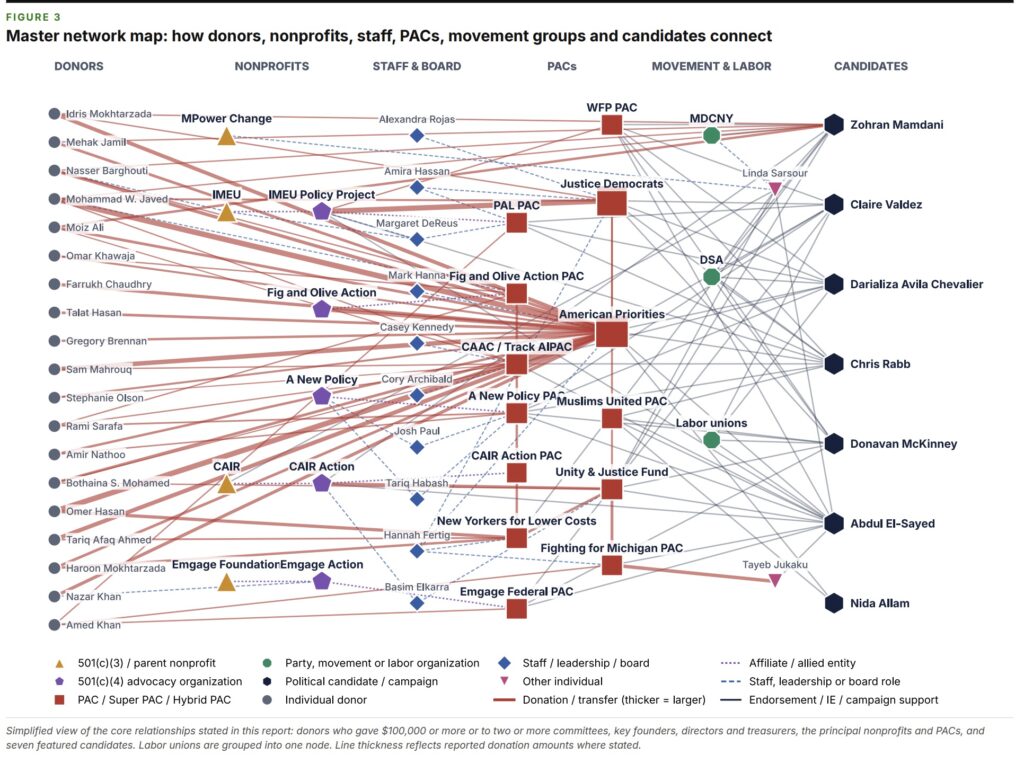 Canary Mission report screenshot
Mamdani’s rise reflects a broader effort to build a durable political infrastructure capable of shaping Democrat primaries beyond any single race, the report claims.
Canary Mission does not argue that any single organization controls the network. Rather, the report claims that activist groups, PACs, labor unions, and nonprofits reinforce one another by backing many of the same candidates simultaneously.
The report includes El-Sayed, the Democrat nominee for U.S. Senate in Michigan, in its network map. While El-Sayed has not publicly identified himself as a socialist or as a DSA member, critics have linked him with democratic socialist activists and causes.
Victor Davis Hanson: Europe’s Immigration Crisis Is a Warning to America
Editor’s note: This is a lightly edited transcript of “Victor Davis Hanson: In His Own Words” from Daily Signal senior contributor Victor Davis Hanson. Subscribe to Victor Davis Hanson’s own YouTube channel to watch past episodes.
Jack Fowler: France is ablaze yet again. Let’s talk about the riots. Now, a few things. The riots are not only in France, Belgium, and Italy, and now Albania also. And they’re being called student riots.
Victor Davis Hanson: Yeah. They’re being called, outside of France, French riots
Fowler: French, yeah. I’m sure many people who watch this show, listen, have seen the videos of the Limoges town hall, about 150 years old, burned this weekend.
Donald Trump has weighed in. He’s urged France to close its borders. He has called France ungovernable and the riots apocalyptic. The police have said in these cities they’re outmanned. So hundreds of thousands of protesters—they shouldn’t be called protesters—criminals taking to the streets of all the major cities.
And then we’re gonna talk about a particular case. But Victor, your thoughts?
Hanson: Well, it is kind of Orwellian, isn’t it? That you bring in millions of people, many of them illegally, you allow, and then 45% of your budget is social welfare, and you’re up to 125% [gross domestic product] in debt, and you’re giving people cradle-to-grave social support.
The unemployment rate of new immigrants is almost 50%. And with all that, life is heaven in France compared to Somalia, the Sudan, Libya, Algeria, Morocco, Syria, Afghanistan, etc. And then you start to riot in league with students who are, I guess, upset about shoddy conditions in their high schools and all of that.
And then you get socialists fanning it on and there’s allegations there’s Chinese money involved. So you’re destroying this place, and you’re a guest in this country, even maybe you’re second generation, some of them. But compared to where you came from, it’s still heaven. And your attitude toward your hosts that welcomed you in is not magnanimity, it’s contempt.
And so, the host is getting very angry.
They are deliberately targeting iconic buildings. They went after a 19th-century government building that was a historical monument in one French city. There was a really disturbing scene in Milan where they were very close to the Duomo, that historic Christian church, and there were flames and everything.
And when you’re at 16%, 10%, 30% in Sweden maybe, then you start to see things. And one of the things you start to see is that these NATO countries will not support the United States and not even allow us to use their airspace because we are at war with a Muslim nation, and that resonates.
And even though they say, “We are the avatars of democracy and we support democracy,” and then there’s this little democracy in the Middle East, and they never miss an occasion to damn Israel and they’re boycotting produce and goods that are supposedly outside the 1947 or ’48 borders, and they’re siding with these radical Palestinians.
Remember, Europeans, you and the U.N. and the Bush administration said, “Hamas, we’re going to get all the Jews out of Gaza, and you can have an election.” And they had an election. There were no Jews since 2005. And what did they do? They threw all their opponents off high-rises and killed them, the Palestinian Authority rivals.
And then, for nearly 18 years, they didn’t build anything. For $40 billion in foreign aid from the U.N. and Europe, the United States, they built 350 miles of tunnels, and then they hid there while their civilians were used as shields, and then they slaughtered 1,200 Jews. That’s their experiment with democracy.
And you side with that over a free society in Israel. And so that’s their problem.
And it doesn’t do them any good, Jack, because they’re so paranoid about these unassimilated un-integrated populations that they turn on their protector, the United States. The only reason they said you can’t land here was Iran told them that we’re going to go after you.
And they did. They did do it at the RAF base in U.K. And so, they’re so scared of their own population that are Muslim and they get to go, “Well, if we help the United States, the Muslims, they may be mad at us, and they may riot.”
Well, they’re going to riot anyway. What good did that do to offend the United States and say, “You can’t use our airspace.You can’t land in Sicily. You can’t land in Spain. Now, Muslim populations, see what we did for you?”
And they said, “No. No. No. That’s not on our agenda, just, you know, helping Iran out. We’re going to take over the country because you don’t want it or you can’t defend it or you don’t deserve it, and we’re taking it over.”
And that’s their attitude. They don’t get it.
You know, our friend Bruce Thornton in 2007. He wrote a book called “Rise and Fall: The Slow-Motion Suicide of Europe.” And Roger Kimball published it at Encounter. It was a great book. It predated Douglas Murray’s book of nearly the same title by 15 years.
And he said in the book, as Mark Steyn did in his, “If demography continues as it does, if immigration continues as it does, as politics continue as it does, within 20 years, Europe will be unrecognizable.” And it pretty much was a prescient—a prediction.
Fowler: Yeah. Well, here’s a case, Victor, of why should Europe be saved when Europeans are acting in this fashion?
So this is the micro version, Thomas Hobbes. It’s an ancedote, but I think it’s an important one. So here’s a—
Hanson: Bellum omnia, bellum omnium contra omnes, the war of everybody against everybody.
Fowler: Yeah. Well, here’s one everybody who’s a dirtbag. This is from The Mirror, London. “Rapist who killed police officer at World Cup fan zone gets one year in prison.”
So here’s the story. Bear with me, folks.
“Convicted rapist who punched and killed a police officer at a World Cup fan zone has been jailed for just one year. Father-of-two Christian Zedig, 32, was off duty and had gone to watch the match between Norway and Ivory Coast on a giant screen on June 30 in Copenhagen, Denmark.
“When a fight broke out, he intervened and in the ensuing chaos was struck in the throat. When police arrived, they found Christian with life-threatening injuries as the blow had ruptured his artery. He died on July 3 at the hospital. Nkumba Ludovic Tshiembe surrendered to police and was remanded in custody but initially denied wrongdoing.
“He pled guilty eventually at an assault trial this week. At the end of the trial, he was sentenced to just one year in prison, and he was also ordered to pay some damages to the wife and the daughter of the slain police officer.”
Now get this: Tshiembe was sentenced to seven years in prison in 2017 for attempted murder after stabbing a man in the heart at a nightclub.
Before that, he had been convicted of rape. So this is who lives and breathes and destroys on the streets of Europe, and justice does not come to them ready for.
Hanson: Did you see that interview with the editor-in-chief of The Economist with, I think her name is Alice Weidel? She’s the head of the AfD in Germany, Alternative for Deutschland.
And they were talking about this issue, what you’re talking about. And she was trying to get scare quotes that Ms. Weidel had said or her co-chair, I think his name was Chrupalla or something had said. And it was, “You say that these people who commit crimes are not wanted in Germany?”
“Yes.” “And you say if they are citizens, we can denaturalize them, or if they’re illegal, we can send them back?”
“Yes, of course. Why would we do that? Why wouldn’t we? They were guests. We gave them opportunities, and they broke the law. If they broke the law in coming here, they’ll have to go home. If they broke the law once they were citizens, they’re no longer citizens. We can denaturalize them. We can’t afford this.”
But she was just very calm, and you should have seen the interviewer. She was astounded. How can any European say this? But what I’m getting at is that stories like that, they’re not forgotten. They’re all memory-banked in the collective memory of 450 million Europeans, and it’s getting to a breaking point.
I think it’s kind of getting here in the United States. You know, there was a story about the New York Fashion Institute where two girls wanted to get some drug, I think cocaine, and they called up somebody, and he came with the intent of basically killing them and had pure fentanyl. Did you read about that?
And he gave them fentanyl, and one of the girls went immediately into a coma. She died. Both of them died. And she was completely naked, and he sexually assaulted her.
And there was another story in Boston where a—I think the person was in law enforcement, and he was in law enforcement barracks, and they found a naked girl walking across the street, and he had enticed her to come in and physically assaulted and raped her.
But the point is that that person had a long, like this person, and this is in the United States, had a long criminal record. And the other one, even though he was 19, I think he had a record. And we’ve had a lot of these sensational cases in California recently of sexual assault, pedophilia, fentanyl by illegal immigrants, and they all have prior records.
And so, you have to ask yourself, this is a Western disease, and we’re affluent in leisure at the end of history. We solved all the problems. We have our iPhones, our iPads. We got our Teslas. We got everything we want. And now we’re at the point where we can afford to feel magnanimous. Now, maybe the poor can’t, maybe the middle class can’t because they’re on the front lines of what we create, because we create chaos through our ideas, and then we retreat back to Menlo Park or Presidio Heights or Malibu, and then we’re safe.
We have our security, we have our money, and we have our nice ZIP codes, and we have private schools for our kids. But the theories that we advance about revolving door criminality, no bail, and decriminalizing theft, letting murderers out, that will fall on people that unfortunately we don’t really care about.
And that’s true in Europe and the United States. It’s the same thing. The only good thing about this horrific thing that’s happening is that we still have almost three weeks to look at what’s going on in Europe. And we should say what is going on in Europe is about a year and a half of what’s going on here.
And we’ve already seen some of it on the campuses of Columbia, at Stanford, trashing the president’s office in Philadelphia, chasing Jews into a library at Harvard, roughing up somebody and then getting an award at graduation, even though you roughed him up. And George Floyd, you know, 14,000 arrests, 35 people killed, $2 billion in damages, arson, da, da, da.
And you should vote against that. And there’s another thing to remember, and I’ll shut up. These people always, during the time—how do they get elected? Well, they get elected by saying things that they didn’t say before they ran for office. And they won’t say after they’re elected, whether it’s James Talarico here or Abdul El-Sayed or Millet Quiros.
Why is it that—take a guy like Paxton. He’s got a long record that he is ashamed of. He should be so—in some cases. Does he ever say, “I didn’t say that”? No. He just lives with it, and it’s authentic. Does Trump ever say, “Well, I kind of spoke out of turn, and I really didn’t mean that about Zelenskyy, that we need a new president”?
No. Whatever he is, he is. But why is it that all of these candidates, Talarico, El-Sayed, and people who were elected, Zohran Mamdani, why do they all, in Europe and in here, they cleanse, they purify, they excise their entire social media full of quotations? So Hasan Piker, he’s the only one that says—well, no, I take that back.
He’s now contextualizing his things that we deserve Sept. 11, and I hate the United States. He said that was rhetorical. Why is El-Sayed trying to get angry when you say he said, “Hurt people, hurt people,” after people tried to kill Jews in a synagogue?
Or why does he say, “That’s irrelevant, don’t bring that up.I was just talking on a hot mic when I said that my constituents might be happy or basically happy to hear the news of the death of the Iranian terrorist leader, supreme leader.”
Or why does Talarico say, “You know, I didn’t really mean that people with white skin are spreading a white skin virus. I didn’t mean that.”
Or why does Mamdani say, “Well, I really didn’t mean I want to go after whiter neighborhoods.” Or why does his housing head, I think Cea Weaver, why— Now she, “I really didn’t mean that when I said homeownership is a form of white supremacy.”
But my point is the Left always has to hide what they are, because if they told you what they are, nobody would ever want them.
And that’s what we should remember when we go into this election. What you’re seeing in Europe is what you’re going to get here, but they’re not going to tell you that.
If you hate beef and you hate fossil fuels, you’ll be like Talarico and put a cowboy hat on and be pictured in a Ram truck with a cowboy hat and eating a hamburger for a while, and then it will vanish when you’re in power.
So this unrest in Europe should be very didactic. It should really give us a glimpse of the future here if we continue down this path.
We publish a variety of perspectives. Nothing written here is to be construed as representing the views of the Daily Signal.
Muslim Brotherhood, CAIR, and US Elections: What to Know
As Muslims have become more politically organized, Muslim advocacy organizations have also become increasingly involved in American politics and elections. Among the organizations that have drawn significant scrutiny are the Muslim Brotherhood and the Council on American-Islamic Relations, or CAIR.
Understanding the history of these organizations, their relationships with foreign terrorist groups, and the controversy surrounding them can provide context for why they have become part of political debates and why more voters need to pay attention to candidates with connections to them.
The Muslim Brotherhood
The Muslim Brotherhood is a transnational Sunni Islamist organization that was founded in Egypt in 1928 and views Islam as a complete social, religious, and political system that should govern both public and private life.
The Muslim Brotherhood’s influence has extended beyond Egypt, with affiliated movements and organizations developing throughout the Middle East and other parts of the world.
The Muslim Brotherhood became prevalent in America in 2004 after the FBI released the Muslim Brotherhood Memorandum of 1991, which outlined how Islam would take over the West through “Civilization Jihad.”
The memorandum outlined multiple organizations that the Muslim Brotherhood would control in order to spread Islam throughout the entire West, including creating a coalition of Muslim organizations and establishing Islamic centers in every city. The organizations would disseminate Muslim Brotherhood propaganda through various channels, including the Islamic Society of North America, the Muslim Student Association, and the Islamic Circle of North America.
Muslim organizations identified in the document have since disputed claims that they are controlled or part of the Muslim Brotherhood.
One organization that has faced particular scrutiny over its alleged connections to the Muslim Brotherhood is CAIR.
What Is CAIR?
The Council on American-Islamic Relations, founded in 1994, is an Islamist organization that focuses on Muslim civil rights and advocacy. CAIR says its work focuses on protecting the civil rights of Muslims, combating discrimination, and promoting understanding of Islam and Muslims.
The organization has also become involved in American politics, including voter registration, candidate forums, voter education and get-out-the-vote efforts.
CAIR’s history has nevertheless made it a subject of controversy.
During the federal prosecution of the Holy Land Foundation for Relief and Development, prosecutors presented evidence concerning a network known as the Palestine Committee, which was established by individuals associated with the Muslim Brotherhood to support the Palestinian cause and Hamas.
CAIR emerged as an unindicted co-conspirator when evidence presented in the case included a wiretapped 1993 meeting of Palestine Committee leaders in Philadelphia showing that the Hamas support network established CAIR to defend its front groups via both information warfare and lawfare.
After opening its first office in Washington, D.C., CAIR received a grant from the Holy Land Foundation for Relief and Development, a charitable organization that was closed and designated a Specially Designated Global Terrorist by the United States Department of the Treasury for funding jihadist terrorist organizations, according to a House Resolution.
CAIR has repeatedly said it does not support acts of terrorism, “whether carried out by al-Qa’ida, the Real IRA, FARC, Hamas, ETA, or any other group.”
The organization also says that it is not connected to the Muslim Brotherhood, saying the “so-called 1991 ‘Muslim Brotherhood memo’ has nothing to do with CAIR. The document never mentions our organization, which wasn’t even founded until 1994.”
CAIR and Hamas
CAIR has repeatedly been connected to the Islamist terrorist organization Hamas, which has carried out horrific terrorist attacks, including the Oct. 7, 2023, attack that killed more than 1,000 people in Israel.
One point frequently cited is the history of some of CAIR’s founders and their connections to the Islamic Association of Palestine, an organization that prosecutors found to be linked to the Palestine Committee network.
CAIR has been linked to Hamas through one of its founders, Nihad Awad, who publicly said he supported Hamas. Another connection comes from the fact that CAIR’s founders have documented connections with the Islamic Association of Palestine, an organization involved in the Palestine Committee Network, which was used to support Hamas’ efforts.
In October 2000, at a large CAIR rally in Washington, D.C., featured speaker Abdurahman Alamoudi, later a convicted terrorist and al-Qaeda financier, publicly expressed support for both Hamas and Hezbollah as the crowd cheered him on.
Additionally, during a Nov. 24, 2023, speech, Awad, who is the executive director of CAIR, said he was happy to see the people of Gaza “break the siege” during the Oct. 7 terror attacks.
The debate of CAIR and Hamas connections has also entered the political arena.
In 2025, Republican U.S. Rep. Randy Fine of Florida introduced HR 4097, which would have designated CAIR as a terrorist organization. Fine’s resolution released more information about CAIR and its ties to terrorist organizations.
CAIR has rejected all of those allegations.
Why It Matters in Elections
CAIR’s political activity has become more relevant as the Muslim population rises and voters have become more organized and engaged in American elections.
Because CAIR has a political arm that endorses candidates and engages in voter mobilization and policy advocacy targeting Muslim voters, it has raised questions over its relationships with Hamas and other terror organizations.
One recent example is Michigan Democrat Senate candidate Abdul El-Sayed, whose campaign has faced questions over his connections to Muslim political organizations.
Center for Security Policy counterterrorism analyst Kyle Shideler testified before the Senate that El-Sayed’s candidacy raised national security concerns because of his connections to Emgage, a Muslim political organization focused on voter engagement.
“[Emgage] was created by a former CAIR member who at one time was on a terror watchlist, and was also a consultant to convicted terrorist Sami al-Arian,” Shideler said.
The allegations surrounding El-Sayed and Emgage illustrate the broader political debate surrounding Muslim advocacy organizations, as to what voters should know about the organizations and the candidate’s histories and relationships.
For voters, understanding those relationships can provide additional context when evaluating the organizations involved in political campaigns, the issues they advocate for, and the candidates who engage with them.
The Daily Signal reached out to CAIR for comment but had not heard back before publication time.
Why Didn’t Fauci Want Young Men and Pregnant Women to Know the Risks?
On Nov. 15, 2021, Anthony Fauci wrote a decision about COVID-19 booster shots in his private diary.
Push the booster on every adult in America. Do it, he wrote, “no matter what the ACIP says”—that is the Advisory Committee on Immunization Practices, the independent panel of outside experts that votes on who should get which vaccines. The panel had not voted yet.
Do it “despite the fact that there was concern about myocarditis in younger men.” Do it because otherwise, “the message of who should get boosted is ambiguous.”
There is the whole scandal in a single entry. A known risk to young men’s hearts, named by Fauci himself, in the same breath as the decision—and then set aside. Not on the evidence, but because it muddied the message.
Four days later, the government expanded booster eligibility to every adult in America, including young men.
This was not the first time something like this happened. Ten months earlier, Fauci and the two officials about to take over the Centers for Disease Control and Prevention and the surgeon general’s office had discussed, among themselves, whether a second dose might carry a first-trimester miscarriage risk. Fauci raised the issue, and his colleagues agreed it was a good point. Then the government didn’t say anything about red flags to pregnant women considering the shot.
Same man. Same move. Ten months apart. Name the risk in private. Give the public the message.
This is an ethical collapse on a grand scale, and I lay it all out in my new book “Why Fauci MUST Rot in Prison.”
Take the young men.
That the mRNA vaccines can inflame the heart muscle is no fringe allegation—the Food and Drug Administration revised its vaccine fact sheets in 2021 to reflect the data. The CDC’s advisory committee met publicly on June 23, 2021, to review the signal. The only thing that remained contested was the magnitude of the danger. The agencies themselves recognized that those most at risk were adolescent and young-adult males in the days after a dose.
COVID-19 was never an equal-opportunity killer; its danger fell steeply with youth. The myocarditis signal, on the other hand, appeared to rise in young men. When the risk of a disease and the risk of the intervention point in opposite directions across the age curve, a single national answer—one schedule for the 80-year-old woman and the 19-year-old man alike—is hardly a triumph of science.
Weighing the risks of the third dose in September 2021, Fauci recorded, “A lack of a lot of data for safety among young individuals particularly in the context of myocarditis.” In the same passage, he wrote that the White House chief of staff was “very much intense [sic] on getting this approval through.”
Consider what the machine chose not to find out. When the question was whether the virus itself damaged young hearts, American medicine spared nothing. The Big Ten built a cardiac registry and ran MRI scans on 1,597 infected college athletes; the results, published in JAMA Cardiology, found myocarditis in 2.3%—and on symptoms alone, the study notes, only five of the 37 cases would ever have been found.
Was there similar energy at the time to research—in a transparent way—the potential risks of COVID-19 vaccines and boosters?
Then there’s the issue of dangers to pregnant women and their children, where the failures were even starker. In late January 2021, Fauci, newly installed CDC Director Rochelle Walensky, and incoming Surgeon General Vivek Murthy discussed vaccination in pregnancy. Pregnant women had been excluded from the pivotal trials, so there was very little direct evidence and next to none by trimester.
Fauci asked around and came back with a concern: The fever and cytokine response after a second dose could, he wrote, “theoretically” be “associated with miscarriage in the 1st trimester.” Fauci said that Walensky recognized that it was “definitely a good point, esp after dose two,” and that Murthy called it “a really good point.”
It didn’t matter. Pregnant women were expected to get the jab—sometimes with the threat of job loss if they didn’t.
Both mothers and young men were entitled to know the risks and the limits of the data. Then each of them, with the help of a doctor, should have been entrusted to decide for themselves. That is medicine. Anything less is Orwellian compliance.
We publish a variety of perspectives. Nothing written here is to be construed as representing the views of the Daily Signal.
Frantic Week in Tight Michigan Senate and Gubernatorial Races as Election Day Closes In
Michigan is entering the critical and final stretch of the midterm campaign, with key races deciding which party controls the Senate and who will be running the state during the final two years of Donald Trump’s presidency.
This week features a Fox News town hall, a second Senate debate, the start of early in-person voting, and visits from both Trump and former President Barack Obama.
Both the Senate as well as gubernatorial race are Michigan’s biggest in decades, with polls suggesting they could be close.
Monday, Sean Hannity moderated a town hall with GOP Senate nominee Mike Rogers and GOP gubernatorial nominee John James during prime time to give them platforms to address current issues in Michigan.
Senate candidates Rogers and Abdul El-Sayed are scheduled to meet for their final debate Wednesday night in Detroit.
The first debate earlier this month was highly combative, with each of them firing personal attacks, interrupting, and engaging in clashes over Iran, tariffs, Israel, and immigration, as both candidates sought to paint the other as dishonest and out of touch with Michigan voters.
With an open Senate seat and polling showing a dead heat, Republicans see Michigan as one of their best opportunities to flip Michigan’s currently blue Senate seat in the final weeks of the campaign. Democrat Sen. Gary Peters steps down in January.
Both parties are deploying major national figures in the closing weeks. Obama is set to campaign in Detroit for Democrat candidates.
Trump is scheduled to hold a rally in Port Huron, Michigan, on Oct. 25, backing Republican candidates.
This week in Michigan, online and mail voter registration is coming to a close. Early voting locations are opening across the state, and absentee ballots are already being returned.