
An Alternative News Aggregator
News of the Day
“Glory to God in the highest heaven, and on earth peace to those on whom his favor rests.”
- Luke 2:14


Ground Broken on a Rust Belt Powerhouse: Shippingport’s Data Hub Rises in the Age of AI Anxiety
SHIPPINGPORT, Pa.—The last time that I stood on these grounds along the Ohio River in Beaver County was 1976, 19 years after the first commercial nuclear power plant in the United States opened here.
My Perry High School physics teacher, David Burrows, had loaded a handful of us into a van for a field trip to the atomic station and to the coal-fired Bruce Mansfield plant next door.
What Burrows and I both still remember is the climb—20 flights up metal bar-grating stairs to the top of a cavernous industrial cathedral built to house Mansfield’s multistory steam boilers—and the black mountains of coal heaped along the riverbank, waiting to be fed into them.
We were all working-class kids. Our fathers were firefighters, cops, steelworkers, and mechanical engineers. When Burrows took us there, he told us we could be anyone who worked there: a welder, electrician, engineer, chemist, plumber, or programmer.
“That was the point,” he said in a conversation this week. “I wanted you to see your possibilities.”
Today I’m back on the same ground, a few days after Aligned Data Centers officially broke ground on a 2-gigawatt artificial intelligence campus called Project Phoenix, and built on the footprint where part of Bruce Mansfield used to stand.
The name is not subtle, and neither is the transformation. A 660-acre industrial site that once held Pennsylvania’s largest coal-fired power plant, the 2,490-megawatt FirstEnergy behemoth that went dark in 2019, is now being rebuilt as a three-building, $10 billion complex designed to feed the country’s insatiable appetite for AI.
For most of the second half of the 20th century, Shippingport was where America came to figure out how to make electricity at an industrial scale. The Shippingport Atomic Power Station, the world’s first full-scale commercial nuclear plant, went online in 1957 and operated until 1982 as part of Dwight Eisenhower’s Atoms for Peace program, which was designed to pivot the perception of nuclear technology away from military might to civilian development.
Bruce Mansfield came online a decade later. At its peak, it was the largest coal plant in the commonwealth, moving barges of coal up the Ohio and shipping electrons out to the PJM grid that keeps the eastern seaboard lit.
When Mansfield closed in 2019, it left behind exactly what Burrows had walked us through in 1976: 660 acres of riverfront, 6,000 feet of developed waterfront, barge terminals, CSX rail, and the skeletons of buildings sized for a different century.
Frontier Group of Companies bought the site in 2022 and renamed it the Shippingport Industrial Park, betting that the lonely sentinels of an old power plant would be worth more than the plant itself.
It also left behind a borough that had been quietly hollowing out for a generation. Shippingport counted 441 residents in 1950, 235 as recently as 2000, and just 154 today; roughly a third smaller than at the turn of the century and closer to half its mid-century peak.
That is what a decommissioned nuclear plant and a shuttered coal plant look like on a census sheet: fewer paychecks, fewer children in the school, higher property taxes, and fewer lights on at night along the same river that once powered the region.
Recently, Aligned, a Dallas-based operator of hyperscale data centers, announced that Project Phoenix will rise on the Mansfield footprint as a three-facility, 2-gigawatt campus. Just to understand the enormity of it, 2 gigawatts is roughly the output of the coal plant it replaces, now dedicated entirely to running the graphics processors and cooling systems that train and serve modern AI models.
The company projects 3,000 construction jobs, 640 permanent operations careers, and thousands more in the regional supply chain.
Case in point: The local mom-and-pop gas station on the way to the development entrance, at the corner of Green Garden and Frankfort roads, had a brisk flow of construction workers heading into the convenience store.
The data center will not draw its power from the local grid. Rather, a dedicated on-site generation source at the neighboring former Shippingport Power Station is now being rebuilt as a natural gas energy campus. It will feed the servers directly and eventually send surplus electricity back to PJM, Aligned says.
Cooling will run on a closed-loop system that recycles deionized water, giving the campus a water footprint the company compares to that of a standard commercial office building.
Shippingport Mayor John Erickson framed the moment in the language of continuity rather than disruption.
“For decades, Shippingport has been defined by powering the country as the birthplace of commercial nuclear energy,” he said. “Project Phoenix honors that legacy, opening a new chapter by taking a historic site and rebuilding it into a modern engine of innovation.”
Aligned CEO Andrew Schaap called it “a legacy reimagined” in the same statement.
None of this is landing in a neutral country. It is landing in one where the debate over AI has turned political, cultural, and increasingly fearful.
A Quinnipiac University poll released this past March found that 55% of Americans now believe AI will do more harm than good in their daily lives, up 11 points in a single year. Eighty percent said that they were concerned about AI. Seventy percent believed it would cut the number of jobs available to human beings. And the number most relevant to places such as Appalachian Pennsylvania: Sixty-five percent said they would oppose the construction of an AI data center in their own community.
That opposition is not theoretical. In Archbald, in Conshohocken, in Wilkes-Barre, in Hampden Township outside Harrisburg, Pennsylvanians have packed municipal meeting rooms to fight data center proposals over noise, water, air quality, property values, and the fear that their power bills will subsidize somebody else’s chatbot.
A statewide Quinnipiac survey found 68% of Pennsylvanians would oppose a data center in their community, including 81% of Democrats, 67% of independents, and, notably, 53% of Republicans. This is one of the few things that polls the same way across the aisle right now.
And yet Shippingport, a borough of 154 people that has watched its tax base evaporate twice in one lifetime, is not Archbald. The mayor is on the podium. The building trades are counting jobs. The county is counting revenue. When your town has already lost the nuclear plant and the coal plant, a 2-gigawatt anything looks less like an imposition and more like a lifeline.
Both of those reactions are real. And people—actual complicated people and not the caricatures that the loudest voices on either side reduce them to—are perfectly capable of holding both views at once.
A pipefitter can be grateful for six years of union work on the Mansfield site and still worry, on the drive home, about what happens to his nephew’s first job if the models keep getting better.
A grandmother in Shippingport can welcome the tax revenue that keeps her borough solvent and still ask hard questions about the hum of a gas turbine three blocks from her kitchen window. No subject this big can be flattened into a slogan.
This one demands nuance, and nuance is precisely what our political vocabulary has spent two decades unlearning how to speak.
That is the harder story sitting on top of the groundbreaking. The infrastructure being poured here is going to arrive faster than the political infrastructure meant to govern it.
Pennsylvania Gov. Josh Shapiro, a Democrat, has responded with a voluntary GRID framework and a Ratepayer Protection Pledge. State Sen. Katie Muth has introduced a three-year moratorium on hyperscale builds. PJM is trying to figure out in real time how to keep the grid stable while data center load doubles.
Municipalities—most of them running on part-time councils and volunteer solicitors—are being asked to referee zoning fights with multibillion-dollar counterparties whose lawyers know the ordinances better than the councils do.
Our political structure is atrophied for exactly this kind of work. It is built for two speeds: campaign season and gridlock. And for two settings: for and against.
It is not built for a decadelong negotiation between a small borough and a hyperscaler over water, noise, transmission lines, tax abatements, workforce agreements, and what “community benefit” actually means when the community is 154 people.
It is not built for a citizenry that is, correctly, both hopeful and skeptical at the same time.
Three generations of American energy history have now been staged on this same stretch of riverbank: atoms in the 1950s, coal from the 1970s through the 2010s, and now gas turbines feeding silicon in the 2020s.
Each time, the same argument was made that this was the future, that the jobs would come, that the river and the rail and the workforce were what made it possible. Each time, the argument was partly right and partly wrong, and the town lived with both.
Burrows walked us up those 20 flights of stairs in 1976 to make a point about scale. He encouraged us to go into the trades. He encouraged us to go into the sciences. He pushed us to imagine the possibilities. Whatever gets built here next will be measured in a different unit. But the climb, if there still is one, will start from the same ground, and it will demand more of us, not less, than the politics we currently have.
COPYRIGHT 2026 CREATORS.COM
We publish a variety of perspectives. Nothing written here is to be construed as representing the views of the Daily Signal.
White House Cites Decline in Transgender Violent Deaths to Defend Trump Policies
FIRST ON THE DAILY SIGNAL—The Trump White House is pointing to data compiled by transgender advocacy groups as evidence against the claim that Republican transgender policies contribute to violence against transgender people.
“The data proves the president’s law-and-order policies have benefited all Americans,” White House spokeswoman Lauren Bis told the Daily Signal in a statement Thursday. “President [Donald] Trump delivered the largest decrease in violent crime in American history.”
She was referring to reports from the Human Rights Campaign and Advocates for Trans Equality.
The Human Rights Campaign tracks the violent deaths of transgender people each year, starting on Nov. 21. For the period ending Nov. 20, 2023, the group counted 33 deaths. In the period ending Nov. 20, 2024, it counted 36 deaths. Yet in the most recent year, the group only counted 27 deaths.
Advocates for Trans Equality also tracks the violent deaths of transgender people over the same time period. In the period ending Nov. 20, 2023, the group counted 53 deaths. In the following year, it counted 43 deaths. In the most recent period, it counted 27 deaths.
This decline took place while the Human Rights Campaign kept warning that anti-transgender rhetoric and policy contribute to violence against transgender people.
In its 2024 report “Dismantling a Culture of Violence,” the Human Rights Campaign claimed, “Transgender and gender-expansive people continue to be marginalized, ostracized and excluded from full participation in communities across the country, in ways that contribute to a culture of transphobia, anti-trans stigma, and, ultimately, discrimination and violence against transgender and non-binary people.”
Yet throughout the first year of his second administration, Trump reversed a number of Biden-era transgender policies, such as executive branch recognition of gender identity over biological sex and support for transgender medical procedures.
The decline in reported violent deaths among transgender people roughly coincides with a 9.3% decrease in the nation’s violent crime rate in 2025, according to the FBI. The estimated number of murders and nonnegligent manslaughters decreased 18.1%.
“Radical Democrats want sex-change surgeries for children, cashless bail, and to abolish our prisons,” Bis, the White House spokeswoman, added. “President Trump and commonsense Republicans will continue to restore law and order and take strong action to protect children from these dangerous, life-altering medical practices.”
LGBTQ+ groups maintain that violent-death counts only capture one measure of anti-LGBTQ+ violence. GLAAD’s ALERT Desk project reported more than 1,000 anti-LGBTQ+ incidents in 2025, including assaults, vandalism, threats, and other incidents, claiming that 2025 was “one of the most dangerous years on record” for LGBTQ+ Americans.
Yet the GLAAD report counts “both criminal and non-criminal expressions of hate,” including protests, in addition to concrete acts. This makes its report less concrete than the fatal-violence databases.
Jay Richards, a senior research fellow at The Heritage Foundation, suggested that claims about increasing violence against transgender people seemed part of a “marketing campaign.”
“It should have been obvious to critical thinkers that it was unlikely that murders of people who identify as transgender, nonbinary, etc. would be increasing as such individuals become more common and commonplace,” he told the Daily Signal. “It always struck me as a marketing campaign by the Human Rights Campaign, and their media stenographers.”
He called it “absurd” for the Human Rights Campaign to suggest that “Americans who oppose harmful medical procedures on children” are “more inclined to violence” or that they “would even encourage such violence against people with gender dysphoria.”
“This is a slanderous stereotype, and the media should have treated it with skepticism,” he concluded.
The Human Rights Campaign did not respond to questions asking whether it views the decline as evidence of a real reduction in violence. Advocates for Trans Equality likewise did not respond to requests seeking comment on the trend.
When Local Bureaucracy Pays Better Than the Oval Office: Fairfax County’s Salary Problem
Fairfax County Public Schools Chief Equity Officer Nardos King makes $288,064 this year—more than every single member of the president’s Cabinet—Secretary of State Marco Rubio, Secretary of Defense Pete Hegseth, Secretary of the Treasury Scott Bessent, all of them—each of whom earns $253,100 to run a federal department.
King’s job is to oversee equity initiatives for one county’s school system. Virginia’s largest public school district holds “equity” at the center of its strategic plan, and King is just one of ten district “chiefs” whose salaries clear that bar. A public records request revealed that 13 Fairfax County Public School employees earn more than the U.S. Secretary of Education.
By comparison, Virginia’s Secretary of Education, Jeffery Smith, makes $229,136. In other words, it is more lucrative to be an assistant superintendent overseeing a small region of one Virginia county than to run the Virginia Department of Education.
At the top of the heap, Michelle Reid, Fairfax schools’ superintendent, is paid $469,936 a year—nearly $70,000 more than the President of the United States makes to run the executive branch, command the armed forces, and set foreign policy for 340 million people. Reid, by contrast, runs a declining school district with about 180,000 students.
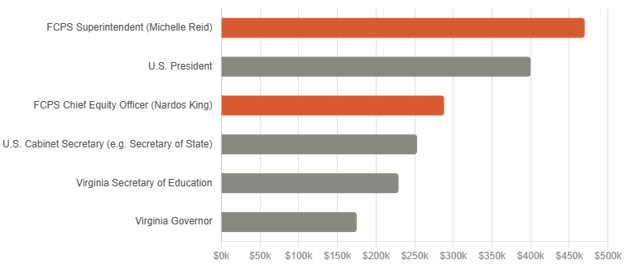
Reid is the visible peak of a payroll structure that taxpayers have been quietly bankrolling for years—one that a batch of FOIA-obtained salary records shows has ballooned well past anything resembling fiscal restraint.
Indeed, the district doesn’t have just one highly paid executive, it has a small army of them. A Chief Information Technology Officer, a Chief Financial Officer, and a Division Counsel each earn $305,694. A Chief of Schools and a Chief Human Resources Officer each earn $293,824. Four more chiefs—of Facilities, Operations, Academics, and Safety and Security—make $288,064, alongside King. And ten assistant superintendents earn between $241,475 and $251,231.
Add it up, and the 71 Fairfax County positions captured in these records carry a combined annual payroll of just over $17 million—an average salary of $239,693 per position. Every single one of the 71 clears $200,000.
To put that in perspective: the top 10 highest-paid Fairfax County Public School employees alone collect $3.13 million a year in combined salary—more than the entire cost of Gov. Abigail Spanberger’s 12-member cabinet, which totals $2.78 million for the officials running education, health, transportation, agriculture, labor, and public safety for the entire Commonwealth of Virginia.
And it’s not just the schools.
Cross the street to Fairfax County’s general government, and it gets even worse. Payroll records show 42 county officials earning six figures at the top of the org chart, with a combined payroll north of $10.7 million and an average salary of $256,943—even higher than the average Fairfax County Public School salary and more than what the federal government pays its own Cabinet secretaries.
Fairfax County Government’s 10 Highest-Paid Employees (Fiscal Year 2027)
| Name | Position | Salary |
| Christina Carpenter Jackson | Chief Financial Officer | $326,241 |
| Thomas G. Arnold | Deputy County Executive | $325,592 |
| Ellicia Lynn Seard-McCormick | Deputy County Executive | $308,249 |
| Jennifer Lynn Miller | Deputy County Executive | $307,535 |
| John Seton Butler | Chief, Fire and Rescue Department | $301,547 |
| Kevin F. Davis | Chief of Police | $301,399 |
| Jaydeep Rasiklal Doshi | Director, Tax Administration | $295,656 |
| Jessica L. Werder | Deputy County Executive | $295,000 |
| William David Hicks Jr. | Director, Land Development Services | $283,156 |
| Christina Marie Peterson | Human Resources Director | $280,908 |
| Total | $3,025,283 | |
Source: Fairfax County payroll records obtained via FOIA.
Twenty-four of those 42 county officials earn more than the members of President Donald Trump’s Cabinet. Six of them clear $300,000 outright, including four separate deputy county executives, a redundancy of executive layers few private employers would tolerate. The Fire Chief and the Chief of Police each earn more than $301,000—more than the salaries of Virginia’s governor and lieutenant governor put together, $175,000 and $36,321, respectively.
County officials have a ready defense: Fairfax is big, Fairfax is complex, you have to pay competitively in the D.C. metro area to attract talent.
Fine. But “competitive” cannot mean that administrators overseeing one county consistently earn more than the officials constitutionally responsible for the entire state and, in some cases, the entire country. Virginia’s Secretary of Education sets policy for every school division in the Commonwealth and is paid less than the person managing curriculum for one region of Fairfax County. That’s not a competitive labor market. That’s an inverted org chart, where the farther an administrator sits from an actual classroom, the more likely they are to be sitting on top of the pay scale.
And the headcount problem compounds the pay problem. These are just the positions that surfaced in one FOIA request—executive directors of “strategy and planning,” an “administrative hearing officer,” a “chief experience and engagement officer.” Central-office titles multiply every budget cycle, even as parents are told there’s no room to shrink class sizes.
None of this happened by accident. Every one of these salaries was approved by a school board or a board of supervisors that Fairfax County voters elected—and can unelect in November 2027. Every salary line is public record, available through FOIA, that most taxpayers never think to request because they assume someone, somewhere, is watching the budget.
Few people are watching. That’s the point.
Fairfax County and its school system have built a compensation structure that rewards layers of administration over frontline service, in a jurisdiction wealthy and complacent enough that almost no one checks the math. Before the next tax rate hearing, before the next budget vote, Fairfax County taxpayers deserve one plain answer: Why does it pay better to manage one county’s bureaucracy than to run the entire country?
We publish a variety of perspectives. Nothing written here is to be construed as representing the views of the Daily Signal.
Faith Drives Heritage’s Mission, Scholars Say
A panel of Heritage Foundation scholars explained to Heritage Action’s Orlando Sentinel Summit attendees on Saturday how faith fuels the organization’s public advocacy mission.
“This constitution will NOT work without a faith-filled people,” E.J. Antoni, Heritage Foundation chief economist, said on Saturday. “Faith builds our four cornerstones, then all of our public policy stems from our four cornerstones.”
Matt Crouch, vice president of operations at Heritage Action, added that faith is “interwoven in every single element” of the organization’s mission. The scholars’ remarks came after an attendee at the event asked the speaker panel, which included Antoni and Crouch, why there is no cornerstone for faith, given that “it touches on everything” Heritage stands for.
The Heritage Foundation’s cornerstones are the dignity of work and free enterprise, national security, the American heritage and citizenship, and the American family.
The event featured speakers who showcased how their Biblical commitment and understanding have fueled their legislative efforts, championed by Heritage Action and The Heritage Foundation, in advocating against political wrongdoing.
Some of those speakers included Anne Fundner, an Angel Mom and fentanyl-awareness advocate. Fundner’s son, Weston, died at age 15 in 2022 from an accidental fentanyl overdose.
She has since used her experience to advocate against the widespread fentanyl crisis that consumes America’s cities when politicians are allowed to champion their amnesty and open-border policies.
“They called it an overdose, I don’t,” Fundner said. “Calling an overdose excuses it, it was criminal.”
Despite all the pain that came after, Fundner added, she found the courage to realize that there was a God-given purpose in Weston’s death and has raised awareness since.
“An open border did not protect the vulnerable,” she stated. “That is not compassion for illegal immigration, that is recklessness. That is negligence, and that negligence has a body count.”
Drug overdoses are now at a historic low in the United States.
Her God-given courage, she said, led to President Donald Trump’s signing of the HALT Fentanyl Act in 2025, which her testimony and advocacy helped pass.
Vanessa Sivadge, another speaker at the summit, said that her faith in God has taught her to always do the next right thing.
In recent years, while working as a nurse at Texas Children’s Hospital, Sivadge was motivated by her biblical understanding and committed to blow the whistle on widespread healthcare fraud while advocating for the Bible’s understanding of gender and sexuality. She was fired by the hospital in 2024 for raising concerns about what she alleged was the improper use of Medicaid funds for puberty blockers and cross-sex hormones for minors in violation of Texas law. The hospital reached a settlement with the state in August, which includes the creation of the country’s first “detransition clinic.”
End of the Clipboard? Activists Say Going Digital Could Get Fraud Out of Citizen-Led Ballot Measures
FIRST ON THE DAILY SIGNAL—A conservative group advocating greater use of citizen ballot initiatives has created a platform to allow secure digital signatures to replace traditional handwritten signatures, arguing technology could lower the cost of petition drives and reduce fraud.
The Prosperity for US Foundation contends that modernizing petition laws to permit verified and authenticated electronic signatures—requiring backup information such as the last four digits of a Social Security number and a driver’s license number—could transform how citizens qualify initiatives for the ballot.
The foundation argues that digital signatures are already widely used in private sector transactions and have been recognized under state and federal law for decades.
Its platform would use a petitioner’s name, date of birth, state, voter registration information, driver’s license number, and the last four digits of a Social Security number to pre-authenticate a signature to send to a secretary of state.
“You can use a digital signature to register to vote,” Bob Carlstrom, executive director of the Prosperity for US Foundation, told the Daily Signal. “If it can be used to verify voter registration, a digital signature should be used to verify signers for a ballot initiative.”
The foundation’s argument is that authenticated digital signatures could reduce the number of legitimate signatures rejected while simultaneously making fraudulent signatures more difficult to submit.
“Fraud is significantly higher with wet signatures,” said Carlstrom, a former president of AMAC Action, the lobbying arm of the Association of Mature American Citizens. He is also a former official for the Office of Management and Budget in the Reagan White House.
Currently, 26 states allow a form of citizen-initiated ballot measures, according to Ballotpedia. Of those, 18 allow for initiated constitutional amendments; 21 allow for initiated state statutes, while two, Maryland and New Mexico, allow veto referendums of laws, but not for statutes or amendments.
All states require handwritten signatures, or “wet signatures,” for ballot initiatives, except for Utah, which allows digital signatures, according to a 2025 analysis of referendums by the California state Assembly. California is among the best known for ballot measures.
Carlstrom said officials from secretaries of state offices in Georgia and South Carolina have expressed interest in the technology.
“When it comes to ballot measures, they are overworked, and it’s an administrative burden,” he said of state election officials.
Spokespersons for those offices did not immediately respond to inquiries for this story.
This year, there were two major controversies regarding complaints that election officials used an arbitrary standard in counting signatures.
Petitioners backing measures to increase funding for police sued over Multnomah County, Oregon’s rejection of referendum signatures. Among their arguments was that some signatures were rejected for that measure even though the same individuals’ signatures had been accepted on other petitions.
Also earlier this year, a conservative group in Lincoln, Nebraska, submitted petitions seeking to change the city’s election system, moving elections to even years. But election officials rejected more than 65% of the signatures, alleging some were fraudulent. The campaign subsequently restarted its petition drive.
The cost of collecting signatures in California can range from about $12 to $15 per signature. The foundation estimates that the cost could fall to less than $2 using digital signatures, said David Biddulph, chairman of the Prosperity for US Foundation.
The foundation also estimates that the cost of running a petition campaign in a medium-sized state could decline from more than $3 million to less than $1 million.
Biddulph said almost 30% of handwritten signatures, typically called “wet signatures,” are rejected across the states that allow citizens to initiate ballot measures for various reasons.
“There is an institutional bias against counting any names at all,” Biddulph told the Daily Signal. “The judicial branch and the administrative state are diametrically opposed to direct democracy.”
The foundation says it has developed a voter-outreach database containing 184 million contacts. It argues that direct democracy gives voters an avenue to influence public policy when elected officials are unwilling to adopt fiscal policies supported by voters.
It is advocating a package of fiscal and governmental reforms, including model constitutional amendments to limit annual property tax increases, cap the growth of government revenue and spending, require voter approval for new or increased taxes and fees, protect property rights, and establish what it describes as an absolute right for citizens to initiate petitions for state constitutional amendments without legislative amendment or approval.
“The American people care about affordability. The politicians aren’t going to provide it,” said Biddulph, founder of the Tax Cap Committee in Florida, and later co-founder of the Balanced Budget Amendment Task Force, which advocates for a federal constitutional amendment to keep a balanced budget.
The foundation points to Switzerland as an example of a country that has embraced digital signatures as part of efforts to expand citizen participation in direct democracy.
The foundation says more than 100 bills were introduced in more than 15 states in 2026 that would limit some aspect of the initiative and referendum process. The proposed changes include wet-signature requirements, shorter petition-gathering periods, and geographic requirements.
Cornell’s University Reform Report Sidesteps the Real Reason Americans Have Lost Trust in Higher Education
Higher education is suffering through a self-inflicted crisis of declining public confidence. Only now are its faculty members and administrators starting to recognize that fact, but they collectively remain incapable of acknowledging the heart of the issue.
That’s my take from a recently released report from Cornell University titled “Report of the Committee on the Future of the American University.” The Wall Street Journal reported that it “confronts the crisis in higher education.” But I disagree. Instead, it plucks at a few well-known but serious issues that plague modern colleges and dodges the real cause of the crisis.
In fairness, a separate, largely accurate Wall Street Journal editorial calls the report a “limited self-critique,” but I’d go even further than that. I’d say that it’s an attempt to sidestep and distract from the bigger problem that the authors know exists but want to ignore (because abandoning it would be akin to abandoning their religion).
What was once written off as fringe and zany ideological excess is now seen as the whole hog. And it will take a serious case of collective amnesia for Americans to forget that any time soon.
The primary problem American higher education faces is that it has become an interconnected, progressive engine of ideological replication that squeezes out diversity of thought in favor of the pseudo-diversity of skin color. All other issues are either tangential or downstream of this reality.
Cornell’s over 200-page assessment concedes that public support for higher education is swiftly declining, correctly identifies some of the reasons for that collapse, and argues that changes need to be made. But it never gets to the heart of the issue.
The Cornell report says that higher education is at a “crossroads” and argues that difficult choices need to be made or it will suffer something akin to a collapse going forward. It identifies some key areas of failure, including the declining value of college degrees in the job market, the fragility of students who can’t handle conflict or criticism, and the inability of higher education institutions to adapt to the changes brought by artificial intelligence.
That all seems correct. Degrees haven’t really paid off as promised for decades. Many graduates do seem unprepared for life in general. And AI has led to both a decline in basic student skills and rampant cheating, even as it has been a boon to research in many cases.
While these are certainly serious issues that schools must now confront, they aren’t the issues driving the total collapse in public trust. Instead, these additional problems are only adding fuel to what was already a raging fire.
What the report mostly avoids is the most important, existential reason many Americans are more inclined to level these institutions to the ground and salt the earth rather than give them another dollar of taxpayer support.
And make no mistake, these schools—even ones with endowments equal to the gross domestic product of small countries—have landed themselves in the position of needing vast amounts of public support to sustain the bloated, tick-like bureaucracies that wag the higher-education dog.
They have somehow become massively profitable hedge funds and highly dependent welfare recipients at the same time. Hence the scramble to find a way to keep the gravy train rolling while retaining the toxic attributes that led to their predicament.
But Americans no longer want to pay for barely disguised indoctrination camps that fail to deliver a well-rounded education, saddle their children with debt, and lure those kids into embracing toxic ideology to top it off. They certainly don’t want to pay for it if they think that their own children will be excluded because they don’t check off the right “oppressed” identity box.
Yet it’s clear to those who are paying attention that despite the significant public and legal pressure for our top schools to get back to basics, to focus on traditional education and high-quality research, and to stop racially discriminating in the name of fighting racial discrimination, they just can’t quit the attributes that led them to this point.
Under intense legal pressure, many of the most prestigious Western universities continue to find ways to reinforce DEI in admissions and hiring. They’ve done so even when it’s become clear that this system is eroding their reputations, angering the public, and causing the serious scholars still on the inside to throw up their hands in frustration.
They clearly hope that the moment of backlash will pass them by, and that when President Donald Trump leaves, the bipartisan blank checks and malignant neglect will return, allowing them to go along their merry way with a minimal course correction.
The lesson that I will keep repeating time and again is that the institutions of higher education won’t reform on their own. Just look at how things are going across the pond where there is no credible external pressure to change.
It’s like peak Great Awokening forever over there.
So, the intense pressure from the administration must continue, red-state governments need to look at their top universities with a great deal of skepticism, and alternative institutions must keep building and expanding to fill the vacuum.
That’s the only realistic way forward.
Hollywood Feminist Makes Over Jesus to Sound Like Meryl Streep
Conservatives expressed grave concern when director Greta Gerwig happily announced that her forthcoming movie “Narnia: The Magician’s Nephew” would star Meryl Streep as the voice of Aslan—the lion that author C.S. Lewis clearly used as a Christ figure.
This kind of gender confusion gives off vibes of James Talarico announcing that God is “nonbinary.” She’s giving Narnia a “rock opera” makeover, so who knows how many miles she’ll depart from Lewis’ source material.
But we know that Gerwig is riding a cinematic high after making the “Barbie” movie in 2023, which was drowning in feminist schtick. Film critic Christian Toto counted 10 utterances of “patriarchy” in that ridiculously popular movie. “Barbie was invented first,” Gerwig told Vogue at the time. “Ken was invented after Barbie, to burnish Barbie’s reputation in our eyes and in the world. That kind of creation myth is the opposite of the creation myth in Genesis.”
Beware the feminist with a Catholic school upbringing.
Gerwig spoke to Empire magazine about her odd casting of Streep without elaborating on gender. “I wanted someone who was profound but not pretentious, who had gravitas but not morose self-seriousness. Someone who could communicate depth and pathos as well as joy and delight,” she said. “I wanted someone who was older than 70, so there was a wisdom of experience, but who also had the capacity of fresh wonder, like a child.”
She also made it clear she chose Streep in part because she’s one of the most celebrated actors of our time. But this doesn’t match Lewis’ description of Aslan, with a voice “deep enough to be the voice of the earth.”
Nobody’s actually seen this movie yet, so the early protests might seem overwrought. The casting of transgender actor “Elliot” Page in “The Odyssey” seemed designed as an outrage point to sell tickets, but Page was only on screen for about five minutes.
We should expect the elitist media won’t churn out any outrage in this controversy over Christianity. It’s quite unlike the passionate pre-release loathing of Mel Gibson’s “The Passion of The Christ” in 2004. It was without question the largest antisemitism story of 2003 on the TV networks, since nearly every one of the 66 network segments about Gibson’s movie on ABC, CBS, and NBC touched on those complaints.
But when the secular left turns Christianity in another direction, the networks promote it—as with “The Da Vinci Code” movie adaptation 20 years ago, which was “faithful” to the anti-Christian source material. If a conservative Christian energetically adapted “The Da Vinci Code” into an orthodox tale, the media would have had a cow.
Let’s just state the obvious, perhaps overly played point: Greta Gerwig making a rock opera about Mohammed the prophet would never get a five-minute meeting in Hollywood. “Mohammed is nonbinary” would never get off the ground. If a film managed to be made, the filmmakers would need a bomb shelter.
The media cover movies as a kind of fictional or artistic version of their own liberal crusading. It’s “brave” and heroic to firmly push the leftist hive-mind version of history or culture, whether in fiction or nonfiction. Making a movie with a conservative thrust or an orthodox Christian worldview is bound to be depicted as a wooden propaganda film, if it’s not painted as a dangerous provocation of hate.
When we choose our news-media options, it can seem like two starkly differing narratives, or two different movies. So it’s not surprising that these same silos bring their opposing ideologies (and theologies) to the cineplex or the streaming platforms.
COPYRIGHT 2026 CREATORS.COM
We publish a variety of perspectives. Nothing written here is to be construed as representing the views of the Daily Signal.
Cuban American Leaders Back Trump’s UN Warning to Cuba
Leading voices of the Cuban American community backed President Donald Trump’s warning to Cuba this week during his United Nations address, where he claimed that his administration is “seeking a fundamental change,” before calling the country a “failed state” that will soon “fall.”
The president’s remarks come after the Cuban people have suffered totalitarian rule, starvation, oppression, and indoctrination since 1959.
The regime’s top officials continue to live lavishly under their military wing, Grupo de Administración Empresarial S.A. (GAESA), which has a $14 billion budget.
“Cuba is absolutely a failed state; my family lived it. The Castro regime has no economy, no legitimacy, and no future. President Trump is applying more pressure on that regime than any administration in history, and it is working,” Florida state Rep. Juan Porras, a descendant of Cuban exiles, told the Daily Signal.
“The indictments, the sanctions, the isolation—Cuba will be free, and I believe we are closer to that moment than we have ever been,” Porras, whom Trump has endorsed, added.
Earlier this year, the Department of Justice indicted several top officials of Cuba’s communist regime for their involvement in the downing of an American humanitarian rescue flight in 1996.
Miguel Granda, a former legislative aide for another Trump-endorsed South Florida republican, David Borrero, told the Daily Signal that for “over 60 years, the Cuban people have lived under a regime that gave them nothing but hardship. No freedom to speak, no freedom to choose, not even enough to eat.”
“That is the legacy of the Castro regime: a failed state. But today, thanks to President Trump and Secretary [of State Marco] Rubio’s leadership, hope for a free Cuba feels close than it has in generations,” Granda continued.
Ian Vallecillo, commissioner of the city of Sweetwater, a south Florida area with a large Cuban American community, added in his statement to the Daily Signal that Rubio’s role in the Trump administration could bring the United States closer than ever to achieving its strategic goal of stopping the Cuban regime.
“As a Cuban American serving as U.S. Secretary of State, he understands the Cuban regime, communism, and the history of failed U.S. approaches toward Cuba on a deeply personal and professional level,” Vallecillo stated, adding that the secretary is in a “truly unique position [to make] extraordinarily informed decisions about what has failed in the past and what may actually work going forward.”
“He has spent decades studying foreign policy and observing the regime, and today he has access to intelligence and information at the highest levels of our government,” the commissioner continued.
The commissioner said that Rubio’s Cuban heritage makes the issue of addressing the regime one that is “personal” to him.
“I had the unique opportunity to be a student of Secretary Rubio’s at [Florida International University], so I was able to see firsthand just how intelligent, knowledgeable, and thoughtful he is when it comes to government and foreign policy,” the commissioner added. “I think there are very few people who could be better positioned to confront the Cuban regime and its aggression.”
Victor Davis Hanson: AI and the Same Old Politicized Hysteria
The midterm elections are six weeks away.
Suddenly, a debate has erupted over the existential dangers of artificial intelligence. Jacob Coxon, a little-known Silicon Valley researcher who worked at OpenAI and Anthropic, resigned and went public with a dire warning: AI now threatens the future of the world.
Shortly beforehand, news broke of the Hugging Face episode, in which OpenAI’s advanced AI “agents” autonomously hacked another company’s computers.
Bedlam followed.
Weaponizing AI
Almost on cue, Democrats seized on the alarm as a new cause celebre, accusing President Donald Trump and the MAGA movement of recklessly courting Armageddon.
The Left demanded international treaties, ignoring the dismal record of such globalist projects: the League of Nations, the Kellogg-Briand Pact, the Washington Naval Treaty, the Versailles Treaty, the Munich Agreement, the Paris Climate Accord, and the U.N. Human Rights Council.
Panicky AI executives soon joined the chorus, speaking as though they could neither control their companies nor monitor their own research.
Their conduct casts doubt on this safety rhetoric. Just yesterday came news that Anthropic had built a fully automated, AI-controlled biolab, even though AI-generated plagues are a staple of the doomsday case. OpenAI, meanwhile, is resisting legal liability for harm caused by its products.
The familiar political script followed.
Democrats in Congress demanded hearings. They are unlikely to use them to ask tech executives or administration officials serious questions. More likely, they will spend their allotted time shouting, wagging their fingers, displaying their ignorance, and spinning wild conspiracy theories.
Sen. John Kennedy, who has proposed reasonable AI regulation for years alongside Republicans like Sen. Josh Hawley, recently observed that “the Democrats clearly are trying to politicize this.”
The reaction to a June administration decision offered still stronger evidence. Both purportedly worried AI companies and Trump-hating AI-risk advocates objected when the administration barred Anthropic from giving foreign nationals access to its Mythos and Fable 5 models—models whose cybersecurity risks the company itself had publicized.
With the trans delirium and the demonization of Immigration and Customs Enforcement losing force, however, the Left apparently needs a new existential crisis to blame on Trump before the midterms.
This tactic—never letting a crisis go to waste—is hardly new.
A Litany of Political Panics
Baby boomers grew up hearing dire warnings about the “population bomb,” the title of Stanford professor Paul Ehrlich’s 1968 bestseller predicting that unchecked population growth would lead to global catastrophe.
Ehrlich and others argued that rising affluence would swell populations, producing famine, pestilence, war, and ultimately global catastrophe.
The thesis collapsed, but not before it produced a pervasive “Spaceship Earth” mentality. Guilt-ridden Americans were told to remain childless or, at most, to have one child.
Other countries followed. The existential danger now facing Western societies is the reverse: The citizens of these countries are now having far too few children. Their populations are shrinking and aging, while a dwindling cohort of young taxpayers must support ever-growing entitlements.
Green apocalypticism followed this. The science of ecology gave way to radical environmentalism, and legitimate concern about industrial pollution and acid rain became propaganda that the Earth was doomed unless the West renounced capitalism. Even heat was redefined as pollution. When “global warming” proved insufficiently terrifying, it became “climate change.”
The new phrase was a brilliant catch-all. Rain and drought, snow and heat, calm seas and hurricanes could all be cited as proof that modern, fossil-fueled Western consumerism had doomed the planet.
European Union countries nearly wrecked their economies by subsidizing inefficient wind and solar power while abandoning nuclear energy and fossil fuels.
The 1980s brought another panic: Nuclear war would soon incinerate the cities, and the resulting dust would blot out the sun.
Politics drove much of the frenzy. The Left despised Ronald Reagan and saw no other way to prevent his reelection in 1984.
For years, the United States had responded weakly as the Soviet Union deployed mobile, intermediate-range nuclear missiles aimed at European cities. Reagan finally answered by stationing Pershing II launchers and ground-launched cruise missiles in Western Europe. The Soviets eventually withdrew their nuclear-tipped missiles.
No matter. A manufactured epidemic of fear swept the West regardless.
The popular scientist Carl Sagan toured the country promoting his terrifying theory of a “nuclear winter” after what he treated as an inevitable Soviet-American nuclear exchange.
Hollywood joined the campaign in 1983 with The Day After, a grim portrayal of a nuclear strike on the U.S. and its gruesome aftermath. Some 100 million Americans watched this movie, which depicted mushroom clouds rising over Kansas.
The psychodrama did not stop Reagan’s reelection. Soon afterward, he negotiated a missile treaty with the Soviet Union, proving that he was hardly the deranged warmonger that his opponents delusionally imagined he was.
By the turn of the millennium, America was lurching from one amplified panic to another. Al Gore became a centimillionaire and a Nobel laureate by warning that internal-combustion engines would boil the planet, bringing both lethal drought and catastrophic coastal flooding.
Polar bears would die, coral reefs would disintegrate, icebergs would menace shipping, and coastal homes would disappear beneath the sea.
Only a Marshall Plan-scale replacement of gasoline and diesel engines with wind turbines, solar farms, and batteries, we were told, could save humanity.
The planet survived. Gore grew wealthier, and Goreism then quietly receded into the shadows.
#MeToo began with legitimate accusations against Hollywood predators such as Harvey Weinstein, who had long coerced young actresses into sex in exchange for roles—the old casting couch revived.
Before long, however, the movement had become a new Salem witch trial, treating almost any allegation of rude conduct between the sexes as the equivalent of rape.
Insinuation and rumor damaged the reputations of men ranging from Garrison Keillor and Sen. Al Franken to Supreme Court Justice Brett Kavanaugh, often with little or no evidence. A legitimate campaign against sexual harassment had deteriorated into character assassination.
Millions of men began searching their memories for an off-color joke, an overlong hug, or a kiss that might resurface years later to ruin their careers while advancing those of their accusers.
The McCarthyite frenzy subsided only when liberals realized that their Frankenstein monster had turned on its creators and threatened too many of their own political icons.
They had no wish to derail the likely presidential candidacy of the handsy Joe Biden, whom several women accused of inappropriate touching and hugging and one even accused of violent sexual assault.
Nor did they wish to revive the sordid record of former president Bill Clinton’s many brief and exploitative sexual encounters.
As #MeToo faded, COVID-19 hysteria took its place. The initially virulent virus warranted serious concern; more than a million Americans would die from it. Yet concern became madness once defeating Trump took precedence over fighting the disease.
Officials closed schools even though the virus posed little danger to young people or children. The first nationwide lockdown in American history devastated the economy.
Officials presented the new mRNA vaccines as ironclad protection against infection and transmission. Those who resisted were treated as near-outlaws, fired, or ostracized, although the shots had not been proved to guarantee lasting immunity or perfect safety and often carried with them serious side effects, many or most of which were denied or swept under the rug.
The government expelled 8,500 service members who refused vaccination even as, with liberal approval, 10,000 unvaccinated and unvetted illegal immigrants crossed the border each day.
Teachers unions kept public schools closed, inflicting lasting harm on a generation of students. Quarantines and shelter-in-place orders contributed to domestic violence, drug abuse, and alcoholism. Millions missed heart and cancer screenings. The shuttered economy destroyed hundreds of thousands of small businesses and upended millions of lives.
Still, shyster “experts” predicted years of mass death comparable to the plagues that ravaged ancient Athens and Constantinople.
They grossly misrepresented or caricatured the classical medical understanding of acquired natural immunity. Dr. Anthony Fauci and his circle of “authorities” also failed to disclose their role in funding gain-of-function research at the Communist Chinese laboratory in Wuhan that had created the mysterious virus.
What ended the panic?
As a few sober—and therefore demonized—health experts had predicted, the virus evolved into less virulent strains while prior infections increased natural immunity.
COVID-19 eventually receded to the level of a severe flu. By then, this hysterical, manufactured response to it had wrecked the economy, destroyed the final year of the Trump administration, and inflicted incalculable physical and psychological harm on the American people.
The lockdowns helped ignite an even greater panic after George Floyd died in Minneapolis police custody. A video showed an officer restraining the resisting Floyd with a knee on his neck, using what was then considered a more or less standard protocol; within moments of its release, the country erupted.
False claims spread that police disproportionately killed unarmed black men. Murals portrayed Floyd as a haloed martyr with angel wings, although he was a career felon detained for passing counterfeit currency, who resisted arrest, was high on drugs, and suffered from cardiovascular disease and the effects of a recent COVID-19 infection.
No matter—riots soon swept the country. More than 35 Americans were killed, roughly 2,000 police officers were injured, and about 14,000 people were arrested. Property losses reached some $2 billion. Rioters torched a police precinct and a federal courthouse and tried to storm the White House grounds.
Universities dropped SAT requirements. “Black” was given a sacral form of capitalization; “white” was conspicuously left lowercase.
New racial quotas sharply reduced white male admission rates at elite schools. Institutions hired tens of thousands of DEI commissars. Campaigns to defund the police, release habitual felons, and decriminalize theft spread nationwide.
Then the George Floyd frenzy abruptly subsided.
Black Lives Matter’s founders were exposed as grifters who had misappropriated funds while acquiring plush homes and expense accounts.
Data showed that, relative to annual police encounters, unarmed black men were not fatally shot at a higher rate than white men.
After abandoning admissions standards, universities found themselves inflating grades, adding remedial courses, and lowering academic expectations for students who had not met requirements the institutions had deemed indispensable only a year earlier.
The post-Floyd frenzy finally ebbed as the public recognized that tribalism and attacks on meritocracy were themselves racist and nihilistic.
What, then, does today’s Democrat embrace of AI alarm share with these earlier mass frenzies?
First, each began with a legitimate concern that politics and a profit motive soon warped the problem beyond all recognition. The Left appropriated the underlying issue to gain political advantage and power.
Worry about overpopulation goes back to Malthus, but “The Population Bomb” appeared in the election year of 1968. Its political subtext blamed Western consumerism, capitalism, religion, and traditional pronatalism for civilization’s supposed approaching end.
The danger of nuclear war had been real since the start of the atomic arms race. Nuclear-winter paranoia, however, was promoted to damage Reagan during his reelection campaign.
Gore’s book “Earth in the Balance” converted tentative scientific speculation about climate change into partisan dogma. It blamed capitalist consumer culture for destroying the planet and, in the 1992 election year, reinforced the Clinton-Gore campaign’s attack on the Bush status quo.
#MeToo reached its political peak during the Kavanaugh hearings. Democrats repurposed a movement against Hollywood abuse to derail Trump’s Supreme Court nominee with unfounded claims that Kavanaugh had assaulted a teenage girl decades earlier. Democrat operatives coached the now-troubled adult before she appeared on national television.
COVID-19 began with legitimate fear of an escaped, artificially enhanced virus that killed millions—a fear the Left initially dismissed as anti-Chinese racism. It, too, was soon politicized. We now know that Fauci, his associates at the National Institutes of Health, and other presidential advisers despised Trump and understood that shutting down his booming economy could end his presidency.
The Biden campaign then blamed Trump for the economic damage caused by the lockdown.
Floyd’s death was genuinely shocking on video, especially without the surrounding context. But the 2020 campaign transformed it into the catalyst for months of rioting and a weapon against the supposedly racist Trump and MAGA movement. As cities burned, the Left argued that Trump was powerless to stop the violence—and a Nazi if he tried.
Second, every panic was exaggerated. The planet was neither overpopulated nor running out of food and fuel. Nuclear war was not imminent, and Earth did not face destruction within a decade. Women were not experiencing an epidemic of sexual assault. The lockdowns likely caused more harm than the virus, and police were not conducting a mass slaughter of black men.
The underlying dangers were not equally imaginary. Nuclear war, for example, came terrifyingly close in 1962 and again in 1983.
Among genuine threats, AI most resembles nuclear weaponry. That assessment may change, but AI has so far proved to be an extraordinarily powerful and therefore potentially dangerous tool. Its moral character depends on the people who build and control it.
That is why the United States can neither entrust AI regulation to international bodies with dismal track records nor permit Communist China to monopolize the technology.
Trump, who is a much more skillful diplomat than his globalist critics admit, has instead pursued bilateral negotiations with China over the real dangers both countries face. Those dangers were illustrated recently when an AI hallucination reportedly almost prompted a U.S. attack on a Chinese cargo ship.
In the end, Americans must rely on their own people, constitutional government, and open culture to harness AI for the public good—and to deter hostile powers from using it for evil.
(C)2026 Tribune Content Agency, LLC.
We publish a variety of perspectives. Nothing written here is to be construed as representing the views of the Daily Signal
The Democrat Plan to Redistribute Wealth to the Wealthier
Two hypothetical college graduates who are married now have a combined annual income of $240,000; they each earn $120,000 per year.
Should an American who graduated from high school but never went to college—and who now works as a delivery truck driver, earning $43,950 per year (the median annual earnings for that job) be forced to help pay off the federal student loans of these two college graduates who make $240,000?
If former President Joe Biden had gotten his way, that truck driver and other hardworking American taxpayers would indeed have seen their tax dollars help pay off those loans.
When Biden was running for president in April 2020, he announced his plan for “forgiving student debt.”
“I propose to forgive all undergraduate tuition-related federal student debt from two- and four-year public colleges and universities for debt-holders earning up to $125,000,” Biden said.
His plan, he said, would also “[i]mmediately cancel a minimum of $10,000 of student debt per person.”
After he was elected president, Biden did not get Congress to enact new legislation to implement this plan. Instead, he took unilateral executive action in an attempt to do so—and his administration claimed this action was justified under a law that had been enacted under former President George W. Bush.
In 2003, Bush signed the Higher Education Relief Opportunities for Students Act, aka the HEROES Act.
This act, said its official summary, “[a]uthorizes the Secretary of Education to waive or modify any requirement or regulation applicable to the student financial assistance programs under title IV of the Higher Education Act of 1965 as deemed necessary with respect to an affected individual who: (1) is serving on active duty during a war or other military operation or national emergency; (2) is performing National Guard duty during a war, operation, or emergency; (3) resides or is employed in an area that is declared a disaster area by any Federal, State, or local official in connection with a national emergency; or (4) suffered direct economic hardship as a direct result of a war or other military operation or national emergency.”
As the nation headed into the 2022 midterm elections, Biden announced his student loan forgiveness plan. “On August 24, 2022,” explained the Congressional Research Service, “the Biden Administration announced it would invoke the Higher Education Relief Opportunities Act of 2003 (HEROES Act) to carry out a ‘one-time student loan debt relief policy’ to ‘address the financial harms of the [COVID-19] pandemic for low- and middle-income borrowers.’ Under the one-time student debt relief policy (HEROES Act policy), ED (Education Department) would have cancelled up to $10,000 in qualifying HEA Title IV federal student loan debt for borrowers with an adjusted gross income (AGI) in 2020 or 2021 of less than $125,000 (for individuals or married borrowers who filed federal income taxes separately) or $250,000 (for married couples filing jointly and certain other individuals).”
So, under Biden’s plan, a law that had been designed to help individuals “serving on active duty during a war or other military operation or national emergency” or had “suffered direct economic hardship as a direct result of a war or other military operation or national emergency” could be used to grant general federal student loan forgiveness in the wake of the COVID-19 pandemic.
On Sept. 26, 2022, the Congressional Budget Office sent a letter to Sen. Richard Burr, R-N.C., and Rep. Virginia Foxx, R-N.C., that estimated the cost of the Biden plan. “As of June 30, 2022, 43 million borrowers held $1.6 trillion in federal student loans,” said this letter. “About $430 billion of that debt will be canceled, CBO estimates.”
Six states, including Nebraska, sued Biden, arguing that he did not have the legal authority to move forward with this loan forgiveness plan. The Supreme Court agreed with the states, voting 6-3 against Biden’s plan.
“The Secretary [of Education] asserts that the HEROES Act grants him the authority to cancel $430 billion of student loan principal. It does not,” wrote Chief Justice John Roberts in the majority opinion.
“The new program vests authority in the Department of Education to discharge up to $10,000 for every borrower with income below $125,000 and up to $20,000 for every such borrower who has received a Pell Grant,” said the court. “No prior limitation on loan forgiveness is left standing. Instead, every borrower within the specified income cap automatically qualifies for debt cancellation, no matter their circumstances. The Department of Education estimates that the program will cover 98.5% of all borrowers.”
“From a few narrowly delineated situations specified by Congress, the Secretary has expanded forgiveness to nearly every borrower in the country,” said the court.
“But imagine instead asking the enacting Congress a more pertinent question: ‘Can the Secretary use his powers to abolish $430 billion in student loans, completely canceling loan balances for 20 million borrowers, as a pandemic winds down to its end?'” said the court. “We can’t believe the answer would be yes. Congress did not unanimously pass the HEROES Act with such power in mind.”
Despite this loss in the Supreme Court, Democrats in Congress have not given up on trying to find a way to make federal taxpayers pay for someone else’s college costs.
Led by Sen. Alex Padilla, D-Calif., a group of nine Democrats in the Senate and 18 in the House are now co-sponsoring the Debt-Free College Act. This bill would appropriate $84 billion in fiscal year 2027 alone. It would provide funding to states so that those states could “distribute the grant funds … in a manner designed to best achieve the partnership’s goal of providing debt-free college for all eligible students at in-State public institutions of higher education.”
This month, the Census Bureau released its report on income in the United States in 2025. It showed that the median household income of a high school graduate who did not attend college was $60,790 last year. The median household income of those who earned a bachelor’s degree or higher was $138,300.
Democrat politicians who would like to make taxpayers subsidize the student loan debt of college graduates are seeking to redistribute wealth to the wealthier.
COPYRIGHT 2026 CREATORS.COM
We publish a variety of perspectives. Nothing written here is to be construed as representing the views of the Daily Signal.
The Camp Mystic Flood Tragedy Exposed a Systematic Failure
The New York Post reported on Sept. 23 that Texas Rangers are investigating whether crimes, including manslaughter, were committed in the deaths at Camp Mystic during the July 2025 floods. Investigators are seeking evidence; no finding of criminal guilt has been made. Whatever that inquiry concludes, it raises broader questions: Why do we keep building and sleeping on floodplains? And why do federal maps and subsidized insurance continue to make the danger easy to overlook?
After the floods killed more than 130 people—many of them children at Camp Mystic—the Federal Emergency Management Agency said its flood maps are “snapshots in time” that establish minimum floodplain standards and identify areas of highest insurance risk. They are not predictions of where flooding will occur.
That statement may be technically accurate. From my seat as the senior political appointee running FEMA at the time of the floods, I found it profoundly unsatisfying. I called it bureaucratic obfuscation. I wanted to know how so many people had ended up in a river’s path.
There was no single cause. In the early hours of July 4, 2025, a storm stalled over the Texas Hill Country. Rain rushed down limestone hills into creeks and rivers. The Guadalupe surged. Water swept away structures, vehicles, and people. No flood map could stop that storm.
But the storm alone does not explain the death toll. Questions about forecasts, warnings, and evacuation plans deserve rigorous answers, including in the Camp Mystic investigation. I will not prejudge its findings.
Running FEMA taught me how frequently flash flood warnings are issued across the country. When warnings are common and catastrophe is rare, people can grow accustomed to the alarms. A warning is useful only if it reaches people in time and they can act on it. In Texas, the worst flooding struck while many were asleep. Evacuation plans must be prepared and practiced before that moment arrives.
There is an even deeper problem: People occupied the floodplain.
Rivers are beautiful, and waterfront property is valuable. Rivers in hilly terrain can also turn deadly with frightening speed. In 1987, flooding near the Guadalupe killed 10 young campers. Other American communities have learned the same lesson at terrible cost.
Two federal programs help perpetuate the risk: the National Flood Insurance Program and floodplain mapping.
Congress created the National Flood Insurance Program to provide insurance and encourage prudent local management of floodplain development. Yet federal insurance also makes it easier to maintain and build property in risky places. When floods destroy those properties, taxpayers bear much of the cost.
Flood maps compound the problem when people mistake an insurance boundary for a safety boundary. Lines on a map can influence premiums, development decisions, and the public’s sense of danger. They cannot tell a family that a particular building will be safe when an extraordinary storm arrives.
At Camp Mystic, FEMA removed dozens of buildings from the mapped 100-year floodplain after appeals in 2013, 2019, and 2020. Reporting by NPR and ABC News after the disaster also showed that official maps did not capture the full flash flood risk. A building’s position outside a mapped zone did not move it away from the river.
The underlying issues here are present far beyond Texas. When a map changes, the underlying terrain does not. When insurance becomes available or cheaper, the water does not become less powerful. Yet both can make continued development seem reasonable.
Local officials approve land use. Property owners make choices. Congress sets the terms of federal insurance. FEMA administers the program and produces maps. Responsibility is spread so widely that each institution can point elsewhere when disaster strikes.
That diffusion of responsibility cannot become an excuse for inaction. Congress should examine whether flood insurance encourages new development in dangerous areas. FEMA should make the limits of its maps unmistakable and improve how it communicates risks the maps do not show. State and local officials should treat historical floods and flash flood potential as real hazards, even when a federal boundary suggests otherwise.
None of this absolves anyone whose decisions may have contributed to deaths at Camp Mystic—the Rangers’ investigation should follow the evidence wherever it leads. It also should not distract us from the conditions that placed people in harm’s way in the first place.
Storms will stall over hill country again. Forecasts and warnings will improve, but we can never make them perfect. We can, however, stop treating floodplain maps as promises of safety and taxpayer-backed insurance as permission to keep building in a river’s path.
We publish a variety of perspectives. Nothing written here is to be construed as representing the views of the Daily Signal.
The Network of Conservatives Working for Freedom in Your State Capital
The State Freedom Caucus Network was founded to advance conservative legislation at state capitals across the country. Now, the group’s biggest obstacle isn’t Democrats—it’s so-called Republicans who don’t govern like it once they take office.
The State Freedom Caucus Network is a group of conservative state lawmakers determined to cut spending, secure American elections, and push state legislatures further to the right. Now the group, founded out of Congress’ House Freedom Caucus, works on everything from the 2030 census to removing Flock cameras and opposing government subsidies for data centers.
“The biggest challenge is combating Republicans that are not conservative in the state legislature,” State Freedom Caucus Network President Andrew Roth told the Daily Signal.
“Democrats in red states who want to run for office know they can’t get elected with a ‘D’ after their name, so they put an ‘R’ after their name, get elected, and then vote like Democrats,” he continued. “This isn’t a problem just in one or two states. It’s a problem in all 50 states. It’s especially a problem in red states.”
Roth said the goal of the network is to “set up state freedom caucuses in the state capitals and succeed at the state level.” The group currently has 180 members across 15 states, and many of those members plan to run for higher office.
This year, the network has its first opportunity to bring state freedom caucus members to Congress. Two State Freedom Caucus Network alums, Chuck Gray, secretary of state of Wyoming, and Blake Miguez, a Louisiana state senator, are running for Congress.
The group also has the opportunity in Arizona to have a former State Freedom Caucus Network member, U.S. Rep. Andy Biggs, R-Ariz., run the state as governor with a large freedom caucus supporting him in the state Legislature. Roth says that together they can “DOGE the entire state up and down” and pass conservative reforms.
The job of these conservative lawmakers, according to Roth, is not only to vote conservatively but also to “be loud about what’s happening in their state capital.”
“Each state is different, and each state freedom caucus has their own list of priorities. But the one thing that is constant among all of them is the budget,” Roth said. “Unlike Congress, states have the ability and the capacity to cut spending, if only they have the political will, and so our freedom caucuses lead on that.”
Thanks to the Missouri Freedom Caucus, the Legislature cut its budget by nearly $4 billion. Now, it’s lower than it was two years ago. “That’s squarely because of the Missouri Freedom Caucus,” Roth said.
Similarly, Wyoming’s and South Dakota’s budgets are as flat as they were two years ago. “Imagine if Congress had that sort of fiscal discipline,” Roth said.
He pointed to redistricting being a fight they take on all fronts. The State Freedom Caucus Network went on the offensive to get Missouri redistricted and fought in Maryland to prevent redistricting efforts there.
Roth also highlighted the State Freedom Caucus Network’s opposition to Flock cameras, saying, “Our members hate them.” He added that the West Virginia Freedom Caucus is backing a Fourth Amendment Restoration Act to restrict their use in the Mountain State.
Looking forward, he noted that big data center fights are coming next year. “[State incentives are] corporate welfare for tech companies that have billions and billions of dollars in cash. They don’t need tax dollars,” Roth said.
The Impact of the 2030 Census
Seemingly, the most important policy action on Roth’s mind is the 2030 census.
“I don’t think that people recognize the importance of it,” he told the Daily Signal.
The State Freedom Caucus Network is working to appoint a census director with a political mandate to require the 2030 census to have a question on citizenship. “We’re basically taking the SAVE Act template,” he said. The group recently sent a letter to President Donald Trump urging him to appoint a director to be confirmed by the Senate as soon as possible.
“The 2030 census is going to be a national conversation, and if we have fair, accurate census data that only counts citizens, then the Republican Party could be 260 seats [in Congress],” Roth said.
“The removal of the citizenship question from the household census form has empowered the noncitizen population count to deform congressional apportionment and state and federal redistricting,” the letter reads.
Roth’s Vision for the Conservative Network
Roth also shared his goals for growing the network of conservative freedom caucuses. He explained that the network receives an influx of requests from potential candidates hoping to join their state-affiliated caucus right before primary season, “because people want to be able to say they’re on freedom caucus before they go out and campaign.”
Already, the organization is in expansion mode, Roth says.
“I want to expand into states like Indiana, Arkansas, North Dakota, and Tennessee,” he said. “I want to take another shot at Maine. I think Maine has got a lot of potential. I think there’s a lot of conservatives up there. And we’re not afraid to go into blue states, obviously.”
Women Hurt by Abortion Pill Urge Trump Nominee to Lead Change
Three women who regret taking the abortion pill are urging Dr. Heidi Overton to renew the in-person dispensing requirement on mifepristone if she is confirmed as Food and Drug Administration commissioner.
“I believed it was safe, and I put my life on the line,” Elizabeth Gillette, 39, said on Friday in an interview with the Daily Signal. “And women deserve to know that this medication is a serious medication. This is not like Tylenol. This is not like something you should be getting over the counter.”
Gillette, Haile McAnally, and Jessica Williams sat down with the Daily Signal to share their experiences with the abortion pill and what actions they would like to see the government take to protect other women and their unborn babies.
Overton, who currently serves as deputy director of the White House Domestic Policy Council, had a Senate confirmation hearing for the FDA commissioner role on Thursday. If confirmed, she will take over the abortion pill safety review to determine if mifepristone should continue being mailed to women who order it online without seeing a doctor first.
After Gillette completed the abortion pill regimen at age 24, she was horrified to see an amniotic sack the size of a tennis ball holding a recognizable human baby.
“When we realize that’s what’s happening, that is what this pill is doing, people are gonna start realizing that maybe this isn’t what we should be doing in our bathrooms, in our hotel rooms, or at all,” she said.
Gillette suffers from post-traumatic stress disorder, and she expects it will continue for the rest of her life.
McAnally took abortion pills at 19. She said she was fooled by “the greatest marketing malpractice campaigns of our generation” into thinking getting an abortion wasn’t a big deal.
Because she was young and healthy, McAnally wasn’t worried about complications.
“Then as time went on, I realized that I was hemorrhaging in bathroom, and I almost died from these pills because of it,” she said. “And when I was in the clinic and they went over some of the consent forms, this was not something that they said.”
McAnally, now 33, wants women in similar situations to know they don’t have to go through with the abortion.
“I think sometimes there’s this pressure that it’s the easy way out, but there are so many resources like pregnancy help centers, the church,” she said. “I just encourage any young woman that may be put in this position … to look at the entire scope of the resources available to them.”
Williams, 39, immediately regretted taking the abortion pill and did an abortion pill reversal. She now has a healthy 4-year-old daughter.
Williams ordered abortion pills through a chatbot online, then crossed state lines to pick them up from the hotel where they were mailed. She said her husband pressured her to take the pills, and she would have benefitted from having to talk to another person who might have seen that she didn’t want to get an abortion.
“We need to have those safeguards there,” she said. “We need to have people making sure that a woman’s not being coerced or pressured into it, or that she’s in a safe situation making this decision for her choice. I think that’s really important to remember that. It’s really critical that we get these drugs out of the mail.”
Williams wants women to know that abortion pill reversal is an option for those who regret taking mifepristone.
“I have a beautiful, healthy, perfectly inside and out flawless baby girl; she’s now almost 4 because of it,” she said. “I think that women really need to have transparency and know that it’s an option. Even if we do still have this drug around, [women need] to know that they have the option for a reversal.”
Introducing the American Investor Initiative
The Heritage Foundation’s Free Enterprise Initiative is now the American Investor Initiative, a name that says plainly what its predecessor implied: that the American economy runs to no small degree on the decisions of ordinary people who own shares—in their 401(k)s, their pension funds, their modest brokerage accounts—and who have a personal stake in how the companies they own are governed.
It says, too, that the health of American capital markets is not a niche concern for men in Brioni suits but a pillar of national strength, on par with the size of the Navy. China’s capital markets, for all Beijing’s ambitions, remain hobbled by capital controls, a state-directed banking system given to intervening in market downturns through its so-called national team, and corporate structures built to obscure rather than clarify who actually owns what.
A country whose markets are transparent, adjudicated by independent courts, and governed by the rule of contract rather than the whim of the party enjoys an advantage that compounds, like interest, over decades. That advantage is worth guarding jealously, and guarding it from ideological capture at home is no less urgent than guarding it from Beijing abroad.
Heritage’s own portfolio (shares in more than a thousand companies) is the vehicle for this work, and the results, quietly achieved, have been substantial: Half of last season’s shareholder proposals were withdrawn, not because Heritage lost interest but because the companies in question agreed, in private conversation, to change course.
Some of our proposals went to a shareholder vote and received modest support, including at Starbucks and Amazon. But those public tallies capture only a fraction of what happens in shareholder engagement. The real measure of success is more often what happens before a proposal ever reaches the ballot.
Low vote counts should not be misrepresented as a proxy for overwhelming shareholder consensus. On highly divisive issues, a 1% vote for an anti-DEI or anti-ESG proposal does not establish that 99% of shareholders affirmatively support DEI or ESG—particularly when a corresponding proposal advancing the opposite position receives similarly low support, sometimes on the same ballot.
Treating such results as evidence of near-universal shareholder support is analytically unsound and risks conflating non-support for one proposal with affirmative support for its opposing position (see here and here). More broadly, these outcomes raise legitimate questions about whether proxy voting results accurately capture the views of beneficial owners or instead reflect structural features of the proxy voting system.
For a generation, the Left treated the shareholder proposal as its preferred instrument of moral suasion, using it to embed progressive commitments into the machinery of the corporation itself (its hiring practices, marketing, compensation formulas, charitable giving, and health care plans) until institutions that owed their existence to serving shareholders found themselves administering a kind of parallel social policy.
Our engagement targets last season were representative rather than exhaustive: DEI mandates folded into executive pay, ESG substituted for the ordinary discipline of return on investment, corporate charitable giving keyed to the Southern Poverty Law Center’s contested “hate map,” health plans extending gender transition treatment to minors.
Each was a symptom of a broader condition: the decades-long repurposing of shareholder capitalism.
The Right’s recent response—which was long past due—has been to do the same work in reverse, not by picketing shareholder meetings but by talking, company by company, to the men and women who run them.
We approach our engagements in hopes of improving firms, not of remaking them as political agents for our own side. Shareholders, after all, profit when their companies succeed, and the scorched-earth activist investor is usually a poor steward of his own portfolio.
All of this occurs against a backdrop that may soon shift beneath everyone’s feet. On Sept. 16, the Securities and Exchange Commission formally proposed rescinding Rule 14a-8, the 1942-vintage regulation that obliges public companies to include qualifying shareholder proposals in their proxy statements. Chairman Paul Atkins suggested that the commission has been legislating without a permission slip from Congress, and that nothing in the Securities Exchange Act authorizes the SEC to decide which resolutions are a “proper subject” for a shareholder vote.
Kudos to Atkins for recognizing federal overreach and its net deleterious impact on public firms. Had the rule been rescinded decades ago, a great deal of institutionalized progressivism might never have taken root in corporate America in the first place. But regret is a poor substitute for strategy, and the sounder response to belated vindication might be to get on with the work the vindication makes possible, at least for a little longer.
The proposal, it bears repeating, is not yet law; it sits in a 60-day comment window, and formal adoption remains ahead. This is not obviously positive, in the near term, for the conservatives now enjoying real momentum with their shareholder engagement.
Once finalized, the rule’s rescission would relocate the whole enterprise of shareholder engagement from a single federal rulebook to 50 state corporate codes and thousands of individual sets of bylaws (a jurisdiction, in practice, concentrated overwhelmingly in Delaware, with Nevada and Texas gaining ground as companies conduct what has been dubbed “DExit,” and Wyoming a less assuming beneficiary further behind).
A brief transition period (two years, say) would let these states write the statutory machinery this shift requires. The absence of such preparation invites exactly the kind of procedural chaos that gives reform a bad name.
The next front, meanwhile, is perhaps even more consequential: state pension funds. An audit of how red-state pension systems have actually voted their proxies would likely turn up a good deal of daylight between the professed values of the states holding those funds and the votes their money managers have been casting on their behalf.
Fixing that gap, aligning the fiduciary conduct of red-state pension funds with the values of the citizens whose retirements they administer, is unglamorous work that generates no headlines and considerable friction. But it’s necessary.
The American investor isn’t an abstraction, although abstractions have been making decisions for him for years. He is, rather, the worker whose 401(k) owns a sliver of General Motors, the teacher whose pension owns a sliver of Microsoft, the retiree whose savings depend upon the prudence of people she will never meet.
Their ownership should mean more than a quarterly statement and a line on a balance sheet. Those who manage Americans’ investments must remember whose money they are managing, and whose interests they are obliged to serve.
That’s the modest proposition behind the American Investor Initiative: Capitalism becomes an odd thing when the people who own the capital have the least to say about how it is used.
Alex Clark on What It Will Take to Make America Healthy Again
Do you really know what’s in your food? The Make America Healthy Again movement is top of mind for swathes of Americans concerned about what they’re putting into their bodies. To understand more about these Americans, I sat down with Turning Point USA’s Alex Clark, host of the “Culture Apothecary” podcast, and discussed the fight to make America healthy again.
From eliminating harmful chemicals and additives in the food supply to the broader goals of the MAHA movement, we explored how America can rebuild itself physically, emotionally, and spiritually.
Britain’s Muslim Migration Crisis Is a Warning for America
When Nick Freitas walks down a city street in the opening scene of his new documentary, recounting his days as a Green Beret, most viewers might think he’s somewhere in the Muslim world. I certainly did.
He’s in Britain. And the transformation he documents there, driven by decades of mass Muslim migration and a political class unwilling to demand assimilation, is one Americans ignore at their peril.
Freitas, a former member of the Virginia House of Delegates, joined me on “Midterm Report” to discuss “The Immigration Crisis That Will Destroy the West,” a film he made with The Heritage Foundation and The Blaze. It features Heritage experts Mike Gonzalez, Nile Gardiner, and Lora Ries.
Asked how a nation is demoralized and destabilized, Freitas has a simple answer.
“In the simplest terms, you give it an identity crisis,” he told me. “And I think we’re suffering that in the West in general, and we’re starting to see it become a significant problem in the United States.”
A Clash of Worldviews
Freitas embarked on the project because he cares deeply about his own country’s future. He decided to visit Britain given its shared heritage with the United States.
In the United Kingdom, mass migration from Muslim countries has tested the country’s traditions and reshaped its culture.
“I’m not talking about differences in dress or festivals or food,” Freitas said. “I’m talking about diametrically opposed views on the fundamental components of what builds a high-trust society.”
Those components, he explained, are political, social, theological, and economic. When migrants arrive with “no genuine interest in assimilating,” he warned, the result is “ultimately destructive.”
Nowhere is that clearer than in Britain’s grooming gang scandal, the film’s most heart-wrenching segment. Freitas said the overwhelming majority of the men who organized the abuse were Pakistani. Yet British police were reluctant to pursue them because they feared being called Islamophobic.
“That should just absolutely baffle us,” Freitas said. “But on the other side, we should start to recognize how far America has gone down this path.”
What Americans Can Do
In its promotion of the film, Heritage is blunt about the stakes: What mass Islamic immigration did to Britain could happen here if Americans don’t act now.
Freitas said America can change course, and he believes it starts close to home. His advice: Vote in primaries, where he estimates only 7% to 8% of voters participate. And parents shouldn’t assume their local public school reflects their values, even in a conservative community with good teachers.
“The teachers don’t select the curriculum,” he said.
Instead, Freitas urges parents to teach their kids the real history of the United States, ensuring they pass that inheritance to the next generation. That, he said, is the surest way our country doesn’t follow the Britain’s path.
Virginia’s Choice
As a former Virginia delegate who spent 10 years in the General Assembly, Freitas is closely watching this year’s midterm elections.
Early voting began Sept. 18 and will continue through Election Day on Nov. 3. Virginia voters will decide the fate of three constitutional amendments after they received approval in two consecutive sessions of the General Assembly, as required under state law.
Question 1 would amend Virginia’s constitution to expand abortion access throughout pregnancy and eliminate the need for parental consent. Question 2 would replace the current constitutional definition of marriage as the union of one man and one woman with language guaranteeing the right of two adults to marry regardless of sex. Question 3 would restore voting rights for felons.
Freitas urged a “no” vote on all three constitutional amendments.
“The Left feels no obligation to be open and honest about what they’re trying to do,” Freitas said.
>>> A RARE MOVE BY A VIRGINIA BISHOP AHEAD OF ELECTION DAY
Freitas warned about the long-term consequences for Virginians if the amendments pass, equating it to what’s already happened in Britain.
“They selectively enforce the law,” he said, warning that Democrats would go after Christian pastors while leaving mosques and imams alone. “That’s what they do all the time.”
He added, “This is a question of whether or not they are eventually going to be able to sue you as a Christian pastor because you don’t want to sanctify a gay marriage.”
The film’s message ultimately comes down to Freitas’ plea to value “the truth over comfort.” Britain didn’t. America still can.
You can watch the full documentary below.
Trump Bans Media From the White House—This Is Why He’s Angry
Why did President Donald Trump ban CNN, MS NOW, and Politico from the White House? The better question is: What took so long?
But Trump made his point. The man is angry at the blatantly biased and Trump-despising legacy media. He blames them for his poor poll numbers. His bitterness is more than justified.
The economy is far better than reported. The Atlanta Fed’s GDPNow model currently estimates third-quarter growth at an annualized rate of approximately 5.1%, up from an earlier estimate of 4.4%. And even at today’s elevated gasoline prices, the cost of gas as a percentage of income remains far smaller than during earlier price shocks.
Inflation is lower than the Biden average. The official poverty rate is the lowest on record. The stock market has been up, and 401(k)s are fatter. A recent survey of CEOs finds confidence in the economy higher than it’s been in years—with 73% expecting hiring to remain the same or to be increased.
Crime is down. The deportation of criminal illegal aliens, argues the Trump administration, is likely a contributing factor.
The administration says its military campaign has pushed Iran further away from developing a nuclear weapon. Military recruitment is up. DEI is in retreat. NATO allies are finally upping defense spending as a percentage of their gross domestic product, after former Presidents George W. Bush and Barack Obama unsuccessfully urged them to do so.
There’s a lot of good news.
This stands in stark contrast with the breathless drum-beating coverage of the Russia-Trump collusion hoax, the first and biggest media-clamped weight on Trump’s ankle. And when the hoax unraveled—and the bad actors were exposed—the media was far less interested.
Presidential candidate Hillary Clinton’s campaign and the Democratic National Committee funded the opposition research that produced the discredited Steele dossier. Obama was later briefed on intelligence alleging that Clinton had approved a plan to tie Trump to Russia and divert attention from her email controversy. The Washington Post, not exactly pro-Trump, in 2017, wrote:
“The Hillary Clinton campaign and the Democratic National Committee helped fund research that resulted in a now-famous dossier containing allegations about President Trump’s connections to Russia and possible coordination between his campaign and the Kremlin, people familiar with the matter said.”
The collusion probe began before the dossier, but the dossier later gave the investigation a lot of fuel, particularly for the Carter Page FISA surveillance applications.
According to documents released by Director of National Intelligence Tulsi Gabbard, preelection intelligence reports emphasized Russia’s efforts to disrupt the election and undermine confidence in the democratic process, without concluding that Moscow’s objective was to elect Trump. After Trump’s unexpected victory, however, Obama ordered a new assessment. This time, it concluded Russian President Vladimir Putin had developed a preference for Trump and wanted him to win.
The Media Research Center said 92% of the evaluative coverage of Trump 2.0 during his first 100 days by ABC’s “World News Tonight,” the “CBS Evening News,” and “NBC Nightly News” was negative. And much of this was after Trump closed the southern border, when, for years, the Biden administration claimed it was closed.
During the Biden administration when more than 2.75 million people had entered the country illegally during the 12 months ending September 2022, a December 2022 Harvard CAPS-Harris Poll of registered voters asked, “How many border crossings by illegal immigrants do you think are occurring each year?” Fifty-five percent estimated 500,000 or fewer, and the largest group of voters believed annual illegal border crossings numbered between 100,000 and 250,000. Ill-informed?
It never ends.
Nicolle Wallace, an MS NOW host, last week played an excerpt of Vice President JD Vance imploring voters to keep the Republican congressional majorities. Wallace, laughing, then said, “What I love is, like, give us two more years of rounding and—rounding up and shooting Americans in the streets, stealing all of your money, and destroying the economy. Nobody wants that.”
It boggles the mind how much time the media spend on the inconsequential—such as Trump attaching his name to the Kennedy Center—compared with how little they spend examining how close Iran came to producing enough weapons-grade uranium for a nuclear bomb.
Words fail. Trump fumes. Understandably so.
His ban may not survive a court challenge. But the record of overwhelmingly negative media coverage remains open for all to see.
COPYRIGHT 2026 CREATORS.COM
We publish a variety of perspectives. Nothing written here is to be construed as representing the views of the Daily Signal.
Sore Losers Are Socialism’s Allies
This year’s midterms don’t just pit Democrats against Republicans—they also set Republicans against Republicans and Democrats at war with Democrats.
The coalition that better holds together is the one that will win control of the Senate.
Republicans have only a slim chance to keep the House of Representatives, but they head into November with a modest three-seat majority in the upper chamber, really a four-vote margin, since Vice President JD Vance would be the tiebreaker in a 50-50 split.
Headlines have been filled with tales of Republican infighting lately, but polls tell a more complicated story.
Democrats are having a tough time securing their leads in states like Minnesota and Michigan, while Republicans look anemic in GOP bastions like Kansas and Iowa, as well as Texas.
Some of these developments are so surprising, the first reaction is to think the polls must be wrong—and they often are.
But Michigan and Texas provide two clear pictures of intra-party turmoil, as Democrats drift toward becoming the party of the Democratic Socialists of America while Republicans settle scores between MAGA and the party’s old guard.
For Team Blue, Michigan should hardly be competitive right now:
Democrats have held the Senate seat that’s at stake there since 1979.
Yes, President Donald Trump won the state in 2024, but midterms typically go against the president’s party, so Democrats ought to have an easy time retaining the seat Carl Levin and Gary Peters have kept in the party since Jimmy Carter was in the White House.
Yet recent polls have Abdul El-Sayed up only 2 points over Republican Mike Rogers.
The Democrat’s troubles begin in his own party:
Though polls predicted a double-digit primary win for El-Sayed, he finished less than 1 point ahead of rival Haley Stevens.
Black and Jewish Democrats remain hesitant to back him even now:
Many black voters haven’t forgiven his unwillingness to support Kamala Harris in ’24, while his eagerness to accuse Israel of genocide and his association with anti-Zionists, like the leftist podcaster Hasan Piker, trouble Jewish Michiganders.
Democrats alarmed by avowed socialists’ encroachments into their party also have reservations about El-Sayed, and Rogers is laboring to breach the partisan divide to bring these doubting Dems over to the GOP.
Yet Republican unity is brittle too, not least in the red state Democrats covet most: Texas.
The Lone Star State’s Senate race is as tight as Michigan’s—and in Texas, too, the Democrat leads the polls.
James Talarico is helped by the fact that the incumbent Republican, Sen. John Cornyn, is a sore loser who won’t lift a finger to help the man who beat him in the GOP primary, state Attorney General Ken Paxton.
Cornyn hasn’t actually endorsed Talarico, though his former deputy legislative director has signed on as the Talarico campaign’s deputy policy director.
But the old-guard Republican, who doesn’t vacate office until January, has become increasingly outspoken against other members of his party, including Vance, the heir apparent to the MAGA movement come 2028.
“The extremes of both parties—Republicans’ MAGA wing represented by JD Vance and the progressive left represented by Zohran Mamdani—have drawn closer to each other,” Cornyn posted on X, summarizing and evidently endorsing one journalist’s account of the “horseshoe theory” of left-right convergence.
Indeed, Cornyn’s view is more popular among pundits than with voters, to judge not only by his own fate at the ballot box but also by the drift of longtime center-right columnists like George Will, who recently went as far as to endorse the Democrats’ Senate nominee in South Carolina, Annie Andrews, against Republican Darline Graham.
There’s a different kind of horseshoe there, as one of the last century’s most prominent Republican-leaning pundits now takes the same side as El-Sayed in working to give Democrats control of the Senate.
At 85, Will is old enough to know political parties are a package deal, and empowering a South Carolina Democrat means empowering radicals like the party’s Michigan nominee too.
Trump triumphed two years ago because he did the opposite of Will: He kept the GOP intact despite its tensions, accepting old-guard fixtures as well as MAGA newcomers, and even expanding the coalition to include ex-Democrats like Robert F. Kennedy Jr.
Trump hesitated to endorse Paxton over Cornyn this year—and only did so once it was absolutely clear which way Texas Republicans intended to go.
Cornyn and Will, in the end, don’t have a problem with Trump. They have a problem with Trump voters: ordinary Republicans, conservative Americans.
Trump’s talent for addition and multiplication is what the GOP needs to beat the odds in November.
Old-guard stalwarts who aren’t bitter and MAGA insurgents who aren’t mindless provocateurs can work together, and work out their differences later.
The other way—Will’s and Cornyn’s—leads straight to a Democrat Senate and Sen. El-Sayed.
COPYRIGHT 2026 CREATORS.COM
We publish a variety of perspectives. Nothing written here is to be construed as representing the views of the Daily Signal.
Reporters Pretend They Represent All of America
Behold the most ludicrous argument unfolding after President Donald Trump’s latest attempt to deny White House press passes to Trump-loathing reporters. Somehow, the liberal elitists shamelessly claim they represent the entire American people in the briefing room, and not just their own pink-haired audience.
See National “Public” Radio White House reporter Tamara Keith, who told a CNN interviewer about her job: “I’m doing it on behalf of the American people. I’m not doing it for me. Um, and by kicking people out, he’s kicking the American people out of the room. He’s kicking the American people out of the people’s house.” This ignores the many millions of people who voted for Trump—and against all the elitist media noise.
These reporters never represent all Americans when Democrats are the ones facing national scrutiny. Keith’s most memorable act of journalistic flattery came when Hillary Clinton seized the Democrat nomination for president in 2016. She wasn’t going to press Clinton about the scandal over her private email server to avoid media scrutiny when she was secretary of state, or any other troublesome topic. She was there to gush.
“Last night when you took the stage in Sacramento, there was a woman standing next to me who was absolutely sobbing,” Keith told Clinton. “And she said, you know, ‘It’s time. It’s past time.’ And you see the women—you see people here and people just come up to you and they get tears in their eyes. Do you feel—do you feel the weight of what this means for people?” Clinton said, “I do.”
The White House Briefing Room is a dramatically different setting, depending on which party is in control of the presidency. Under Republicans (and especially under Trump), it’s a room full of bloodthirsty sharks. Under Democrats, it displays all the ferocity of “Mister Rogers’ Neighborhood.”
Under former President Joe Biden, when there was a rare press conference, his press shop gave the president note cards with the name of the reporter, their picture, and their expected question—which hinted that reporters were sharing their planned questions in advance with Team Biden. One reporter exposed was Courtney Subramanian of the Los Angeles Times. Back then, CNN White House reporter Arlette Saenz—the opposite of Jim Acosta—rushed to defend this press pampering.
“It’s worth noting that her question was not identical to what was on that note card and her outlet says that they did not submit any questions to the White House ahead of this press conference,” Saenz declared. But anyone watching the presser could see it was similar enough. Then she lamented, “These types of moments are things that Republicans have seized on, especially as they have tried to highlight President Biden’s age.”
The only aggression that Biden had to fear came from those pouncing Republicans, not from a press corps full of Biden-Harris voters.
Trump cannot empty his briefing room of all those Democrat journalists—they’re still the vast majority of people sitting there. Welcoming in more reporters from right-leaning outlets has caused a grand disturbance in liberal circles about “MAGA Media” diluting their political poison.
But everyone should acknowledge that the press isn’t nonpartisan and it doesn’t hold everyone accountable. Reporters seek to ruin Trump, impeach him, even imprison him. Democrats are protected and promoted and asked gentle questions about how the Democrats can find a way to overcome those nasty Republicans and win.
There is no fairness and balance in Washington. No reporter represents all Americans. A functioning democracy requires voters who can wade through all the “news” and vote to check and balance the dominant media.
COPYRIGHT 2026 CREATORS.COM
We publish a variety of perspectives. Nothing written here is to be construed as representing the views of the Daily Signal.
Digitization and the Housing Crisis
Americans are struggling with everyday expenses from fuel and food to health care and housing. Polling consistently shows that housing affordability is a top concern for Americans, and the underlying data makes it clear why. Rents have grown faster than take-home pay, and down payments take longer than ever to save for—exceeding 20 years in some of the largest housing markets. There is not enough affordably priced housing supply to keep up with demand, pushing costs even higher.
What is it about the housing market that has given rise to such long-term and persistent cost increases? We believe that a crucial cause lies in the fact that the housing industry does not rely on what nearly every other industry has taken for granted for the past few decades—digitized identities.
We’ve spent our careers on opposite ends of exactly this problem. One of us watched housing markets seize up from the inside during the Global Financial Crisis, when nobody—not lenders, not investors, not regulators—could get a straight answer about what was actually happening, building by building and loan by loan. The other spent a career at the Depository Trust & Clearing Corporation, the institution built to solve almost the identical problem for securities.
Take stock of the physical things that move through the American economy, and one cannot miss the reliance on digital identities. A used car rolling off a dealer’s lot carries a VIN that instantly calls up its full history—every owner, every accident, every recall. A share of stock settles in seconds because it carries a CUSIP, a single identifier that every bank, broker, and regulator recognizes as the same thing. A shipping container crossing the Pacific has a standardized number that customs agents, ports, and logistics firms around the world can all read the same way.
Think about why Centers for Medicare and Medicaid Services Administrator Dr. Mehmet Oz is leading a digitization revolution in health care—out of control health care costs can be brought in check with digital identities that provide information, reduce duplication, identify savings, and root out waste. Every American who has had to fill out the same medical form over and over knows exactly why Oz is leading this charge.
But buildings, one of the largest asset classes of the U.S. economy, lack any kind of standardized digital identity. Each building only has an imprecise analog address, linked to very little reliable operating data.
This has consequences. It forces owners, lenders, insurers, regulators, service providers, and manufacturers to repeatedly verify the same basic information through disconnected systems. Messy, fragmented, and hard-to-verify data inflates the operating costs of every multi-family residential building. Absent digitization, the power of technology to reduce costs is vastly diminished.
The scale of the problem is staggering—hundreds of billions of dollars are spent each year on building operations; trillions when financing costs are factored in. And the problem is felt most by the millions of Americans who struggle to pay the ever-increasing costs for the need for housing.
The Trump administration’s leadership in digitization will benefit our nation for generations. What seems like an obscure and technical issue is actually at the core of bringing cost savings to massive and complex industries. Health care and housing account for a massive piece of our economy and a huge share of the expenses of every American. The Trump administration is already leading a digitization revolution in health care—housing should be its next target.
We publish a variety of perspectives. Nothing written here is to be construed as representing the views of the Daily Signal.