
An Alternative News Aggregator
News of the Day
“Glory to God in the highest heaven, and on earth peace to those on whom his favor rests.”
- Luke 2:14
Virginia Democrats Host Get-Out-the-Vote Rally in Henrico
Former Secretary of Transportation Pete Buttigieg barnstormed through the commonwealth, making a stop to support three Virginia Democrat candidates who are attempting to flip tightly contested districts.
Shannon Taylor in the 1st District, Elaine Luria in the 2nd District, and Tom Perriello in the 5th District were all on hand to speak alongside Buttigieg, a potential 2028 Democrat candidate for president.
The event was hosted at the Henrico Theater, which is actually in the 4th District. That’s a safe Democrat seat this year that’s represented by Jennifer McClellan, the first black woman to represent Virginia in Congress. “The road to a House majority comes right through Virginia,” she told the crowd.
Perriello, a former U.S. representative, said that his internal polling shows him in a tight race with incumbent Rep. John McGuire in a district President Donald Trump carried by 12 points two years ago. He cited many other numbers as well: “$1,200 is the number of dollars out of people’s pockets from this Iran war because of higher gas and grocery prices,” he said.
Perriello also counted out costs related to health care.
“About 30,000 people in my district alone have been forced into in my district alone who’ve been forced into the shadows of the uninsured by the cuts of Medicaid and the cuts to middle-class premiums,” Perriello said. “Another number is 15: the number of days we have until we show John McGuire the door.”
The only Washington Post/Schar School poll of the contest showed McGuire leading Perriello 51% to 45% at the end of September.
Taylor focused less on Trump’s policies and more on her opponent, a 10-term Republican incumbent.
“Rob Wittman has used his position to enrich himself, instead of serving the people who elected him,” she claimed, echoing her television ads that blanket the Richmond market. “His net worth has gone as much as 40 times, he’s traded over two-and-a-half million dollars in stock, including companies that his own committee is supposed to regulate.”
The Washington Post poll conducted late last month showed Taylor leading Wittman 50% to 46%. Wittman won the district by 13 points in 2024. Taylor also called for a ban on insider stock trading by members of Congress, a lifetime federal lobbying ban for former members of Congress, and jail time for politicians who break the law.
Luria, a former U.S. representative who lost her seat in 2022 to Republican Jen Kiggans, pointed out that in 2018 she helped flip three Republican seats to Democrat control, making Nancy Pelosi the speaker of the House during the first Trump term.
Luria also turned the spotlight on her opponent.
“[Kiggans] voted 100% of the time with Trump and voted to cut veterans benefits by 22%,” she said. “She voted for the “Big, Beautiful Bill” that’s going to gut Medicaid from 21,000 people in our district, and on top of that, she voted against extending the [Affordable Care Act] subsidies that I worked to pass when I was in Congress.”
Christopher Newport University’s recent poll showed the contest in Virginia’s 2nd District is within the margin of error, although Luria held a narrow, three-point edge in that survey.
The main attraction was Buttigieg, who took jabs at Trump’s administration.
“We’re going to win because this congressional GOP and this president have failed even by the mark that they set for themselves,” he said. “They came into office promising that they were going to make life more affordable. Remember, they said they were going to cut costs on Day One. Groceries and everything else were going to get cheaper on Day One, that’s what Donald Trump promised. It is day 638.”
In a spirited 15-minute speech, Buttigieg also vowed to “ban partisan gerrymandering once and for all” if Democrats can win in November. Democrats in the General Assembly scheduled a special election in April to attempt to write a gerrymandering amendment into the state constitution. That measure passed but was struck down on technical grounds by the Virginia Supreme Court.
If all three of these candidates prevail, however, Democrats would control at least nine of the state’s 11 seats even without the gerrymander.
Global Affairs Chief Kaplan Exiting Meta After 15 Years
Green Inferno: Fire Destroys 6 Luxury Cadillac EVs at Texas Dealership, Takes 18 Hours to Extinguish
A fire that began with a single luxury vehicle at a Cadillac dealership in Fort Worth, Texas, spread to destroy six electric SUVs and damage two others before firefighters brought it under control nearly 18 hours later.
The post Green Inferno: Fire Destroys 6 Luxury Cadillac EVs at Texas Dealership, Takes 18 Hours to Extinguish appeared first on Breitbart.
Pennsylvania Welfare Coordinator Accused of Trading EBT Cards for Crack Cocaine
A now former welfare employee in Lehigh County, Pennsylvania, is accused in a fraud case involving 48 EBT cards, crack cocaine, and a lot of cash.
The post Pennsylvania Welfare Coordinator Accused of Trading EBT Cards for Crack Cocaine appeared first on Breitbart.
Leftist Network of PACs, DSA, and Activist Groups Backed Candidates Like Abdul El-Sayed: Report
A leftist network involving the Democratic Socialists of America, Muslim nonprofits, and aligned PACs has promoted far-left Democrat candidates such as Abdul El-Sayed in Michigan, New York City Mayor Zohran Mamdani, and Rep. Rashida Tlaib, according to a new report.
“Following the events of October 7, 2023, an influential far-left political network rapidly mobilized by leveraging established progressive, socialist, labor and Muslim organizations,” the report by the nonprofit watchdog Canary Mission states. Titled “The Machine Behind the Democratic Party’s Radical Transformation,” the report argues that Palestine-focused groups, super PACs, and nonprofit groups emerged following the Hamas attack and subsequently engaged in Democrat primaries.
The report, first obtained by the Daily Wire, quotes Linda Sarsour, a co-chair of the 2017 Women’s March, on Muslim influence behind Mamdani’s rise to prominence.
“The story is not just that it’s random that Zohran [Mamdani] ascended to this place, it is our Muslim-American community, and I will also say that it’s our Muslim money,” Sarsour said in a panel discussion at the Council on American-Islamic Relations’ September 2025 Leadership & Policy Conference, according to the report. “The PACs that have supported Zohran … is probably over 80% of Muslim-American donors in this country.”
The PAC structure allows “candidates to benefit from money they did not legally ‘accept,'” the report notes, because third parties spend it on their behalf. This means that candidates can benefit from independent expenditures while stating that they do not directly receive PAC money, a useful talking point to appear more grassroots.
“Each organization performs a different function, but the combined effect can make the same candidate appear simultaneously grassroots-backed, donor-supported, institutionally endorsed and movement-aligned,” the report claims.
Canary Mission claims that different organizations play different roles in the network.
The leftist PAC Justice Democrats helps identify, develop, vet, and endorse candidates. The Democratic Socialists of America provides organizers, canvassers, volunteers, and activist infrastructure. Labor unions provide money and endorsements and organize turnout operations.
CAIR-linked entities and other Muslim political groups help mobilize voters and support candidates. Meanwhile, Palestine-focused advocacy organizations attack the Israel lobby and the American Israel Public Affairs Committee.
The report identifies American Priorities PAC, a major outside-spending vehicle in Democrat primaries, as one of the most significant new players in the network.
“These organizations reinforce the same candidates without operating as a single entity, while working in coalition to cultivate donors, coordinate messaging, and create incentives for continued PAC spending and mutual endorsements,” the report states. “The network’s power comes from stacking different forms of support.”
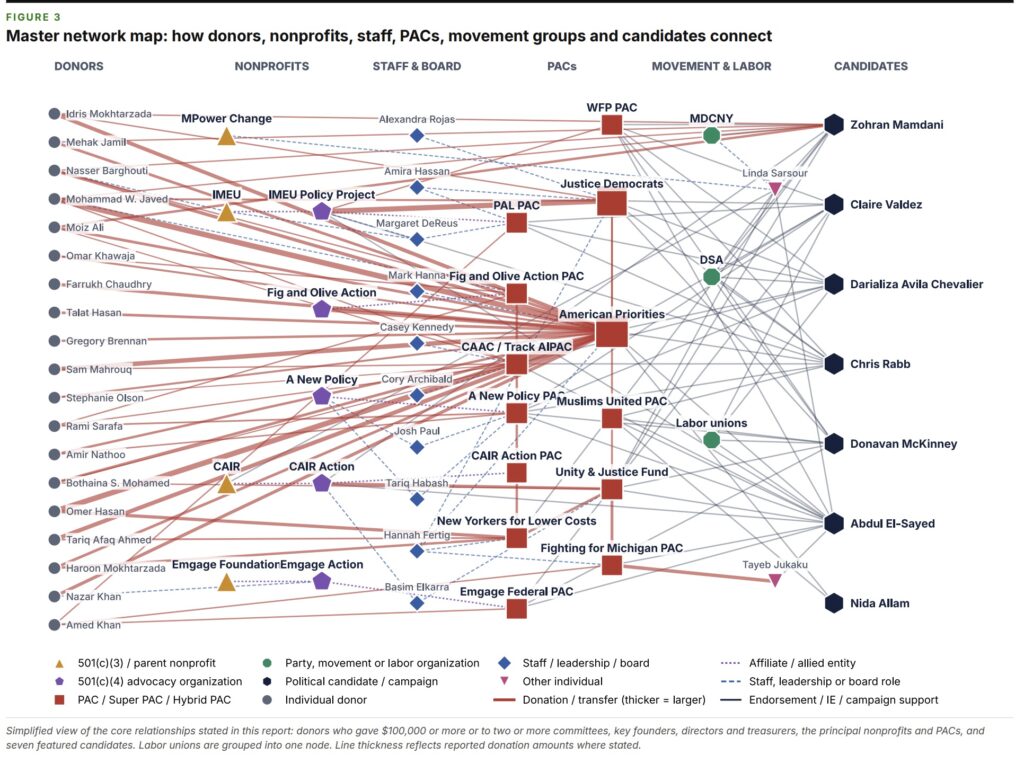 Canary Mission report screenshot
Mamdani’s rise reflects a broader effort to build a durable political infrastructure capable of shaping Democrat primaries beyond any single race, the report claims.
Canary Mission does not argue that any single organization controls the network. Rather, the report claims that activist groups, PACs, labor unions, and nonprofits reinforce one another by backing many of the same candidates simultaneously.
The report includes El-Sayed, the Democrat nominee for U.S. Senate in Michigan, in its network map. While El-Sayed has not publicly identified himself as a socialist or as a DSA member, critics have linked him with democratic socialist activists and causes.
Exclusive: Trump to Tout 'America First' Immigration Victories in North Carolina, Highlighting Arrests of Sex Offenders, Child Abusers
President Donald Trump is set to tout his "America First" immigration victories at a rally in Greenville, North Carolina, this evening.
The post Exclusive: Trump to Tout ‘America First’ Immigration Victories in North Carolina, Highlighting Arrests of Sex Offenders, Child Abusers appeared first on Breitbart.
Ilhan Omar Furiously Denies Immigration Fraud Charges, Says She Only Married Brother For Love

WASHINGTON, D.C. — Congresswoman Ilhan Omar vehemently denied any wrongdoing amid ongoing allegations she committed immigration fraud, saying she only married her brother for love.
Poll: 64% Back Data Centers With Protections
Victor Davis Hanson: Europe’s Immigration Crisis Is a Warning to America
Editor’s note: This is a lightly edited transcript of “Victor Davis Hanson: In His Own Words” from Daily Signal senior contributor Victor Davis Hanson. Subscribe to Victor Davis Hanson’s own YouTube channel to watch past episodes.
Jack Fowler: France is ablaze yet again. Let’s talk about the riots. Now, a few things. The riots are not only in France, Belgium, and Italy, and now Albania also. And they’re being called student riots.
Victor Davis Hanson: Yeah. They’re being called, outside of France, French riots
Fowler: French, yeah. I’m sure many people who watch this show, listen, have seen the videos of the Limoges town hall, about 150 years old, burned this weekend.
Donald Trump has weighed in. He’s urged France to close its borders. He has called France ungovernable and the riots apocalyptic. The police have said in these cities they’re outmanned. So hundreds of thousands of protesters—they shouldn’t be called protesters—criminals taking to the streets of all the major cities.
And then we’re gonna talk about a particular case. But Victor, your thoughts?
Hanson: Well, it is kind of Orwellian, isn’t it? That you bring in millions of people, many of them illegally, you allow, and then 45% of your budget is social welfare, and you’re up to 125% [gross domestic product] in debt, and you’re giving people cradle-to-grave social support.
The unemployment rate of new immigrants is almost 50%. And with all that, life is heaven in France compared to Somalia, the Sudan, Libya, Algeria, Morocco, Syria, Afghanistan, etc. And then you start to riot in league with students who are, I guess, upset about shoddy conditions in their high schools and all of that.
And then you get socialists fanning it on and there’s allegations there’s Chinese money involved. So you’re destroying this place, and you’re a guest in this country, even maybe you’re second generation, some of them. But compared to where you came from, it’s still heaven. And your attitude toward your hosts that welcomed you in is not magnanimity, it’s contempt.
And so, the host is getting very angry.
They are deliberately targeting iconic buildings. They went after a 19th-century government building that was a historical monument in one French city. There was a really disturbing scene in Milan where they were very close to the Duomo, that historic Christian church, and there were flames and everything.
And when you’re at 16%, 10%, 30% in Sweden maybe, then you start to see things. And one of the things you start to see is that these NATO countries will not support the United States and not even allow us to use their airspace because we are at war with a Muslim nation, and that resonates.
And even though they say, “We are the avatars of democracy and we support democracy,” and then there’s this little democracy in the Middle East, and they never miss an occasion to damn Israel and they’re boycotting produce and goods that are supposedly outside the 1947 or ’48 borders, and they’re siding with these radical Palestinians.
Remember, Europeans, you and the U.N. and the Bush administration said, “Hamas, we’re going to get all the Jews out of Gaza, and you can have an election.” And they had an election. There were no Jews since 2005. And what did they do? They threw all their opponents off high-rises and killed them, the Palestinian Authority rivals.
And then, for nearly 18 years, they didn’t build anything. For $40 billion in foreign aid from the U.N. and Europe, the United States, they built 350 miles of tunnels, and then they hid there while their civilians were used as shields, and then they slaughtered 1,200 Jews. That’s their experiment with democracy.
And you side with that over a free society in Israel. And so that’s their problem.
And it doesn’t do them any good, Jack, because they’re so paranoid about these unassimilated un-integrated populations that they turn on their protector, the United States. The only reason they said you can’t land here was Iran told them that we’re going to go after you.
And they did. They did do it at the RAF base in U.K. And so, they’re so scared of their own population that are Muslim and they get to go, “Well, if we help the United States, the Muslims, they may be mad at us, and they may riot.”
Well, they’re going to riot anyway. What good did that do to offend the United States and say, “You can’t use our airspace.You can’t land in Sicily. You can’t land in Spain. Now, Muslim populations, see what we did for you?”
And they said, “No. No. No. That’s not on our agenda, just, you know, helping Iran out. We’re going to take over the country because you don’t want it or you can’t defend it or you don’t deserve it, and we’re taking it over.”
And that’s their attitude. They don’t get it.
You know, our friend Bruce Thornton in 2007. He wrote a book called “Rise and Fall: The Slow-Motion Suicide of Europe.” And Roger Kimball published it at Encounter. It was a great book. It predated Douglas Murray’s book of nearly the same title by 15 years.
And he said in the book, as Mark Steyn did in his, “If demography continues as it does, if immigration continues as it does, as politics continue as it does, within 20 years, Europe will be unrecognizable.” And it pretty much was a prescient—a prediction.
Fowler: Yeah. Well, here’s a case, Victor, of why should Europe be saved when Europeans are acting in this fashion?
So this is the micro version, Thomas Hobbes. It’s an ancedote, but I think it’s an important one. So here’s a—
Hanson: Bellum omnia, bellum omnium contra omnes, the war of everybody against everybody.
Fowler: Yeah. Well, here’s one everybody who’s a dirtbag. This is from The Mirror, London. “Rapist who killed police officer at World Cup fan zone gets one year in prison.”
So here’s the story. Bear with me, folks.
“Convicted rapist who punched and killed a police officer at a World Cup fan zone has been jailed for just one year. Father-of-two Christian Zedig, 32, was off duty and had gone to watch the match between Norway and Ivory Coast on a giant screen on June 30 in Copenhagen, Denmark.
“When a fight broke out, he intervened and in the ensuing chaos was struck in the throat. When police arrived, they found Christian with life-threatening injuries as the blow had ruptured his artery. He died on July 3 at the hospital. Nkumba Ludovic Tshiembe surrendered to police and was remanded in custody but initially denied wrongdoing.
“He pled guilty eventually at an assault trial this week. At the end of the trial, he was sentenced to just one year in prison, and he was also ordered to pay some damages to the wife and the daughter of the slain police officer.”
Now get this: Tshiembe was sentenced to seven years in prison in 2017 for attempted murder after stabbing a man in the heart at a nightclub.
Before that, he had been convicted of rape. So this is who lives and breathes and destroys on the streets of Europe, and justice does not come to them ready for.
Hanson: Did you see that interview with the editor-in-chief of The Economist with, I think her name is Alice Weidel? She’s the head of the AfD in Germany, Alternative for Deutschland.
And they were talking about this issue, what you’re talking about. And she was trying to get scare quotes that Ms. Weidel had said or her co-chair, I think his name was Chrupalla or something had said. And it was, “You say that these people who commit crimes are not wanted in Germany?”
“Yes.” “And you say if they are citizens, we can denaturalize them, or if they’re illegal, we can send them back?”
“Yes, of course. Why would we do that? Why wouldn’t we? They were guests. We gave them opportunities, and they broke the law. If they broke the law in coming here, they’ll have to go home. If they broke the law once they were citizens, they’re no longer citizens. We can denaturalize them. We can’t afford this.”
But she was just very calm, and you should have seen the interviewer. She was astounded. How can any European say this? But what I’m getting at is that stories like that, they’re not forgotten. They’re all memory-banked in the collective memory of 450 million Europeans, and it’s getting to a breaking point.
I think it’s kind of getting here in the United States. You know, there was a story about the New York Fashion Institute where two girls wanted to get some drug, I think cocaine, and they called up somebody, and he came with the intent of basically killing them and had pure fentanyl. Did you read about that?
And he gave them fentanyl, and one of the girls went immediately into a coma. She died. Both of them died. And she was completely naked, and he sexually assaulted her.
And there was another story in Boston where a—I think the person was in law enforcement, and he was in law enforcement barracks, and they found a naked girl walking across the street, and he had enticed her to come in and physically assaulted and raped her.
But the point is that that person had a long, like this person, and this is in the United States, had a long criminal record. And the other one, even though he was 19, I think he had a record. And we’ve had a lot of these sensational cases in California recently of sexual assault, pedophilia, fentanyl by illegal immigrants, and they all have prior records.
And so, you have to ask yourself, this is a Western disease, and we’re affluent in leisure at the end of history. We solved all the problems. We have our iPhones, our iPads. We got our Teslas. We got everything we want. And now we’re at the point where we can afford to feel magnanimous. Now, maybe the poor can’t, maybe the middle class can’t because they’re on the front lines of what we create, because we create chaos through our ideas, and then we retreat back to Menlo Park or Presidio Heights or Malibu, and then we’re safe.
We have our security, we have our money, and we have our nice ZIP codes, and we have private schools for our kids. But the theories that we advance about revolving door criminality, no bail, and decriminalizing theft, letting murderers out, that will fall on people that unfortunately we don’t really care about.
And that’s true in Europe and the United States. It’s the same thing. The only good thing about this horrific thing that’s happening is that we still have almost three weeks to look at what’s going on in Europe. And we should say what is going on in Europe is about a year and a half of what’s going on here.
And we’ve already seen some of it on the campuses of Columbia, at Stanford, trashing the president’s office in Philadelphia, chasing Jews into a library at Harvard, roughing up somebody and then getting an award at graduation, even though you roughed him up. And George Floyd, you know, 14,000 arrests, 35 people killed, $2 billion in damages, arson, da, da, da.
And you should vote against that. And there’s another thing to remember, and I’ll shut up. These people always, during the time—how do they get elected? Well, they get elected by saying things that they didn’t say before they ran for office. And they won’t say after they’re elected, whether it’s James Talarico here or Abdul El-Sayed or Millet Quiros.
Why is it that—take a guy like Paxton. He’s got a long record that he is ashamed of. He should be so—in some cases. Does he ever say, “I didn’t say that”? No. He just lives with it, and it’s authentic. Does Trump ever say, “Well, I kind of spoke out of turn, and I really didn’t mean that about Zelenskyy, that we need a new president”?
No. Whatever he is, he is. But why is it that all of these candidates, Talarico, El-Sayed, and people who were elected, Zohran Mamdani, why do they all, in Europe and in here, they cleanse, they purify, they excise their entire social media full of quotations? So Hasan Piker, he’s the only one that says—well, no, I take that back.
He’s now contextualizing his things that we deserve Sept. 11, and I hate the United States. He said that was rhetorical. Why is El-Sayed trying to get angry when you say he said, “Hurt people, hurt people,” after people tried to kill Jews in a synagogue?
Or why does he say, “That’s irrelevant, don’t bring that up.I was just talking on a hot mic when I said that my constituents might be happy or basically happy to hear the news of the death of the Iranian terrorist leader, supreme leader.”
Or why does Talarico say, “You know, I didn’t really mean that people with white skin are spreading a white skin virus. I didn’t mean that.”
Or why does Mamdani say, “Well, I really didn’t mean I want to go after whiter neighborhoods.” Or why does his housing head, I think Cea Weaver, why— Now she, “I really didn’t mean that when I said homeownership is a form of white supremacy.”
But my point is the Left always has to hide what they are, because if they told you what they are, nobody would ever want them.
And that’s what we should remember when we go into this election. What you’re seeing in Europe is what you’re going to get here, but they’re not going to tell you that.
If you hate beef and you hate fossil fuels, you’ll be like Talarico and put a cowboy hat on and be pictured in a Ram truck with a cowboy hat and eating a hamburger for a while, and then it will vanish when you’re in power.
So this unrest in Europe should be very didactic. It should really give us a glimpse of the future here if we continue down this path.
We publish a variety of perspectives. Nothing written here is to be construed as representing the views of the Daily Signal.
Trump Administration Orders Federal Agencies to Remove China's DeepSeek AI from Government Systems
The Trump administration has formally banned the Chinese AI startup DeepSeek from civilian U.S. government IT systems over security concerns, the Department of Homeland Security disclosed Monday.
The post Trump Administration Orders Federal Agencies to Remove China’s DeepSeek AI from Government Systems appeared first on Breitbart.
Montana: Legislature to Pursue State-Level Suppressor Deregulation in 2027 Session
Young Americans Lead Credit Card Spending Surge As Cost Of Living Squeezes Paychecks
Report: Jay-Z Picks Himself for Super Bowl LXI Halftime in Los Angeles
A report claims that Jay-Z has picked Jay-Z to be the NFL's Super Bowl Halt Time Show's headline act set to be held in L.A. next year.
The post Report: Jay-Z Picks Himself for Super Bowl LXI Halftime in Los Angeles appeared first on Breitbart.
Pages
Rune Hammer Feeds
