
An Alternative News Aggregator
News of the Day
“Glory to God in the highest heaven, and on earth peace to those on whom his favor rests.”
- Luke 2:14

Why Is America Being Hit By One Catastrophic Disaster After Another?
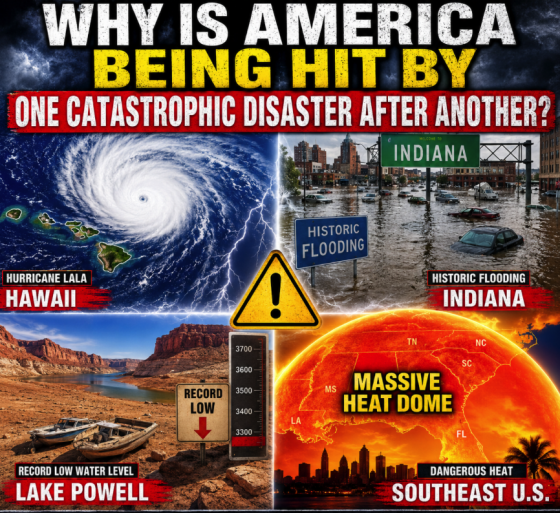 For months, the U.S. has been getting pummeled by one major disaster after another, and the past few days have been absolutely insane. Hurricane Lala just dumped more than two feet of rain in some parts of Hawaii, we are witnessing the worst flooding in the entire modern history of Indiana, the endless drought in the Southwest has caused Lake Powell to drop to the lowest level ever recorded, and an absolutely massive heat dome is going to make it feel like it is over 110 degrees in many cities in the Southeast on Monday. If it was just one disastrous week, we could write this off as bad luck. But it hasn’t just been one disastrous week. In fact, we have been experiencing a nightmarish string of natural disasters that stretches all the way back to 2024. So why is this happening to us?
Hurricane Lala was not supposed to be this powerful.
According to CNN, more than 30 inches of rain have already fallen on Hawaii’s Big Island…
Videos obtained by CNN show streets flooded by torrential rainfall on the Big Island, which got over 30 inches of rain. More than 190 flights in and out of Hawaii have been postponed, Green said.
Emergency responders are expected to be busy dealing with urgent matters for 36 hours as the storm passes Hawaii, with damage assessment expected to begin on Monday, the governor said.
Have you ever lived somewhere that suddenly got 30 inches of rain?
The National Hurricane Center has issued a warning for those that live in Hawaii to be alert for life-threatening flooding and mudslides.
Those that live in areas with steep terrain will be particularly in danger.
By the time it is all said and done, it is being projected that Lala will dump up to 35 inches of rain in some areas…
By the time Lala’s completely gone, some higher-altitude places on the Big Island, dominated by the towering Mauna Kea volcano, will have been hit with as much as 35 inches (89 centimeters) of rain, forecasters said, enough to loosen steep slopes where some of the 210,000 islanders live off the grid in improvised housing.
I can’t even imagine that much rain, because I have never experienced anything like it.
Officials instituted a search and rescue mission after a number of homes were reportedly “swept off their foundations”…
The island of Oahu, including the state’s capital Honolulu, is under a flash flood warning Sunday morning. Parts of Hawaii’s Big Island are also under a flash flood warning, and National Weather Service had previously called that warning a “Particularly Dangerous Situation.”
“Several occupied homes may have been swept off their foundations, and based on that, civil defense has initiated a search and rescue mission,” Hawaii County Mayor Kimo Alameda said overnight.
One minute you are sleeping, and the next minute your house is literally being swept along by floodwaters.
That is how fast it can happen.
Lala also brought extremely high winds to the island chain.
In fact, Accuweather is telling us that there were “wind gusts as high as 140 mph” on Mauna Kea…
As of Sunday morning, wind gusts as high as 140 mph have been observed at the summit of Mauna Kea on the Big Island, where heavy snow and blizzard conditions were observed. Intermediate elevation gusts to 91 mph have been observed at Waimea on the Big Island and near 80 mph on Molokai.
Meanwhile, Indiana is dealing with a flooding disaster that is absolutely unprecedented.
Entire communities are underwater, and officials are calling this a “once-in-a-lifetime” event…
Six people are dead and many more are missing as torrential rain spawned destructive high water across Indiana in what authorities are calling “once-in-a-lifetime floods.”
Entire towns were inundated with murky water as rising rivers exceeded their banks, with some residents taking to kayaks and small boats to save fellow residents or to escape, according to news outlets.
There are actually portions of several states that have been severely flooded, but Indiana was hit the worst.
At one point, the White River actually set a brand new all-time record by reaching a level of 24.93 feet…
The day after a destructive derecho tore across northern Indiana and parts of Illinois, rivers in eastern Indiana swelled, engulfing homes and reaching historic levels.
The White River at Anderson, Indiana, reached 24.93 feet early Friday morning. This surpassed the previous record of 23.60 feet set in 1913, more than a century ago. The river had not been above 20 feet at this location since 1958.
At Raible Avenue in Anderson, the river crested Friday morning at 21.60 feet, just shy of its record of 23.00 feet, also set in 1913.
What a nightmare.
Some of the images that are coming out of Indiana are absolutely heartbreaking…
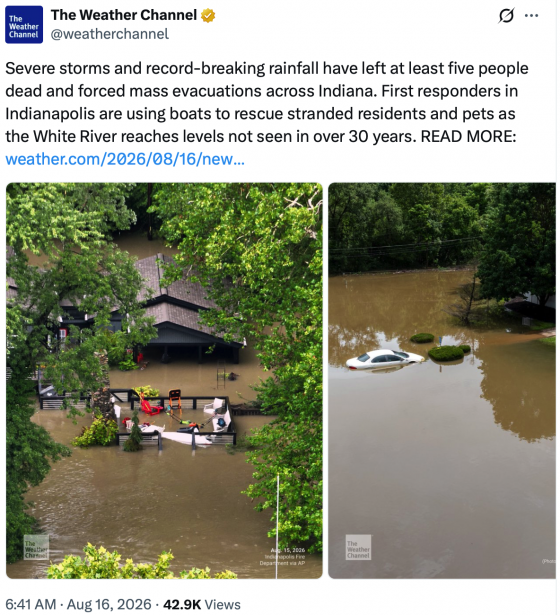
While the center of the country keeps getting hammered by one storm after another, the western third of the nation continues to endure a multi-year drought of epic proportions.
I wrote about the horrific wildfires in the Northwest at the end of last week.
In the Southwest, the big story today is the fact that Lake Powell has now hit the lowest level ever recorded…
Lake Powell, the giant reservoir on the Utah-Arizona border that helps power millions of homes, has fallen to its lowest level ever amidst a worsening western drought exacerbated by climate change.
The lake’s surface dropped to 3,519.91 feet above sea level on Aug. 15, according to the Bureau of Reclamation’s automated gauge system. The previous lowest level was 3,519.92 feet, reached in April 2023. Dropping below 3,490 feet could imperil the lake’s ability to generate electricity, and federal officials have been pulling water out of smaller reservoirs upstream to help delay reaching that level.
Federal officials are going to do what they can, but if it simply doesn’t rain this crisis is only going to intensify.
If you live in that area of the country, this is a story that you will want to watch very closely.
In the Southeast, a gigantic heat dome continues to absolutely bake tens of millions of Americans…
An extensive heat dome will continue to build across the Gulf Coast early this week, bringing several days of dangerous heat and high humidity with little overnight relief and increasing the risk of heat-related illnesses.
On Monday, it is going to feel like it is 113 degrees in Jacksonville, Florida.
That is hot!
Of course it isn’t just the United States that has been experiencing more frequent natural disasters.
Since the beginning of June, our planet just hasn’t stopped shaking.
I wrote about the magnitude 7 or greater earthquakes that have been occurring in recent months last week, and now we have another one to add to the list…
Rescuers started arriving today for thousands of evacuees on Indonesia’s Flores Island after a powerful 7.7-magnitude earthquake killed 51 people, injured dozens and damaged hundreds of houses and buildings.
Some 5,000 people fled their homes as the quake hit the island on Saturday at 5.58am local time – around 11pm in the UK.
It was followed by at least 341 aftershocks, a spokesman for the BNPB national disaster agency, Berton Suar Pelita Panjaitan, said.
Magnitude 7 or greater earthquakes are supposed to be rare.
In some years, we have less than 10.
But now they are happening with alarming regularity.
We live at a time of tremendous chaos.
Catastrophic events are occurring all around us, and I fully expect the months ahead to be even crazier.
Michael’s new book entitled “10 Prophetic Events That Are Coming Next” is available in paperback and for the Kindle on Amazon.com, and you can subscribe to his Substack newsletter at michaeltsnyder.substack.com.

About the Author: Michael Snyder’s new book entitled “10 Prophetic Events That Are Coming Next” is available in paperback and for the Kindle on Amazon.com. He has also written nine other books that are available on Amazon.com including “Chaos”, “End Times”, “7 Year Apocalypse”, “Lost Prophecies Of The Future Of America”, “The Beginning Of The End”, and “Living A Life That Really Matters”. When you purchase any of Michael’s books you help to support the work that he is doing. You can also get his articles by email as soon as he publishes them by subscribing to his Substack newsletter. Michael has published thousands of articles on The Economic Collapse Blog, End Of The American Dream and The Most Important News, and he always freely and happily allows others to republish those articles on their own websites. These are such troubled times, and people need hope. John 3:16 tells us about the hope that God has given us through Jesus Christ: “For God so loved the world, that he gave his only begotten Son, that whosoever believeth in him should not perish, but have everlasting life.” If you have not already done so, we strongly urge you to invite Jesus Christ to be your Lord and Savior today.
The post Why Is America Being Hit By One Catastrophic Disaster After Another? appeared first on The Economic Collapse.
We Are Literally Witnessing End Times Weather All Over America
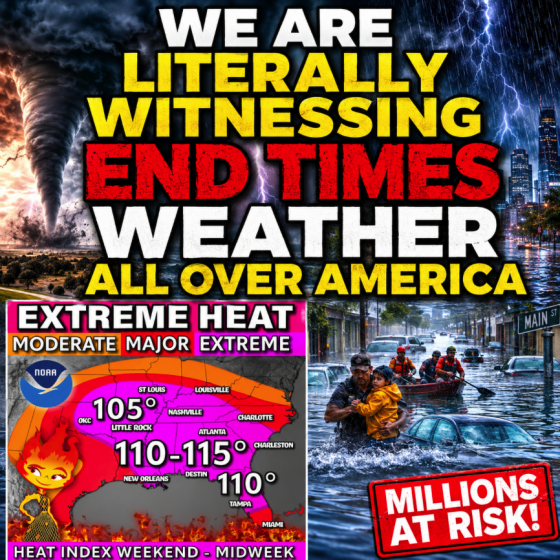 We have experienced one natural disaster after another in 2026, and this week has been particularly crazy. The facts that I am about to share with you are absolutely insane. This weekend, the heat index could reach 115 degrees in some areas of the Southeast. A 1-in-1,000 year rainfall event has produced catastrophic flooding in the Midwest. By the end of this year, the state of Illinois could experience more tornadoes than any state ever has in the entire history of our country. On top of everything else, wildfires have now burned portions of every single national park in the state of Washington. Our weather patterns have not even been close to normal, but most of you already knew that.
Yes, we really are witnessing end times weather all over America.
The Midwest faced widespread damage Tuesday after a fierce line of thunderstorms produced a high-velocity windstorm called a derecho.
That high-velocity windstorm was so powerful that it actually caused a home in Portage, Indiana to explode…
Amid the storms, a home exploded in Portage, Indiana — erupting into flames after it was hit by wind gusts up to 99 miles per hour.
Many refer to derechos as “inland hurricanes” because of the force of the winds.
In Illinois, one woman lost her brand new barbecue grill and her entire roof to the howling winds…
There were numerous reports of wind gusts of 80 mph or more at personal weather stations.
“Total devastation. No roof,” said Kerry Hourigan, standing outside her home of 25 years in the Chicago suburb of Tinley Park. “Stupid thing, but my focus was I just bought a new barbecue grill, and I have no idea where that is. It’s disappeared.”
A number of tornadoes also spawned in the Chicago area.
And as we have seen so many other times already this year, those tornadoes left behind very impressive trails of destruction…
The National Weather Service confirmed that at least three tornadoes touched down in Chicago’s south suburbs during the midday hours Tuesday. Photos from the Chicago area posted on social media showed flooded roads, trees tangled in power lines and homes with gashes in their roofs.
Illinois has already shattered the state record for tornadoes in a single year.
By the time 2026 is done, meteorologist Bill Snyder believes that Illinois will break the national record for tornadoes in a single year…
“This is the craziest storm season I’ve ever seen,” WGN-TV meteorologist Bill Snyder said. “There’s been no rest for the wicked.”
Snyder said Illinois will likely pass 200 confirmed tornadoes after Tuesday’s storms, far and away the most tornadoes of any state in the country for 2026, according to the National Weather Service.
If Illinois continues this stormy trend, it may not only add to its state record but perhaps break a nationwide record for the total number of tornadoes in one state in any single year — 232 tornados in Texas in 2015 and 1967.
“I’m firmly convinced Illinois will break the national tornado record before 2026 is over,” Snyder said.
Following the derecho and the tornadoes, it started to pour in the Midwest.
The rain just kept coming down hour after hour.
Now some parts of Indiana look like they were just hit by Noah’s Flood…
Flooding submerged Indiana neighborhoods in water for the second day in a row, as parts of the state saw Wednesday the highest daily rainfall totals ever recorded in their areas.
Some braced for more severe weather still ahead, as meteorologists warned Thursday that Indianapolis faced the greatest threats of storms slated to bring heavy rain to the Midwest throughout the rest of the week.
Upwards of 36 million people were under flood alerts Thursday across the region, according to the National Weather Service. Its forecast offices in Kentucky, Illinois, Indiana, Iowa and Tennessee warned that rainfall across each state could be persistent and widespread, potentially drenching parts of each state with another 4 inches or more.
It would be difficult for me to overstate the severity of this disaster.
The city of New Castle, Indiana actually experienced a 1-in-1,000 year rainfall event…
New Castle received more than 11 inches of rain in just over a day. Such a high rainfall rate is extremely rare, with only a 1 in 1,000, or 0.1%, chance of it happening in any given year.
That part of Indiana is not supposed to get 11 inches of rain.
But it just did.
As the water rose all around him, one man saved his life by clinging to a light pole…
Many people had to be rescued by boat in Cambridge City, Indiana, after catastrophic floods on Wednesday left them stranded. Water filled city streets, rising several feet in the hardest-hit places and seeping into, at best, the ground floors of local homes. Some residents faced harsher conditions, with the deluge completely covering the roofs of their cars or crashing into their homes through doors and windows.
One man desperately clung to a light pole in Cambridge City as muddy, brown water swirled around him, before he was eventually rescued. Another, Christian Corder, of nearby New Castle, Indiana, evacuated his home after it flooded and told “CBS Mornings” that dealing with the aftermath has been “very overwhelming.”
“A lot of stuff is ruined,” Corder said, recalling how “the rain never stopped — it just kept coming and coming.”
Indiana Governor Mike Braun has declared a state of emergency, and more rain is on the way.
Meanwhile, the Southeast is about to experience a different kind of an emergency.
Over the next few days, it will be covered by “the planet’s strongest heat dome”…
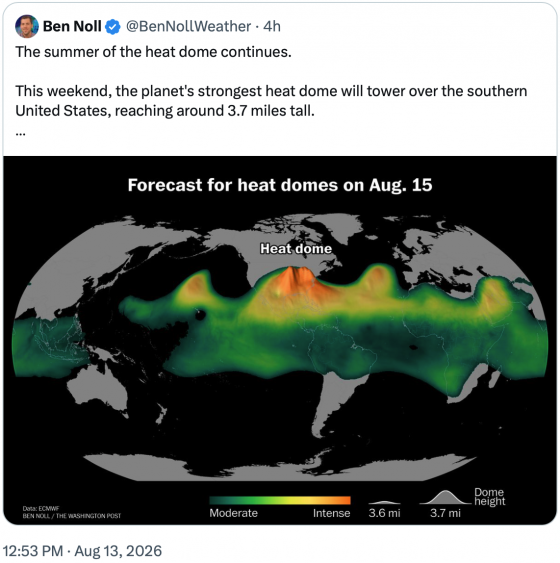
That is no ordinary heat dome.
And things are going to get really, really hot for those that will be underneath.
According to meteorologist Jeff Berardelli, the heat index in some parts of the Southeast could reach 115 degrees…
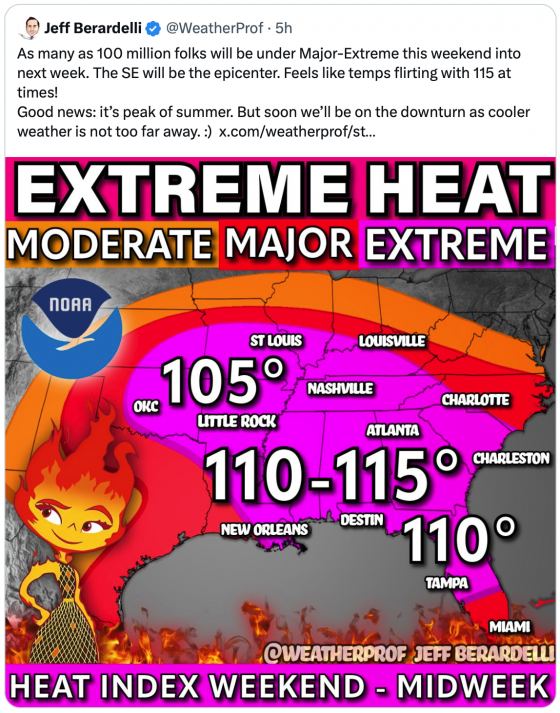
If you live in the Southeast, please try to stay inside this weekend.
And if you live in Hawaii, that advice applies as well.
Tropical Storm Lala just formed, and it is expected to strengthen greatly as it approaches the Hawaiian islands…
Tropical Storm Lala has formed in the Central Pacific Ocean, the National Hurricane Center said on the morning of Aug. 13, adding that a hurricane watch has been issued for the Big Island of Hawaii.
Lala, now with sustained winds of 40 mph, is forecast to strengthen and could be near hurricane strength when it approaches the Big Island by early Saturday, Aug. 15.
On the island of Oahu, Honolulu Mayor Rick Blangiardi said in a news release that “this is the time to prepare, not panic,” as the system approached. “We still do not know exactly where this system will track or how strong it will become, but we know enough to take it seriously. I am asking everyone on Oahu to use the next several days wisely.”
Yes, Hawaii can get a lot of rain.
But this storm is different.
We are being told that up to 20 inches of rain could fall, and if that happens it is likely that we will witness “life-threatening flooding”…
The storm is forecast to carve a path near the island chain, with dangerous weather conditions beginning Friday night.
“The Potential Tropical Cyclone is expected to produce rainfall totals of 5 to 10 inches across much of the Island chain, with maximum totals of 20 inches possible. This rainfall may produce life-threatening flooding and mudslides, especially in areas of steep terrain,” the National Hurricane Center wrote, adding that life-threatening surf and rip currents are also expected.
Before I end this article, I certainly don’t want to leave out the western portion of the nation.
Over 6.4 million acres have already burned in the United States in 2026, and most of that land is located in our western states…
The numbers are staggering: Wildfires this year have consumed more than 6.4 million acres of land across the country as of Thursday, with 103 new fires reported on Wednesday alone.
Things are particularly bad in the Northwest.
At this point, portions of every single national park in the state of Washington have burned.
We have never seen anything like this before.
I realize that I have been writing about this “Godzilla El Niño” a lot, but there is a reason why I have been doing so.
Many believe that this “Godzilla El Niño” is the primary reason why we have been witnessing so many crazy weather events, and now we are being told that it has gotten even stronger…
El Niño continued to strengthen over the past month, the Climate Prediction Center said, with sea-surface temperatures more than 3.6 degrees above average in the eastern equatorial Pacific Ocean.
The Climate Prediction Center report, which synthesizes several climate models from North America and abroad, also said that this El Niño will continue to strengthen through the end of the year.
A lot of experts expect this “Godzilla El Niño” to far surpass the strength of any other El Niño in recorded history by a very wide margin.
If that turns out to be accurate, what we have experienced so far will just be the tip of the iceberg.
So buckle up and hold on tight, because it appears that things could get very bumpy during the months ahead.
Michael’s new book entitled “10 Prophetic Events That Are Coming Next” is available in paperback and for the Kindle on Amazon.com, and you can subscribe to his Substack newsletter at michaeltsnyder.substack.com.
About the Author: Michael Snyder’s new book entitled “10 Prophetic Events That Are Coming Next” is available in paperback and for the Kindle on Amazon.com. He has also written nine other books that are available on Amazon.com including “Chaos”, “End Times”, “7 Year Apocalypse”, “Lost Prophecies Of The Future Of America”, “The Beginning Of The End”, and “Living A Life That Really Matters”. When you purchase any of Michael’s books you help to support the work that he is doing. You can also get his articles by email as soon as he publishes them by subscribing to his Substack newsletter. Michael has published thousands of articles on The Economic Collapse Blog, End Of The American Dream and The Most Important News, and he always freely and happily allows others to republish those articles on their own websites. These are such troubled times, and people need hope. John 3:16 tells us about the hope that God has given us through Jesus Christ: “For God so loved the world, that he gave his only begotten Son, that whosoever believeth in him should not perish, but have everlasting life.” If you have not already done so, we strongly urge you to invite Jesus Christ to be your Lord and Savior today.
The post We Are Literally Witnessing End Times Weather All Over America appeared first on The Economic Collapse.
The Daily Global Oil Deficit Is Even Higher Than Originally Projected, And That Means That The Energy Crisis Is About To Greatly Escalate
 Since war with Iran erupted in February, the world has been using a lot more oil than it has been producing. The good news is that we had a tremendous amount of extra oil sitting around. As a result, we have been able to avoid shortages and we have been able to serve as the supplier of last resort for nations all over the globe. The bad news is that our commercial oil inventories are now almost entirely depleted, and the U.S. Strategic Petroleum Reserve is being drained very rapidly. We will soon hit a wall, and when that happens the global energy crisis will start getting really crazy.
According to the International Energy Agency, the amount of oil being produced globally each day is falling faster than they originally projected…
Global oil supply will fall by ~4% and oil demand is set for a deeper contraction this year, as renewed hostilities in the Middle East push up fuel prices and weigh on consumption, the International Energy Agency said in its monthly oil market report on Wednesday.
The Paris-based agency sees global oil supply falling by 4.3M bbl/day this year, compared with the 3.7M bbl/day forecast in the IEA’s July report, which would take total supply to the IEA’s lowest forecast yet for this year at 102M bbl/day.
At this stage, global demand for oil is well above global supply.
In fact, the International Energy Agency is now expecting the world to run an oil deficit of approximately 1.8 million barrels a day during the third quarter of this year. That is “more than double its previous estimate”…
The result would put global oil supply ~1.27M bbl/day below demand this year, widening from an 860K bbl/day deficit implied from the IEA’s July forecasts.
“Global oil supply has fallen well below demand due to the Strait of Hormuz shutdown, the U.S. blockade of Iranian exports, attacks within the Bab el-Mandeb Strait and reduced Kazakh CPC Blend exports,” the IEA said.
For Q3, the IEA expects the global oil market to run a deficit of 1.8M bbl/day, more than double its previous estimate of ~800K bbl/day and the deepest quarterly deficit since Q4 2021.
I realize that there is a lot of technical jargon there, and so let me try to break this down very simply.
Things are a lot worse than they thought they would be.
Now our commercial oil inventories have almost disappeared and the U.S. Strategic Petroleum Reserve has fallen under 300 million barrels for the first time since early 1983…
Crude oil stockpiles in the U.S. Strategic Petroleum Reserve have fallen below 300 million barrels, the lowest level in more than four decades, as global inventories stay under pressure due to the Iran war.
The SPR fell by 6.1 million barrels to 298.7 million barrels last week, according to data released by the Department of Energy on Monday. The reserve, created in 1975, is at its lowest level since January 1983.
Of course we will not be able to use all of that oil.
There is a certain level that we cannot go below, and apparently more than 25 percent of the oil is “physically inaccessible” for various reasons…
More than a quarter of that oil is physically inaccessible, blocked by failing pumps, corroded pipes, and underground salt caverns that have deformed beyond their operational parameters, according to internal government documents reviewed by Sputnik.
The finding means the actual emergency capacity of the American energy backstop is smaller, and slower to deploy, than any headline barrel count conveys.
We are being told that we have about 40 days left.
What will we do after that?
Already, diesel prices are starting to go through the roof…
U.S. and European diesel prices rose sharply on Monday after attacks on refineries in Russia and Saudi Arabia added to supply disruptions, raising concerns for farmers in need of the fuel for the planting season in the Northern Hemisphere and harvesting season in the Southern Hemisphere.
The U.S. ultra-low sulfur diesel futures contract rose 7.4% to settle at $4.19 a gallon on Monday, the biggest gains since July 13. European diesel refining margins, measured as the difference between the price of fuel and the cost of crude oil, rose nearly 10%.
The surge followed confirmation of an attack by Ukraine on a refinery in Russia’s Tatarstan region and another attack by Yemen’s Houthis on the Jazan refinery in Saudi Arabia. The Jazan refinery has been shut since July 27 due to an earlier strike by the Houthis, and plans to restart it have been postponed from August 15 to August 30, according to industry monitor IIR Energy.
It is just a matter of time before we see diesel shortages start to pop up all over the world.
This will greatly affect farmers and truckers.
What we really need is for the conflict in the Middle East to end and for traffic to start flowing through the Strait of Hormuz like it did before the war.
But that is not going to happen because there isn’t going to be a deal.
The Iranians are insisting that President Trump must agree to all of their demands before they will reopen the Strait, and there is no way that President Trump will ever do that.
So for now Trump is maintaining the naval blockade on Iran and he is declaring that the U.S. has “total control over the Strait of Hormuz”…
“The U.S.A. has total control over the Strait of Hormuz,” he wrote. “I THINK WE WILL KEEP IT! Our Naval Blockade is being called, by everyone, ‘A WALL OF STEEL,’ and there is nothing Iran can do about it. They have no Navy, they have no Air Force, their remaining soldiers are unpaid, the IRGC is decimated and fleeing, and their ‘Leadership’ is uncertain, at best! They have No Money – Their country is ‘shot.'”
Both sides can argue about who controls what, but nobody can deny that hardly anything is getting through.
In fact, only 8 vessels traveled through the Strait of Hormuz on Tuesday…
The number of vessels tracked transiting the Strait of Hormuz fell to a one-week low of eight, according to data reported by the Reuters news agency, as the ongoing conflict and stalemate kept shipping companies away from the vital waterway.
Tuesday’s tally of eight vessels fell below a 10-day average of about 12, for the lowest daily count since August 5, according to Kpler data reported by Reuters.
Around 130 ships a day passed through the vital waterway before the war started on February 28.
A drop from 130 ships to 8 ships is a disaster.
The world desperately needs the oil, natural gas, fertilizer and petrochemicals that normally travel through the Strait of Hormuz.
But now very few shipowners are willing to have their extremely expensive vessels make that trip.
Iran has been hitting one commercial vessel after another, and one tanker that recently got attacked has spilled oil over an area of 155 square miles…
Oil from a spill off Oman has started to reach the country’s mainland, the U.N.’s shipping body said on Wednesday, according to the Reuters news agency.
“Oil is drifting offshore to the northeast of [Oman’s] Al-Qibliyyah Island, with some oil reported to be reaching the mainland. Oil spill contingency planning is in place,” a spokesperson at the International Maritime Organization (IMO) said.
The oil is believed to be leaking from the grounded tanker Caroline Bezengi, with the slick now covering almost 155 square miles, according to the Omani government.
Meanwhile, the Houthis continue to fire missiles at commercial vessels in the Red Sea…

All of this has enormous implications for our economy.
An extended energy crisis will essentially guarantee a major global economic downturn.
We are already witnessing big problems in Japan and in Europe.
Here in the United States, we lost 23,000 jobs last month, and the employment numbers for 21 of the last 30 months have been revised down…
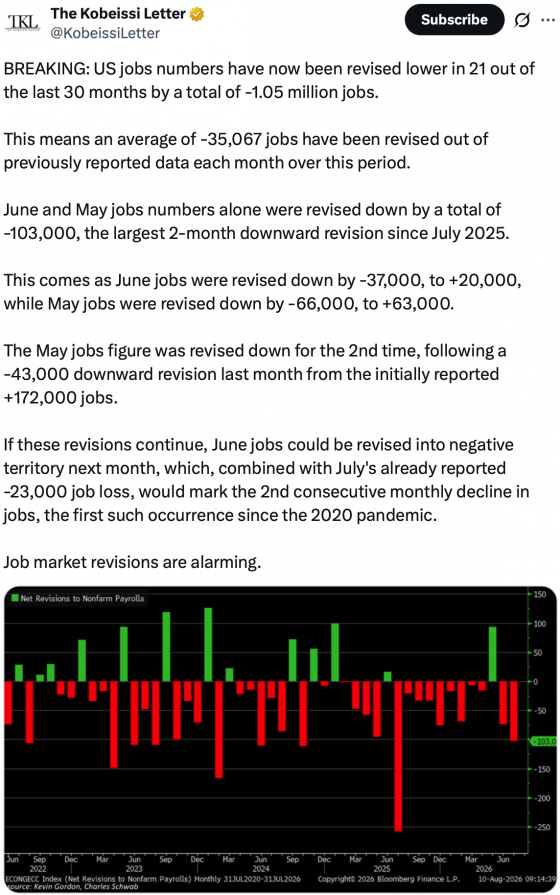
As I have discussed previously, the size of the U.S. workforce has shrunk by more than a million people over the past year.
Just think about that.
More than a million workers have simply disappeared from the workforce somehow.
Sadly, if the crisis in the Middle East is not resolved things will get a lot worse.
Our entire way of life depends upon cheap energy, and we now find ourselves in unprecedented territory.
Michael’s new book entitled “10 Prophetic Events That Are Coming Next” is available in paperback and for the Kindle on Amazon.com, and you can subscribe to his Substack newsletter at michaeltsnyder.substack.com.
About the Author: Michael Snyder’s new book entitled “10 Prophetic Events That Are Coming Next” is available in paperback and for the Kindle on Amazon.com. He has also written nine other books that are available on Amazon.com including “Chaos”, “End Times”, “7 Year Apocalypse”, “Lost Prophecies Of The Future Of America”, “The Beginning Of The End”, and “Living A Life That Really Matters”. When you purchase any of Michael’s books you help to support the work that he is doing. You can also get his articles by email as soon as he publishes them by subscribing to his Substack newsletter. Michael has published thousands of articles on The Economic Collapse Blog, End Of The American Dream and The Most Important News, and he always freely and happily allows others to republish those articles on their own websites. These are such troubled times, and people need hope. John 3:16 tells us about the hope that God has given us through Jesus Christ: “For God so loved the world, that he gave his only begotten Son, that whosoever believeth in him should not perish, but have everlasting life.” If you have not already done so, we strongly urge you to invite Jesus Christ to be your Lord and Savior today.
The post The Daily Global Oil Deficit Is Even Higher Than Originally Projected, And That Means That The Energy Crisis Is About To Greatly Escalate appeared first on The Economic Collapse.
Socialism: A System Where The Government Uses Your Money To Solve Everyone Else’s Problems
 They are coming for your money, and they have a ton of momentum right now. Democratic Socialists are winning election after election by promising free stuff, but of course free stuff is never actually free. Somewhere along the way, someone has to pay for it. If you find yourself protectively reaching for your wallet as you read this, I don’t blame you one bit. Socialism is a system where the government uses your money to solve everyone else’s problems. Unfortunately, it is also a system that is becoming increasingly popular among our young adults.
In a previous article, I noted that a poll that was taken in 2025 found that a whopping 62 percent of U.S. adults under the age of 30 now have a positive view of socialism.
That should chill you to the core.
Meanwhile, Americans view capitalism less favorably than they once did…
- Fewer than half of Americans say capitalism is working even “somewhat” well — down from 60% about a decade ago, according to a June Wall Street Journal-NORC poll.
- 61% of Americans said they were bothered “a lot” by the feeling that the wealthy don’t pay their fair share in taxes, per a Pew Research Center poll in January. That included 41% of Republicans and GOP-leaning independents.
- The same poll showed another 60% overall — and 42% of Republican-inclined voters — said the same about some corporations paying their fair share.
- And views of big business went from 19 points positive in 2012 (58%-39%) to 25 points negative last year (37%-62%), according to the Gallup data.
This is crazy.
So why is this happening?
Well, the truth is that a large portion of the population is very frustrated with the economy.
The rising cost of living has been absolutely eviscerating the middle class, and many young adults consider homeownership to be completely out of reach because home prices are so absurdly high.
When someone comes along and starts promising all sorts of free stuff in this very harsh economic environment, it can be very seductive.
But if the Democratic Socialists of America were actually able to implement their entire agenda on the federal level, it would more than triple federal spending…
The Democratic Socialists of America (DSA) propose new spending that could more than triple federal outlays. They propose the government pay for health care, housing, higher education, and electricity. Jobs are government-guaranteed, retirement benefits are expanded, paid family leave is universal, fossil fuels are eliminated, and reparations are paid.
The DSA platform claims that the bill for all this will be sent to “the richest individuals and corporations.” Tally up that bill, and it ballparks between $71 trillion and $212 trillion in new spending over the next decade. Confiscating every dollar of high-end wealth and corporate profits would cover only a fraction of those costs. The DSA agenda necessitates high taxes on middle-class Americans.
If you took every penny from every billionaire in America, that would only account for 8.4 trillion dollars.
So where is the rest of the money going to come from?
They don’t have an answer to that question, but they have been winning major races all over the country.
And now a 37-year-old Democratic Socialist named Francesca Hong is favored to win Wisconsin’s Democratic gubernatorial primary…
The 37-year-old restaurateur and chef-turned-member of the state Assembly is leading in polls by relatively wide margins ahead of Tuesday’s Democratic gubernatorial primary. Hong, a member of the Democratic Socialists of America who represents the famously liberal state capital of Madison, comes equipped with politically problematic tweets covering everything from abolishing the police to the racist origins of Thanksgiving.
It is hard to believe that someone like that could actually become the next governor of Wisconsin.
I wouldn’t even hire her to run a Dairy Queen.
But this is where we are at as a society, and it appears that lots of Democratic Socialists will be heading to D.C. after the midterm elections.
In 2026, Democratic Socialists have been repeatedly winning primaries in deep blue congressional districts…
- Claire Valdez (New York – 7th District): Won the Democratic primary in an open congressional race.
- Darializa Avila Chevalier (New York – 13th District): Defeated a 30-year progressive incumbent in a highly publicized upset.
- Melat Kiros (Colorado – 1st District): Defeated long-time incumbent Representative Diana DeGette in the Denver-based Democratic primary.
- Christopher Rabb (Pennsylvania – 3rd District): Won the open Democratic primary race for this Philadelphia-based congressional seat.
- Donavan McKinney (Michigan – 13th District): Unseated incumbent Representative Shri Thanedar in the Michigan Democratic primary.
What will D.C. look like if the Democrats take back both the House and the Senate?
Some of the Democrats that are running for seats in Congress appear to be absolutely psychotic.
If there is a major progressive wave in the fall, that could potentially make Alexandria Ocasio-Cortez one of the frontrunners for the Democratic presidential nomination in 2028.
As Ben Shapiro has aptly pointed out, she seems to be pushing a new version of “woke” that is more palatable to many Americans…
Woke 1.0 forced Americans to say, “Am I racist or am I not?” Woke 2.0 is, “Is American capitalism inherently corrupting and bad? Is the West’s system of freedoms and free markets inherently imperialistic, colonialist, genocidal, and racist?”
It’s easier to pitch woke 2.0 than woke 1.0. Why? Americans have been convinced over the course of the last 25 years or so that America is the bad guy, that we and our allies are fundamentally evil, that our foreign policy decisions of the past two decades and maybe longer, going all the way back to World War II, according to some, are actually terrible and horrible, and we’re the bad guys in the world.
Add the economic angst right now, combine those two things, and you get woke 2.0, Ocasio-Cortez’s new program. It is about hatred of America.
But no matter how AOC may want to market it, the content is still the same.
In so many ways, the socialists want to turn our country completely upside down and make it the exact opposite of what it once was.
They intend to do this by taking over the Democratic Party.
Democratic Socialists always run for office as Democrats, and most of them openly identify themselves as Democrats…
Self-identified democratic socialists do not see socialism as being mutually exclusive and continue to identify with other terms on the left, including more mainstream Democratic labels. Of Socialist Democrats, 92% consider themselves to also be Democrats, 84% consider themselves to also be Obama Democrats, and 80% consider themselves to also be progressive.
We are being told that there is a civil war in the Democratic Party, but the truth is that the differences between “mainstream Democrats” and Democratic Socialists are not actually that significant these days.
They are all heading in the same direction. Mostly, their disagreements are about how far to go and how fast it will take to get there.
We already have the biggest government in human history, but they want to make it even bigger.
But socialism doesn’t work.
As Margaret Thatcher once warned, the problem with socialism is that the socialists always eventually run out of other people’s money to spend.
Considering the fact that we are nearly 40 trillion dollars in debt, our country is rapidly approaching that point too.
Michael’s new book entitled “10 Prophetic Events That Are Coming Next” is available in paperback and for the Kindle on Amazon.com, and you can subscribe to his Substack newsletter at michaeltsnyder.substack.com.
About the Author: Michael Snyder’s new book entitled “10 Prophetic Events That Are Coming Next” is available in paperback and for the Kindle on Amazon.com. He has also written nine other books that are available on Amazon.com including “Chaos”, “End Times”, “7 Year Apocalypse”, “Lost Prophecies Of The Future Of America”, “The Beginning Of The End”, and “Living A Life That Really Matters”. When you purchase any of Michael’s books you help to support the work that he is doing. You can also get his articles by email as soon as he publishes them by subscribing to his Substack newsletter. Michael has published thousands of articles on The Economic Collapse Blog, End Of The American Dream and The Most Important News, and he always freely and happily allows others to republish those articles on their own websites. These are such troubled times, and people need hope. John 3:16 tells us about the hope that God has given us through Jesus Christ: “For God so loved the world, that he gave his only begotten Son, that whosoever believeth in him should not perish, but have everlasting life.” If you have not already done so, we strongly urge you to invite Jesus Christ to be your Lord and Savior today.
The post Socialism: A System Where The Government Uses Your Money To Solve Everyone Else’s Problems appeared first on The Economic Collapse.
Is A Global Financial Crash Starting In Japan?
 The unraveling of the yen carry trade is accelerating, and that is really bad news for the entire global financial system. For such a long time, investors could borrow yen for next to nothing and invest that money in financial assets all over the world. That helped to create some epic financial bubbles, but now the entire process has gone in reverse. Interest rates in Japan have been spiking and the value of the yen has been plummeting. Those of you that have been following these developments already know that we are facing a very real financial doomsday scenario.
The yen fell so low last week that the U.S. Treasury felt forced to take emergency action.
Needless to say, that was extremely unusual.
An unprecedented intervention by Japan’s Ministry of Finance and the U.S. Treasury absolutely shocked investors throughout the globe…
The unprecedented U.S.-Japan intervention to support the yen may end up shaping market behavior.
Japan has intervened in currency markets before, but this episode was bigger than usual. It was backed by Washington, reportedly executed using the euro-yen cross rather than directly in dollar-yen, and accompanied by explicit political support.
Some investors consider this a major step.
“Japan’s Ministry of Finance and the U.S. Treasury have successfully weaponized the yen,” said Jesper Koll, expert director for Monex Group, referring to market deterrence. The intervention went beyond conventional foreign exchange management because the countries deployed public balance sheets in concert to influence market psychology, he said.
Unfortunately, that intervention didn’t fix things for long.
The yen is absolutely plummeting against the dollar today.
So what happens now?
Will the U.S. Treasury spend billions more to artificially prop up the yen?
Even if they do, it won’t work for long.
Meanwhile, Japanese bond yields have been going nuts…
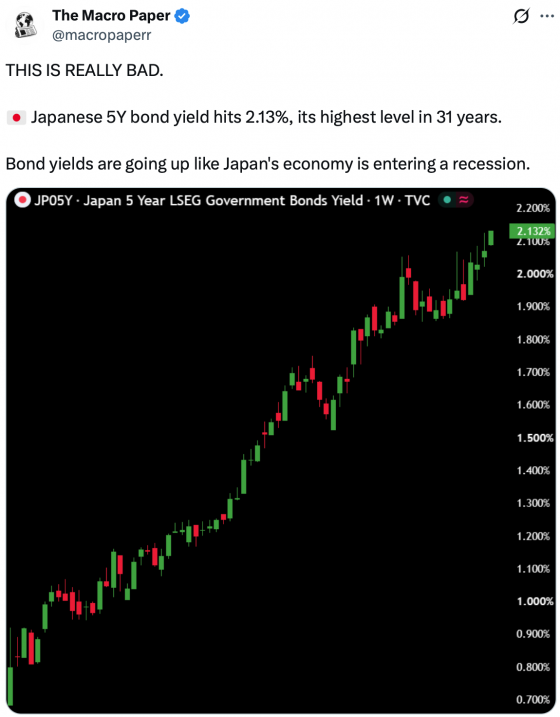
The yen carry trade is blowing up right in front of our eyes.
And so now major financial institutions in Japan are facing staggering losses…
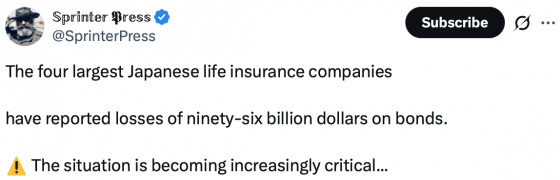
This is only the beginning.
The value of the yen is almost certainly going to continue to fall.
Japanese bond yields are almost certainly going to continue to go up.
And the pain will be felt all over the planet.
Earlier today, I came across a post on X that did a great job of explaining the magnitude of the crisis that we are potentially looking at…
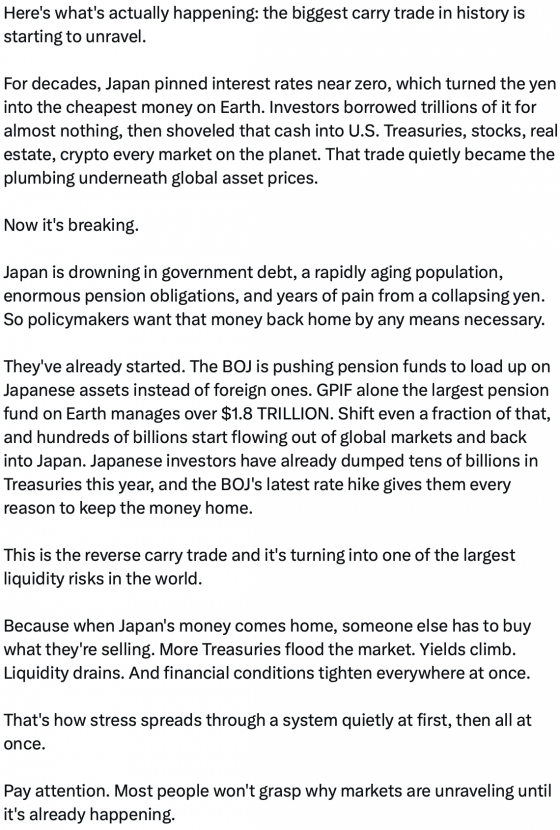
It would be difficult for me to overstate how serious this is.
During a recent interview with Greg Hunter, Jim Rickards warned that the unwinding of the yen carry trade is “the financial equivalent of all out nuclear war”…
Eight-time, best-selling financial author Jim Rickards is warning of a financial calamity already underway that Treasury Secretary Scott Bessent is trying to contain. It is the Japanese yen carry trade where the US Treasury is propping up the yen’s value. Is the yen carry trade coming to a halt and can it blow up things? Rickards says, “The answer is yes and yes. . .. Somebody wrote me and asked if the yen carry trade is a big deal? I wrote them back and said there is nothing bigger. This is actually the biggest story in the world.”
In simple terms, the problem is people have been borrowing at 0% in yen to do deals around the world. Everything was fine until interest rates in Japan started going up after more than two decades. Rickards says, “This is the engine of global economic growth. It has been powering the US economy and the global economy for over 30 years. What could go wrong? The thing that could go wrong the fastest is if Japanese interest rates went up. . .. The bank of Japan says it is going to keep raising interest rates. It’s not going to the moon, but 3% for yen (and Japanese) interest rates is like going to the moon when it’s been 0% for 20 years. So, now, the yen carry trade is unwinding. . .. The original borrower borrows dollars to pay back the yen loan, swaps the yen and pays back the yen loan. What if you can’t borrow? What if the bank says sorry, no soup for you. . .. Now, what do you do if you want to get out of the yen carry trade? You have to sell assets. So, you are going to sit there and make a lot less money or even lose money, or you are going to dump assets to get dollars to pay back the yen loan. They are both bad for the markets. It you have to sell assets, guess what? The price goes down, and other people have to sell assets. The next thing you know it’s a stampede, and everyone is running for the exit. This is not a few investment banks on Wall Street or a few hedge funds. This is the whole world getting out of the leveraged exchange rate engine that has been running the world for 30 years. That is the financial equivalent of all out nuclear war.”
As this crisis builds, it threatens to become an unstoppable tsunami which could end up ripping through everything.
Of course we are already witnessing some very serious trouble signs in U.S. financial markets.
Massive derivative losses have caused the stock price of the largest mortgage lender in the United States to utterly implode…
The already shredded stock of UWM Holdings, the parent company of United Wholesale Mortgage, the largest home-mortgage lender in the US with $40 billion in mortgage originations in Q2, plunged another 35% today, into penny-stock territory of $1.20 a share.
The company, which exclusively originates home loans through mortgage brokers, had gone public in January 2021 via merger with a SPAC that gave it a $16 billion valuation. It was the largest SPAC deal at the time and made CEO and founder Mat Ishbia a multi-billionaire. True to SPAC form, it has been a bloodbath for public investors ever since.
We aren’t talking about some Mickey Mouse operation.
This was the biggest mortgage lender in the entire country.
And then today we witnessed some very alarming forced liquidations of highly leveraged cryptocurrency positions…
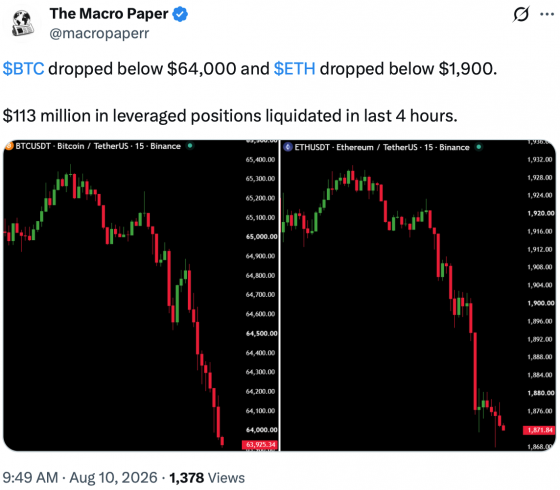
It is starting, and we can see the symptoms all around us.
For average Americans, harsh economic conditions are going to get even worse.
The size of the U.S. workforce has fallen by more than a million workers over the past year, and the cost of living has become extremely oppressive.
But these will be considered “good times” compared to what is coming.
It would greatly help if the Strait of Hormuz was reopened, but you can forget all about that now…
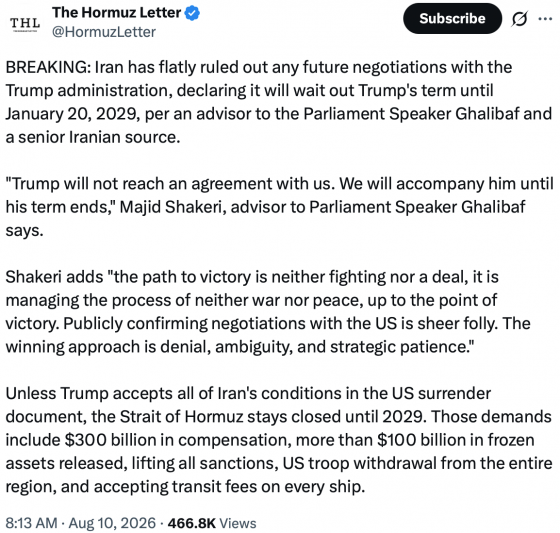
The only way that Iran will open up the Strait of Hormuz is if President Trump essentially throws up the white flag and gives the Iranians every single thing on their wish list…
-
Never threaten Iran with any language or insult the sanctities of this nation.
-
End the war and aggression against Iran and its allies in Lebanon, Palestine, Yemen, and Iraq forever.
-
Lift the naval blockade and withdraw its military forces (naval and air) from around Iran.
-
Pay the damages of the two wars of aggression and imposition on Iran without any reduction or reduction.
-
Lift the cruel and illegal sanctions against the Iranian nation.
-
Unconditionally release the frozen and stolen assets of the Iranian people.
Trump can never possibly agree to all of that.
In fact, he just responded to Iran’s demands by demanding that they pay reparations…
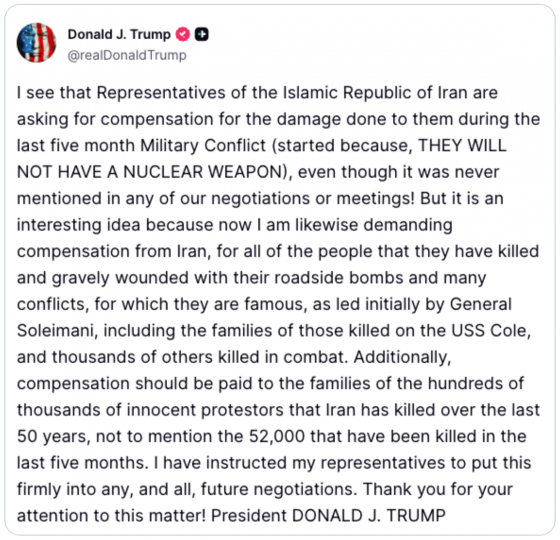
As I have been saying all along, there isn’t going to be a deal.
So the price of oil is going to go even higher, and our stockpiles are going to continue to get drained…
As negotiations between the US and Iran to reopen the Strait of Hormuz go nowhere, oil prices continue to slide lower on some naive hope that a resolution to the conflict will magically emerge. Meanwhile, both commercial and strategic stocks continue to be drained at a historic pace, and one day virtually every tank bottom will be hit, sparking a historic surge in commodity prices as the market realizes that physical always wins the war with paper oil.
That day just got closer today when the US reported that crude oil stocks in the Strategic Petroleum Reserve fell below 300 million barrels for the first time since early 1983, as global inventories are under pressure due to the Iran war.
The SPR fell by 6.1 million barrels to 298.7 million barrels last week, according to data released by the Department of Energy on Monday. The reserve is at its lowest level since January 1983.
The war in the Middle East is far from over, and the really painful chapters of the global energy crisis are ahead of us.
At the same time, a new global financial crisis is suddenly erupting in Japan.
We just keep getting hit by one thing after another.
All of the pieces of the puzzle are coming together all at once, and not in a good way.
Michael’s new book entitled “10 Prophetic Events That Are Coming Next” is available in paperback and for the Kindle on Amazon.com, and you can subscribe to his Substack newsletter at michaeltsnyder.substack.com.
About the Author: Michael Snyder’s new book entitled “10 Prophetic Events That Are Coming Next” is available in paperback and for the Kindle on Amazon.com. He has also written nine other books that are available on Amazon.com including “Chaos”, “End Times”, “7 Year Apocalypse”, “Lost Prophecies Of The Future Of America”, “The Beginning Of The End”, and “Living A Life That Really Matters”. When you purchase any of Michael’s books you help to support the work that he is doing. You can also get his articles by email as soon as he publishes them by subscribing to his Substack newsletter. Michael has published thousands of articles on The Economic Collapse Blog, End Of The American Dream and The Most Important News, and he always freely and happily allows others to republish those articles on their own websites. These are such troubled times, and people need hope. John 3:16 tells us about the hope that God has given us through Jesus Christ: “For God so loved the world, that he gave his only begotten Son, that whosoever believeth in him should not perish, but have everlasting life.” If you have not already done so, we strongly urge you to invite Jesus Christ to be your Lord and Savior today.
The post Is A Global Financial Crash Starting In Japan? appeared first on The Economic Collapse.