
An Alternative News Aggregator
News of the Day
“Glory to God in the highest heaven, and on earth peace to those on whom his favor rests.”
- Luke 2:14


Allie Beth Stuckey Launches a New Space for Christian Women and Moms
Allie Beth Stuckey is a Christian, wife and mother, bestselling author, podcast host, a leader to hundreds of thousands of Christian conservative women, and now the founder of a new app. In January 2025, speaking at a pro-life conference in Washington, D.C., she had an idea that after nearly two years of work has come to fruition: ana kate, a cycle and pregnancy tracking app that’s “unapologetically for women and for life.”
While she and her husband were thinking about baby number four, she thought about all of the apps she had used before that “are at very best ideologically neutral if you can find one of those, but usually hostile to the Christian worldview,” she told the Daily Signal.
She continued, explaining that many of the apps on the market “will tell you how to obtain an abortion,” and “give you very sterilized, euphemistic language for what actually happens in an abortion.” Some of the most popular apps are pro-LGBTQ and “use gender neutral language like pregnant person, person with a period,” she said.
“A lot of them are working in cahoots with Planned Parenthood and LGBTQ organizations to push that very specific worldview,” Stuckey continued.
Her question: “Why do women, Christian women, in the most intimate and joyful, sometimes confusing times of our lives, like why do we have to be the ones to jump through all of these language hoops, and even to wonder are these apps scientifically accurate?”
This is what led her to create ana kate, a space and a home for Christian women to go to that is “unashamed in defining a woman, loving babies, and offering biblical encouragement and community.”
With scientifically backed tracking, a Christian community and prayer board, and direct access to like-minded practitioners, users can seek medical advice, spiritual comfort, and community.
While Stuckey brought the idea and the concept, she sought guidance from like-minded technological experts, engineers, and practitioners to bring her vision to life. She stressed to the Daily Signal the importance to her that it was created entirely by real people.
“I wanted to make sure that all of this stuff is scientifically, medically accurate,” she said. That is why she reached out to experts, including the American Association of Pro-Life Obstetricians and Gynecologists, AAPLOG, to share their wisdom and insight for a “longstanding alliance.”
“I’m just very thankful that we have so many that have been willing to lend their feedback and insight over the past two years,” she told the Daily Signal.
One of her favorite features is the prayer board.
“I think that this is not just unique, of course, for cycle tracking apps, but it’s just unique in general that there is this world of like-minded women who are sharing very vulnerable things, if they choose to,” she said.
Users can, if they choose, submit prayer requests to the ana kate community. If you pray for someone, you can let them know, then you get notified on updates and are “able to praise God with that person,” she said.
“We know as Christians, the Book of James says the prayer of a righteous person has great power as it is working. And so, this is a really powerful forum that I can’t take credit for. It’s really just bringing together the faithfulness of so many Christians who are willing to bear one another’s burdens, and I love that we got to include that in this app,” Stuckey said.
Another feature is a directory of practitioners of all kinds, from doulas to midwives, chiropractors, nutritionists, biblical counselors, and OB-GYNs. Users can connect with women’s health professionals to meet via telehealth or in person in their area.
“We’ve already heard from many practitioners that they’ve gotten clients from the app, which is amazing because it’s only been out a couple weeks,” Stuckey told the Daily Signal.
“We want there to be hundreds of practitioners from every field who are represented on this app, so that women can have so many options in their area, and that’s growing,” she continued.
The app already has over 10,000 downloads and was No. 6 on Apple’s Health & Fitness chart on Apple’s App Store.
The Consequences of Gen Z’s Risk Aversion
Will Gen Z’s well-documented risk aversion mean fewer American babies?
A new study looks at what cultural factors do and don’t impact fertility rates—and found that “people with more willingness to take risks also intend to have more kids.” The data also shows that “where people are more willing to take risks, fertility is higher.”
“Caution, anxiety, and safety-ism seem to be a key limiting factor on fertility,” notes the new “Baby Nudges” study, produced by the Institute for Family Studies and the Wheatley Institute.
That’s not good news for the United States, where the number of births has plunged since 2007, when women were averaging 2.1 births. Now, women average 1.6 births.
And while Gen Z may follow trad wives with big families on social media, it’s not looking promising for many of them to adopt a similar family size themselves.
Gen Z—which currently includes those aged 14 to 29—isn’t exactly known for embracing risks.
“Young people … see a world that is fraying and deeply unsafe,” writes Gabriel Rubin, a Montclair State University professor who interviewed dozens of Gen Z adults. “To Gen Z, risk is everywhere and the world is a scary and grim place.”
You could argue that any young adult, with their future unknown, can find plenty to fear. But the reality is Gen Z is unusually risk averse, even compared to young adults in prior generations.
In 1991, about half of U.S. eighth and 10th graders agreed that they like to take risks sometimes or they get a kick out of doing dangerous things. By 2021, under 40% of eighth and 10th graders agreed about getting a kick out of doing dangerous things, and only a third said they like to take risks sometimes, according to a Monitoring the Future study cited in “Generations” by Jean M. Twenge.
There are already signs that the risk-averse mindset might be affecting how Gen Z approaches adulthood. For one thing, Gen Z was less interested in getting driver’s licenses: 40% of 15- to 19-year-olds had licenses in 2022, compared to 48% in 2000, reported USA Today.
Teens are “less likely to have ever tried alcohol. They’re less likely to have a paid job, to go out on dates, to go out without their parents,” Twenge, a psychology professor at San Diego State University, told Texas radio station KERA in 2023.
That risk aversion is also affecting relationships: “human connection comes with a high level of risk,” wrote Freya India, who is herself Gen Z, in an essay entitled “Risk-Aversion Is Killing Romance.”
“A recent survey found that almost 45% of men aged 18 to 25 have never approached a woman in person. Another Pew Survey found that half of single men between 18 and 30 are voluntarily single, which some suggest is in part because of fear,” India wrote.
Does this sound like a generation that’s going to embrace having babies?
Hardly.
That’s already the case: “Just a quarter of Gen Z women had at least 1 child by 26 compared to 45% of Millennial women,” writes Dan Hess, who authors the “More Births” substack, citing 2026 research released by the Federal Reserve Bank of Atlanta.
If you’re thinking optimistically, it might just be that Gen Z women want to be older when they have children. But think again. “Gen Z women … are dramatically less likely to want children than all three of the previous generations,” notes a September Atlanta Fed paper, comparing Gen Z to Millennials, Gen X, and Baby Boomers.
It’s not the first time Gen Z has shown less interest in becoming parents. About half of 12th graders in 2023 were “very likely” to want children if they married, down from 64% in 1993, according to a Pew Research Center analysis.
But could this generation still pivot?
I’m a Millennial, but I can relate to some of Gen Z’s attitudes. I only got a driver’s license at 17 thanks to my parents’ pushiness—and my dad patiently tooling around empty parking lots on weekends with me until I was ready to go out on the road.
I didn’t have my first child until my late 30s because I met my husband later in life. And yet, even though our baby was very much wanted, I was also terrified. Now several months in, I know that my fears were both realistic—and absurd. It may not give me more sleep, but somehow, fortified by seeing my son’s gummy smile and bright eyes, I just make it all work.
And there are real cultural influences that can encourage people to have kids, according to the “Baby Nudges” study. If you admire a celebrity with a family bigger than yours, you’re 14% more likely to want to have a child or have another child.
“Stranger Things” actress Millie Bobby Brown, who is 22 and the mother of two children with her husband, Jake Bongiovi, may encourage others in her generation to have kids.
“It’s been a beautiful, amazing journey—she’s taught us so much already,” Brown told British Vogue in 2025 after the couple adopted their first daughter.
“Our days are filled with lots of cuddles and laughter and love. It’s just endless joy.”
But celebrities aren’t the only factor at play here.
Want grandkids? Telling your adult kids so makes them in turn more likely to intend to have a baby or another one. Religiosity also has an impact: “The most diligent religious attenders not only desire more children but actually have more children,” notes the “Baby Nudges” authors.
There’s also a contagion factor. I’ve certainly been grateful for the counsel and solidarity of my friends who already had kids—and it turns out I’m far from alone in that scenario. “Believing one’s friends would celebrate a new baby is associated with a 10% increase in desired number of children and a 20% increase in the likelihood of intending to have another child,” states “Baby Nudges.”
It’s important to know how this trend could be reversed—because the current scenario isn’t good for the United States. A shrinking population presents all kinds of economic and societal challenges, and currently, the U.S. is on course to have its population start shrinking after 2056, according to the Congressional Budget Office.
Sure, that’s 30 years in the future, but the only reason the population shrinking won’t start sooner is because of immigration. CBO projects that deaths will exceed births starting in 2030.
And even aside from economic and societal difficulties, what does it say about our American culture that we aren’t having kids, that we aren’t wanting to share our wonderful existence with more? Talk about a sign of malaise.
The good news is we can reverse. But doing so will require Gen Z to get a lot more comfortable with risks.
Faith Amidst Midterm Elections
Summary
- Elections matter, and it’s easy to become stressed around Election Day.
- When we feel anxiety about the future, we must turn to God.
- God wants us to bring our worries to Him in prayer, especially during difficult times.
These are stressful times for the American people. Election season tends to be that way.
Elections matter, and Americans are blessed to live in a country where we are guaranteed the right to vote for our representatives.
If you love your country, you want to see it flourish, and there are probably candidates you believe will hurt it. That is frightening. At the end of the day, though, not every race across the nation will go the way that you want it to.
But the question we must all ask ourselves is this: Does the uncertainty of the midterms—or any political venture—control me?
When we feel stress and anxiety about the future, we must turn to God. Whether it is worries about the midterms, our family, finances, health, or anything else, unbridled anxiety without hope can be crippling.
Ultimately, any desire to have absolute control over the future is a facade. We can and should work hard to bring about justice and healthy change in our government, families, and communities. However, so long as we are doing our part, all we can do is entrust the results to God and tag along for the ride. Fear of what could be does nothing good.
For this reason, Jesus preached to the crowds: “Come to me, all you who labor and are burdened, and I will give you rest. Take my yoke upon you and learn from me, for I am meek and humble of heart; and you will find rest for yourselves. For my yoke is easy, and my burden light” (Matthew 11:28-30).
The “yoke” was the wooden harness for oxen in Jesus’ time used for plowing purposes. Every ox was paired with another one to work together in the fields. Jesus, then, wants us to take up His yoke so that He can help us complete the work to which we are called.
He will not take every single challenge or uncertainty away from our lives. But He will help us in our struggles, working with us and supporting us. Through it all, He carries the weight of our lives and of our fears with us. He seeks to take the burden and reveal loving care that can bring us through anything.
The purpose of God becoming one of us was manifold, but one of the most important reasons was for us to know that we never have to lose hope. No one suffers alone. God took on flesh, suffered, died, and rose from the grave. There is no situation that He cannot renew.
On this celebration of All Saints Day, we can learn from the words of two important saints regarding fear of the future. The first is St. Francis de Sales, who said, “Do not fear what may happen tomorrow. The same understanding Father who cares for you today will take care of you then and every day.”
This is tied to the words of Jesus, “Can any of you by worrying add a single moment to your life-span?” (Matthew 6:27). Stress about what will happen, which is out of our control, is literally useless. What never fails, however, is prayerful trust.
Prayer, intentional communication with God, unites us to the One who is the source of our existence. Denying that He will always provide for us simply breeds more stress. Clinging to prayer and asking for peace amidst what we cannot control is the best preparation for entering into the unknown.
The words of St. Teresa of Avila can aid our worrying souls. She said: “Let nothing disturb you, let nothing frighten you, all things are passing away: God never changes. Patience obtains all things, whoever has God lacks nothing; God alone suffices.”
Prayer will lead us to deeper trust. This trust grounds us in an unshakable patience. It allows us to see with the vision of God, who remains beyond, but in control, of all of the worldly affairs of this life. So, in uncertain times, cling to faith. Be a person of deep prayer who patiently trusts that God will always reign victorious, no matter the (election) season.
We publish a variety of perspectives. Nothing written here is to be construed as representing the views of the Daily Signal.
Victor Davis Hanson: The Ukrainian Gordian Knot
After crossing with his army into Asia, Alexander the Great stopped at Gordium (in modern-day Turkey). He approached the famous Gordian knot—a tangled mass of bark tying an ox cart to a pole, so intricate and tight that no one could unravel it. When told that anyone who could untie the mess would rule all of Asia, Alexander simply pulled out his sword and cut through it—solving the problem and fulfilling the prophecy.
The Ukraine war may be our Gordian knot, but—in our current nuclear age—it is dangerous to cut rather than unravel it.
A European Stalingrad
No one knows exactly how many people have been killed in the Ukraine war, which has now lasted four years and eight months—longer than World War II in the Pacific, the American Civil War, or World War I. There is still no end in sight. Estimates of the human toll vary widely, since it is in the interest of both sides to exaggerate the losses of the enemy while under-reporting their own casualties.
Nonetheless, most sources agree that more than half a million have died. Other estimates put the total fatalities closer to 1 million. At least another million and a half have been wounded or are missing. Some calibrate well over 30,000 total civilian deaths, the overwhelming majority of them Ukrainians. On average, well over 1,500 Ukrainians and Russians are being killed or wounded each day.
To outside observers, the war appears different from most other current armed conflicts, in which religion or ethnicity is the cause, or at least the force multiplier, of the conflict. Despite Ukrainian political independence, both sides are ethnically similar and—when it comes to almost half of Ukraine’s prewar population—linguistically identical. Both sides are indistinguishable in superficial appearance. Both are predominantly Orthodox Christian. They fought alongside each other in World War II and often shared a common history.
In February 2022, Russian President Vladimir Putin planned to decapitate Ukraine with a lightning strike on Kyiv, thereby bringing the entire country within days into his envisioned new Russian empire. That operation, reminiscent of the “Thunder Runs” to capture Baghdad in 2003 with a shock-and-awe wave, utterly failed in the face of remarkable Ukrainian courage and savvy.
What followed, however, has become even more nightmarish than the death cauldrons at Verdun or Stalingrad.
A Slaughterhouse War
Ukraine’s economy is ruined. A fourth of the population has been displaced. Perhaps 15% has fled abroad. The Zelenskyy government relies on Western aid and the heroism of its troops for survival. The latter has established a nearly impenetrable line of defense in the contested Donetsk Oblast, one of the richest and most urbanized regions of Ukraine.
If the Russians were to break through that line, there would be little left to stop them from marching on Kyiv, and thus little to prevent the collapse of Ukraine’s entire resistance. Yet for now, the Russians, in tragically ironic fashion, are playing the role of the trapped German aggressors at Stalingrad: a hemorrhaging army that can no longer advance and won’t retreat.
But as we approach the end of the fifth year of this insane war in late 2026, the Ukrainians—now with roughly one-fifth of Russia’s population, one-twelfth of its gross domestic product, and one twenty-eighth of its area—are starting to run out of men, money, and support. Ukraine’s last chance of salvation is to keep sending its vast drone fleet—brilliantly created all but ex nihilo—against Russian industrial targets, especially fuel refineries.
Russian strategy, by contrast, aims at hitting more civilian targets in Ukraine to kill enough noncombatants to demoralize the population.
The longer the war drags on, the more Russia—its military humiliated, its oil-exporting economy under strain, its losses staggering—grows desperate and dangerous, as its image as a major power erodes further. As a result, Russia hopes to stop European aid to Ukraine by quietly sending “mysterious” drones over European nations—nations Putin despises for their humanitarian affectations and military weakness.
The Russians seek to counter American aid through a renewed partnership with America’s chief rival, China; by stealthily aiding Iran with intelligence, satellite reconnaissance, and smuggled weapons; by hoping that soaring global fuel costs will demoralize the American public on the eve of the midterms; and by making wild threats of nuclear and conventional attacks against the entire NATO alliance.
A Fragmenting West
The war has certainly further deepened the long-standing divisions between the United States and Europe, which transcend President Donald Trump’s occasional furor at Europe and Europe’s own bouts of Trump Derangement Syndrome.
The U.S. is seething at European calls for additional transatlantic solidarity. The U.S. has already provided Ukraine with well over $100 billion in total logistics, weaponry, reconnaissance, and economic aid to prevent Russians from pouring into European countries, but such help has not been matched by the Europeans when it comes to stopping a nuclear Iran.
For decades, European leaders have warned that a nuclear-armed Iran would pose an existential danger. But European denial of dual-use NATO bases to the American military, the prohibition on even flying Middle East-bound U.S. military or logistical aircraft over several European nations, and the constant rhetorical attacks on the American military effort to stop an Iranian bomb are all starting to fragment the alliance’s support for Ukraine.
Europe sees the future of the West as hinging on stopping Russian aggression. The U.S. may agree but sees an unhinged nuclear Iran as an even greater danger. Europe is peeved that Trump is ending fuel sanctions against Russia to lower sky-high global diesel prices. America is even angrier that green and vehemently anti-Russian Europe has been the chief buyer of Russian natural gas since the war began. And on and on the acrimony goes.
It does not help that the framing of the war as European democracy against Russian totalitarian aggression is undermined somewhat by the desperate Zelenskyy government’s banning of allegedly pro-Russian political parties, restrictions on opposition media, and suspension of scheduled elections. Such suspension of elections is something that the U.S. never entertained during the darkest days of World War II. Winston Churchill was voted out of office even as the war in the Pacific raged on.
Adding to the mess, Europe is itself in crisis.
France and Italy have been aflame for weeks. The rioting and upheavals have no easy solution. Native students, socialists, communists, and anarchists have been joined by first- and second-generation immigrants (mostly Muslims from the Middle East and Africa) in calling for more government expenditures for social causes—or else. But a dangerously indebted France already spends nearly 60% of its budget on social welfare programs of some sort.
Suicidal European energy policies have nearly wrecked the once robust European economy. Despite having 100 million more citizens, the EU has a GDP that is $10 trillion smaller than America’s. And NATO’s European members—until recently de facto unarmed—are scrambling to increase their military budgets beyond a meager 2% of GDP.
In short, Europe’s problem is not a dearth of redistributive social welfare programs but an inert economy that cannot even afford its present welfare generosity.
Worse, Europe’s borders are still mostly open. Dismal European fertility ensures an aging and shrinking indigenous population. Meanwhile, the growing immigrant population remains poorly assimilated, poorly integrated, and poorly acculturated to European values—and increasingly angry at its magnanimous hosts.
When or How Will It All End?
So, given these dismal facts, will this horrific war ever end?
There are lots of scenarios for a conclusion to the madness, but most are either unlikely or terrifying.
1) After nearly five years of frightening human costs, economic ruin, and global ostracism, Russia could agree to an armistice based on the status quo of the current battlefront. It would keep Crimea and its eastern Ukrainian acquisitions. It could thus claim victory before its disenchanted population. Ukraine would also be able to declare victory for stopping the Russian colossus from pushing farther into the country.
Ukraine would not join NATO. But during the peace, it would arm itself to the teeth. Ukraine would fortify its new eastern border to deter further Russian aggression, given that Putin’s ultimate agenda is to absorb all the former Soviet republics either by outright conquest or through puppet governments, and so to claim a status like Peter the Great’s by restoring millions of new “Russians” to the current shrinking Russian Federation. This conclusion would not please either side or its allies. And therefore it might be the only realistic way to stop the slaughter.
2) Ukrainian elections might result in a coalition government willing to negotiate a more generous settlement for Putin. The war would end, but with an even greater Russian threat to Ukraine and the rest of Europe than either faced before the war.
3) The unsustainable human and economic costs of the war could result in a coup removing Putin and installing a more realistic oligarchy that would negotiate a peace and blame the deposed Putin for the catastrophe. Putin’s political longevity so far (now well into a third decade in power, having survived a number of existential political crises) makes this notion unlikely.
4) A hollowed-out Russian military could finally collapse, allowing Ukraine to advance to its pre-February 2022 borders.
5) A strapped Ukraine, with its European allies under economic and social strain and the United States occupied with Iran, simply collapses. Russia then annexes most or all of the country. Or perhaps Putin sympathizers win an election, seek to capitulate, and hand over the rest of the country, along with Crimea and the Donbas, to Russia.
6) The war could simply drag on for years, resembling the bella interrupta of the Middle East.
Strange War, Stranger Reactions to It
Finally, there is something surreal about the politics of the Ukraine war. Almost no one is talking about either its catastrophic human costs or the concrete details of how it might end.
Western campuses are silent about the bloodletting. Yet we witnessed violent demonstrations damning Israel for “genocide” and calling on us to “Free Palestine”—even though the death toll following Oct. 7 represents only around six months’ losses in Ukraine. Meanwhile, some on the ultraright who damn Israel’s “aggression” are openly supportive of the Russian invader.
The supposedly antiwar Left talks only of more arms for Ukraine, without any real agenda for how Ukraine can win or stop the slaughter.
Any talk of Western negotiations with Putin is declared proof of appeasement or collaboration, even though the Obama Left gave us the “Russian reset” of 2009 as what it claimed was the only sensible way to deal with the prior Russian invasion of Georgia.
The Right, too, damns the idea of Trump meeting with Putin, even though Ronald Reagan met with the Soviet dictator when the USSR had thousands of nuclear weapons targeting the United States.
After Oct. 7, the West pressed Israel constantly on issues of “proportionality,” “negotiations,” and “collateral damage”—not to mention new elections—but such vocabulary is absent from discussions of the far more lethal Ukraine war.
In sum, someone had better start thinking of ending this godless war before something or someone else far scarier ends it for us.
(C)2026 Tribune Content Agency, LLC.
We publish a variety of perspectives. Nothing written here is to be construed as representing the views of the Daily Signal.
Progressives’ Embrace of Socialism Portends Chaos and Decline
As Americans see chaos and rioting on the streets of Paris, we are not immune to that happening on streets across America.
For decades, France has provided “free” health care, paid family leave, free childcare, free preschool, generous unemployment and housing benefits, and heavily subsidized higher education. This has bred a culture of entitlement and an insatiable desire for the government to do more, while many demand to work less—if at all.
As the government subsidizes these sectors, the price of goods and services rises. More housing aid and blocked building permits cause rents to rise, which precipitates a demand for the government to impose rent control. That diminishes housing supply and the spiral continues. Education subsidies prompt universities to raise tuition; students then take to the streets to protest the “injustice” of unaffordable housing, education, and other services.
France has one of the world’s highest tax burdens, yet they have an enormous public debt. The International Monetary Fund estimates that France’s gross domestic product in 2026 will be a mere 0.4%, compared to 2.3% in the United States.
What France is doing is unsustainable, and if Americans elect candidates who embrace that kind of socialist agenda, it won’t be long before we reap the whirlwind.
On election night in 2025, New York City mayoral candidate Zohran Mamdani began his victory speech by quoting Eugene Debs, one of the most prominent socialists in 20th-century American politics. Mamdani’s speech reflects the growing embrace of socialism among Democrats and young people more broadly.
An August 2025 Gallup poll found that 39% of Americans have a positive opinion of socialism and, for the first time, less than half of Democrats (42%) have a positive view of capitalism. A March 2025 Cato Institute/YouGov poll found that 62% of Americans aged 18-29 have a “favorable view” of socialism.
Democrats’ embrace of socialist candidates is not isolated to liberal enclaves such as New York City. In 2026, they have nominated socialist candidates across the country—even in states such as Michigan, Florida, and Oklahoma.
In 2025, congressional Republicans and President Donald Trump enacted the One Big Beautiful Bill/Working Families Tax Cuts Act. This legislation stopped a $1,700 tax increase on families and provided an additional $600 tax cut. It increased the child tax credit to $2,200 and increased the standard deduction by $1,500 per family to $31,500.
The bill delivered no tax on tips or overtime pay, and tax relief for seniors. It established savings accounts for America’s children and provided $1,000 at their birth and tax credits for contributions to K-12 scholarship granting organizations.
Republicans made small business tax relief measures permanent, helping them create new jobs and stimulate GDP growth. They also ended tax credits for illegal immigrants with new Social Security number protections.
While almost all Republicans voted for this bill, every House and Senate Democrat voted against it. Many Democrat candidates are now attacking this measure and calling for massive new increases in government spending.
The Democratic Socialists of America plans to press hard for its platform if Democrats win majorities in the congressional elections. The Cato Institute estimates that the DSA proposals would cost between $71 trillion and $212 trillion over a decade.
As socialists’ foothold in Democrat politics grows stronger, they are pushing the party further down the path toward the chaos and decline we are seeing in France. America has an opportunity to choose freedom and personal responsibility over government control and a culture of entitlement—but only if we vote accordingly by Nov. 3.
COPYRIGHT 2026 CREATORS.COM
We publish a variety of perspectives. Nothing written here is to be construed as representing the views of the Daily Signal.
What Democrats Would Do to America
Seven years ago, Rep. Hakeem Jeffries, D-N.Y., who is now the Democrat leader in the House of Representatives, signed on as a co-sponsor to a bill that would have prohibited preventing biological males from using women’s restrooms and locker rooms.
Titled the “Equality Act,” it stated that “an individual shall not be denied access to a shared facility, including a restroom, a locker room, and a dressing room, that is in accordance with the individual’s gender identity.”
“The term ‘gender identity,'” said this proposed law, “means the gender-related identity, appearance, mannerisms, or other gender-related characteristics of an individual, regardless of the individual’s designated sex at birth.”
At the time, Jeffries was joined by 236 other House Democrats in cosponsoring this bill, which passed the House on May 17, 2019, by a 236-173 vote. It went nowhere in the Republican-controlled Senate—but Jeffries and his Democrat colleagues did not give up on this cause.
On June 15, 2022, he joined Rep. Katherine Clark, D-Mass., in sending a letter to Rep. Zoe Lofgren, D-Calif., who was then chair of the House Administration Committee. This letter urged her to support creating transgender-friendly restroom facilities in the Capitol and House office buildings.
“All employees, interns, and visitors should have access to safe and comfortable restrooms,” Jeffries and Clark wrote. “For members of the transgender, gender nonconforming and disability communities, that often means the availability of single stall or single-occupancy restrooms.”
“As such,” Jeffries and Clark wrote, “we ask for further examination of this issue and for your facilitation in installing additional restroom facilities to better accommodate those who work or seek to work in the House of Representatives.”
The 2024 Democratic Party Platform celebrated this party’s transgender agenda. Former President Joe Biden, it said, “reversed [President Donald] Trump’s un-American ban on transgender servicemembers,” “has protected transgender Americans’ access to health care and coverage, including medically necessary gender-affirming care,” and “is fighting book bans that censor LGBTQI+ content.”
It also celebrated the Democratic Party’s commitment to killing unborn children—or what they call “reproductive rights”—and forcing American taxpayers to pay for the killing of those children.
“Democrats are fighting back to restore reproductive freedom for every woman in every state,” said their platform.
“We will repeal the Hyde Amendment,” it said.
The Hyde Amendment was initially enacted into law in 1976 and has been renewed every year since then; it marked its 50th anniversary in September. It prohibits federal funding of abortions. If Democrats were to succeed in repealing the Hyde Amendment, every American who pays taxes would be forced to pay for the deliberate killing of innocent human beings.
On June 24, 2025, Jeffries joined 208 other House Democrats in co-sponsoring what they call the “Women’s Health Protection Act.” This bill, according to its official summary, “prohibits governmental restrictions on the provision of, and access to, abortion services.”
Another part of the 2024 Democratic Party Platform attacked Trump’s tax cuts. “In 2017, he enacted a reckless, unpaid-for tax cut that overwhelmingly benefited the very wealthy and biggest corporations,” it said. “It was full of outrageous giveaways, including a massive tax break for the wealthiest 0.1 percent.”
“The law had no impact on the average American’s income—only boosting wages for those in the top 10 percent,” it claimed. “Trump’s allies claimed it would pay for itself, but it instead exploded the federal deficit by $2 trillion.”
In fact, the 2017 Trump tax cuts, which the Republican-controlled Congress made permanent last year, cut the federal income tax rate for people making as little as $9,526 per year. As the Heritage Foundation noted, the standard deduction was “almost doubled.”
“The expanded deduction,” said a Heritage Foundation analysis, “simplifies tax filing by cutting the percentage of tax filers who will need to itemize their deductions in half. Approximately nine of 10 taxpayers will simply claim the new standard deduction.”
As this column has noted before, federal tax revenues have significantly increased under the Trump tax cuts, climbing from approximately $3.314 trillion in fiscal year 2017 to approximately $5.403 trillion in fiscal year 2026, according to the Treasury. The federal deficit increased not because tax revenues declined but because federal spending skyrocketed, climbing from approximately $3.980 trillion in fiscal year 2017 to approximately $7.395 trillion in fiscal year 2026.
During the Biden years, the number of illegal aliens encountered at the southwest border also skyrocketed. In fiscal 2020, the last year of the first Trump administration, U.S. Customs and Border Protection encountered 458,080 aliens attempting to illegally enter the United States at the southwest border, according to the Department of Homeland Security. By fiscal year 2022, under the Biden administration, that had climbed to 2,378,940. In fiscal year 2023, it was 2,475,669. In fiscal year 2024, it was 2,135,005.
Then, in fiscal year 2025, it dropped to 443,671; and, in the first 10 months of fiscal year 2026 (October 2025 through August 2026), it was just 128,009.
Were Democrats to take full control of the United States government by January 2029—with Jeffries as speaker of the House—they would seek to make it illegal to stop a biological male from entering a women’s restroom or locker room. They would try to make the killing of innocent unborn babies legal throughout the land. They would increase taxes and spending.
And they would be unlikely to secure our southern border any better than Biden did.
COPYRIGHT 2026 CREATORS.COM
We publish a variety of perspectives. Nothing written here is to be construed as representing the views of the Daily Signal.
The Elitist Media Are Terrible Guardians of Democracy
Summary
- Even the shallowest consumption of elite media “news” betrays their very politicized and results-oriented approach.
- The latest example is the treatment from CNN and the like of the revelation of direct involvement in the “sham” Dan Sullivan campaign in Alaska.
- They are not guardians of democracy, as they claim, but guardians of Democrats.
Whenever the elitist media come under attack as “fake news” from President Donald Trump, they pretend that this is a battle between the heroic guardians of democracy and this tragically elected authoritarian. They pretend to represent a Civics 101 definition: the press serves to hold all government actors accountable and gives voters the facts they need to make important voting decisions.
Our media don’t resemble that picture at all. They routinely fail to hold Democratic Party officials accountable, because they don’t want to damage their political standing. They often go overboard in describing the Republican Party as a nasty pack of thoroughly corrupt autocrats, liars, cheaters, morons and hypocrites because they’re intensely interested in damaging their political appeal.
Facts aren’t stubborn things in their reporting. They’re very malleable, carefully manipulated for political effect. Trump’s shambolic/hyperbolic communications style makes them lean inevitably into an arrogant assumption that they’re for Facts, and Republicans are not. The so-called independent fact checkers follow suit.
This is why there is so little trust in the media. Even the shallowest consumption of their “news” betrays their very politicized and results-oriented approach.
If the media were truly nonpartisan guardians of democracy, both parties would offend their sensibilities. Take the issue of non-citizens voting, which is illegal. Journalists do not approach this as corruption that undermines the honest functioning of democracy. Journalists approach in their reflexive anti-Trump instincts, that it’s a phony issue, that it is so “incredibly rare” that it’s like it never happens. Shouldn’t they support attempts to keep voter rolls honest, so the votes of citizens aren’t canceled out? Instead, they suggest it’s dangerous that anyone’s looking into it.
Consider the case of “Decoy Dan” Sullivan in Alaska, a conspiracy by the Democrats to spoil the chances of Republican Sen. Dan Sullivan by adding a candidate with the same name. Very late in the game, The New York Times published a report underlining that Democrats conspired to find many Dan Sullivans to confuse voters into defeating the incumbent Republican. The Democrats denied reality.
Republicans smelled a partisan dirty trick from the get-go, but it took this long for one elitist media outlet to break the story. Before that, these so-called guardians of democracy didn’t take offense. They found it an occasion for levity. There were giggles underneath the story on CNN and MS NOW and NBC, where they replayed their late-night host Jimmy Fallon making comedy out of the dirty trick.
But four years ago, when Florida Republicans put an “Alex Rodriguez” on the ballot to confuse voters against a Democrat state senator named Jose Rodriguez, these same national media outlets repeatedly attacked the “sham candidate.” They don’t oppose this tactic on every occasion, like a true guardian of democracy. It all depends on which party benefits.
After the Times expose was published, these networks shamelessly suggested this wasn’t really offensive, with CNN’s Dana Bash leading viewers through the spins that it’s “not illegal” and it’s “not new,” while Trump is trying to “undermine the election.” If it’s something Republicans could “pounce” on, it’s suspicious, regardless of the facts.
Going back half a week, CNN’s Bash and CBS’s Margaret Brennan hammered Attorney General Todd Blanche on their Sunday shows about the supposed election interference of a lawsuit to allege election fraud if Sullivan lost the election. The scandal was that anyone was offended by Decoy Dan and tried to interfere with the prank.
It’s not hard to figure out. The media aren’t Guardians of Democracy. They’re Guardians of Democrats.
COPYRIGHT 2026 CREATORS.COM
We publish a variety of perspectives. Nothing written here is to be construed as representing the views of the Daily Signal.
The Fight Against ESG Is the Fight Against Cultural Marxism
Summary
- ESG and stakeholderism sought to take ideological control of American business.
- The fight against ESG has succeeded far more than expected.
- Recent debanking revelations show that the underlying threat remains.
This is a story I’ve told before, but it’s worth telling again, in light of recent news.
Exactly seven years ago today, I sat in a room full of people who had, in my estimation, the power to decide the fate of Western civilization.
If that sounds a little hyperbolic, well, maybe you’re right. Or maybe you’re not. Read on …
For the previous quarter-century, I had been a political research analyst and forecaster for the financial services industry. Essentially, my beat was the intersection of Washington and Wall Street. For a couple of years, I had noticed a new, more pernicious dimension to that intersection, whereby Wall Street was trying to direct the discourse in Washington, reversing the usual pattern.
The more I learned about this inverted arrangement, the more I saw it as a threat, not just to free and fair capital markets, but to American business more broadly and, in turn, to the economic foundations of the nation.
To be clear, I didn’t learn it all on my own. I had help—a lot of it, most of which came courtesy of the one person who had been the most visible and persistent in fighting back against this phenomenon. His name is Justin Danhof.
At the time, he was the director of the Free Enterprise Project at the National Center for Public Policy Research. Today, he is the director of policy at the Labor Department’s Employee Benefits Security Administration and the acknowledged expert on these issues in the Trump administration. As for the name of “these issues,” they’re mostly called “stakeholderism,” or ESG—environmental, social, and governance investing—and in 2019, they were ascendant in the financial world.
By now, much of the political world and all of the financial world know about ESG. You can’t throw a rock in Washington or New York without hitting an ESG “expert.” Back then, however, it was a niche topic, albeit one with serious potential consequences.
I spoke with Justin several times about his work filing shareholder proposals and engaging with companies, trying to get them “back to neutral” and to help them focus on business over politics. He was savvy, diligent, and resourceful. But he was also outnumbered—dramatically—as well as out-funded—several times more.
After I put him on a call with my clients, seasoned asset and wealth managers, we both realized that we were witnessing a stealthy effort to change how corporations operate and to change how policy decisions are made in this country.
Not only were the big players attempting to compel companies to sacrifice shareholder returns to push environmental and social agendas, but they were trying to sidestep the electorate to create a de facto political regime that was answerable to no one, save the top rungs of the financial elites: the biggest asset managers and their allies.
Even worse, they were accomplishing all of this without raising alarms among their peers in the financial world. Most of my clients, longtime and very successful investment professionals, were aware of ESG and its emergence in financial circles, but almost none were aware of its pervasiveness and its ultimate noxiousness.
We had to change that. We had to make people understand what was happening, how it was happening, and why it was so potentially destructive.
On that day seven years ago, Halloween 2019, two critical things happened. First, Justin and I sat down in a conference room at a large political conference, and we made our pitch to potentially allied think tanks, potentially sympathetic media organizations, and most importantly, potential donors. Now, when I say that “we” made our pitch, what I mean is that Justin made the pitch and I sat there, watching him hold the room in rapt attention.
The story he told was simple. The political Left had, since the end of World War I, shifted its focus away from pushing the “workers of the world” to unite and launch a revolution, and toward capturing the institutions of cultural transmission that had heretofore prevented the workers of the world from recognizing their supposed self-interest and undertaking that revolution. The Left had captured almost all of those institutions: mainstream religion, education (including higher education), news media, and entertainment. The only institution left standing was business, and it too was under attack. ESG/stakeholderism was the Left’s attempt to finish the job and to take ideological control of business, that last holdout institution.
Not long after that meeting ended, I received a call from Roger Kimball, the editor and publisher of The New Criterion and the publisher of Encounter Books. He told me he thought the book I’d proposed would be interesting and could sell a few copies. “If nothing else,” he said, “it already has a great title”: “The Dictatorship of Woke Capital.”
The book, like our presentation, made the case that ESG and stakeholderism represented something far bigger than a new business and investment strategy. They were an existential threat to Western civilization. Or, as I put it in the book: “The transformation of Wall Street was no accident. It was the product of a long, careful process, a march through various other institutions, turning them on their heads until the titans of ‘capitalism’ had been fully convinced that their surrender to the culture was not merely inevitable but constituted the only morally legitimate path.”
The good news is that Justin, with the help of many of the people in that conference room seven years ago, managed to convince a great many others of the threat to American business. The fight against ESG grew and, in many ways, it has been successful—far more successful than either Justin or I expected it to be seven years ago. The bad news is that risk remains and, unfortunately, remains elevated. The worse news is that real damage was done to people and businesses in the interim.
Last week in the Daily Signal, my friend and colleague Allen Mendenhall told the story of the Office of the Comptroller of the Currency’s report on debanking, which shows that debanking, despite denials from banks and ridicule from the political Left, was a real phenomenon. Among other things, the OCC reports that many of the same culprits I identified as operating in the investment world were also operating in the banking world at the very moment that the ESG/stakeholderism assault on the institution of business and finance was underway.
According to the OCC, “banks maintained public and nonpublic policies restricting certain industry sectors’ access to financial services, including those in oil and gas exploration, coal mining or coal-powered plants, firearms or ammunition manufacturing or distribution, construction or operation of detention facilities, the manufacturing, distribution or online retail of tobacco or e-cigarettes, and digital asset activities.”
It is no coincidence that many of these industries—especially oil, gas, and coal—were also targeted by ESG investment screens, shareholder resolutions, and engagement. As one bank told the OCC: “banks were subject to significant external pressures relating to these activities, including congressional oversight, shareholder resolutions, activist campaigns, and scrutiny from state and local officials.” This is the ESG playbook in microcosm.
Christianity was never really an explicit ESG target, but the report shows that the mechanism the banks built to address “reputational risk” nevertheless hurt religious Christians.
In 2021, for example, PNC declined to extend a line of credit to a media company after its ESG group recommended against it. Bank employees stated that one owner’s foundation “has funded several Christian conservative groups, including several identified as hate groups by the Southern Poverty Law Center.” TD Bank concluded that a faith-based health care sharing ministry posed an elevated risk, because “the moral and religious requirements to participate in plans like [this plan] appear to conflict with TD’s values of diversity and inclusion.”
Note, for the record, the source cited by PNC’s employees. According to the OCC’s report, when deciding whom to serve, banks relied on information provided by advocacy organizations, like the Southern Poverty Law Center, third-party ESG reports, and complaint data. The SPLC’s presence, in particular, should surprise no one. As I put it in “The Dictatorship of Woke Capital,” referring to Amazon’s now-defunct charitable program AmazonSmile:
The biggest problem with the SPLC is that [it] singles out, smears, and then effectively defunds conservative and traditional religious organizations in the name of fighting “hate.” … So, what happens to an Amazon customer who tries to sign up for AmazonSmile and direct his donation to the Middle East Forum or ACT for America? He or she receives a response from Amazon that reads: “ … We rely on the Southern Poverty Law Center to determine which charities are in certain ineligible categories.” … If the SPLC … deems a charity unworthy, then Amazon itself deems the charity unworthy.
Note as well that our friend Justin was also on the SPLC case. In the 2020 proxy season, he submitted a proposal to Amazon arguing that the company’s partnership with the SPLC posed a reputational risk and that it should cut ties. The board disagreed and urged shareholders to reject the proposal. Justin was right about the risk, while Amazon and the banks had it backward.
In short, then, it’s all connected, and it’s all still a threat.
ESG and stakeholderism were the tip of the spear in the effort to take business for the cultural Left. The pushback against that effort took on new urgency seven years ago today. The spear has been blunted, but not broken, and the work that started in that room is far from finished.
House Speaker Will Be in Virginia as Early Voting Ends This Weekend
The next Speaker of the House of Representatives will be on stage in Virginia in the final hours before Tuesday’s election. Both Democrat Hakeem Jeffries and Republican Mike Johnson will be in Virginia Beach stumping for candidates in the state’s 2nd Congressional District.
Jeffries is scheduled to appear on Saturday alongside former Rep. Elaine Luria, who is attempting to regain her seat in Congress after losing it to Rep. Jen Kiggans in “the red wave election” of 2022. Johnson is scheduled to join Kiggans on Monday at a “Red, White, and Blue Rally,” also in Virginia Beach.
Former Gov. Glenn Youngkin and country singer Colton James are also expected to appear in a last-minute bid for support.
The race in Virginia’s 2nd District was always expected to be tight, and it has lived up to the hype.
“We want to demonstrate to the people of Virginia how important this race is. Virginia’s 2nd Congressional District will determine the state of the country because this will be a close election,” Johnson said during a visit back in August.
The Center for Politics at the University of Virginia said the race “leans Democratic” in its final forecast of the year, which was issued on Tuesday. The most recent poll of the district, conducted by Christopher Newport University between Oct. 1-10, showed Luria leading Kiggans 46% to 43%. That was within the survey’s 4-point margin of error, however.
U.S. Sen. Mark Warner will appear on Saturday alongside Democrat congressional candidate Beth Macy, who is looking to unseat Rep. Ben Cline in the 6th District. Macy’s communications manager told the Daily Signal that nobody polled this district this cycle. However, “the Democratic Congressional Campaign Committee added the 6th to its ‘Districts in Play‘ list, which is just a shade under their ‘Red to Blue’ designation,” Ralph Berrier said.
For his part, Warner appears to be on a glide path to reelection in a seat that has been held by a man named “Warner” ever since Republican John Warner was narrowly elected in 1978. These two faced off in an all-Warner showdown in 1996. Eventually Mark Warner, who by then had served a term as governor, won the seat after John Warner retired in 2008. The incumbent has said this will be his final race, and there is no indication whether another Warner will step forward in 2032.
Warner’s opponent this time is Bert Mizusawa, a retired Army major general. “I actually have been read into the war plans on Iran when I was on the Joint Staff, around the 2012 era, and the one thing I know is the president is going to have the latest and best information, and the die is cast on Iran right now,” he told NBC4 earlier this month. “We can’t roll the clock back on it, so I think the president deserves our support.”
In Virginia’s 1st District, Democrat Shannon Taylor told reporters in Henrico County on Thursday that she “would vote to end the war on day one,” which she said her Republican opponent, Rep. Rob Wittman, has failed to do. She added that Congress controls the purse strings and could defund the war as well as lift President Donald Trump’s various tariffs.
Earlier this month, Wittman noted in an interview with the Daily Signal that he speaks with many people in the district who are on active military service or who are veterans. “They’re saying, ‘What are we going to do to modernize in the face of these increasing threats from other nations around the world?’” Wittman called on lawmakers to pass a $67 billion defense appropriations bill that is pending in the Senate. He also plans to rally with Johnson on Monday in Henrico County.
Sabato’s Crystal Ball lists the 1st District as a “toss-up,” which is also where it scored the 5th District. Rep. John McGuire, a first-term Republican, is facing former Rep. Tom Perriello in that race. Perriello plans to appear alongside another former occupant of the 5th District seat, Denver Riggleman, in Lynchburg on Saturday. Riggleman lost to Bob Good in the 2020 GOP primary, and McGuire ousted Good in the 2024 Republican primary.
There are also three constitutional amendments on the statewide ballot. Early voting ends at 5 p.m. on Saturday. Polls open at 6 a.m. Tuesday for Election Day.
GAIN-OF-FUNCTION MARXISM: How ‘Woke 1.0’ Gave Birth to a New, More Virulent Strain of Socialism
Summary
- A new form of socialism is growing on the Left.
- It combines economic socialism with woke identity politics.
- It feeds on envy and social alienation.
A new form of socialism has escaped from the lab of “Woke 1.0,” and it seems intent on taking over the Left.
The strain of socialism driving movements like the Democratic Socialists of America goes far beyond the traditional definition of government ownership of the means of production—it marries economic socialism to identity politics.
This isn’t your grandfather’s socialism, featuring factory workers waving red flags and professors droning on about dialectical materialism. The new socialists are young, college-educated, and racially diverse. They talk about intersectionality, pronouns, and microaggressions. They may not think the USSR was on the right side of history, but they’re sure America’s on the wrong side of it.
When socialism surpassed 40% favorability in the latest Gallup poll last month, it wasn’t because young Americans are overwhelmingly burying their heads in the works of Karl Marx and Friedrich Engels. Instead, they’re breathing a noxious cocktail of envy, social alienation, distrust of institutions, and an ideological framework teaching them to interpret inequality as evidence of oppression.
Socialism is still fundamentally about government control over the means of producing wealth, but Marx’s class struggle has expanded into the social realm. The Frankfurt School applied critical theory to culture, while later scholars developed theories centered on race, sex, and sexuality.
Marxist critical theory teaches people to view the world through the lens of oppressor and oppressed. Critical race theory teaches that America is institutionally racist, and it justifies radical change to root this alleged racism out of our systems. Queer theory teaches that an oppressive gender binary keeps us all down, so we have to throw out the old vision of human beings as male and female, to liberate society.
Other theorists developed intersectionality, the idea that overlapping identities can compound oppression. Membership in more oppressed groups therefore confers greater moral authority to demand change—and ultimately, power—or so the reasoning goes.
That logic proved remarkably malleable. Marxism supplied the class struggle, other critical theories applied it to race and sex, and intersectionality combined them into a new ideological strain. Modern democratic socialism gathers all these grievances under a single political banner.
The socialists have worked to build power through institutions Americans don’t necessarily think of as socialist. DSA members have sought influence in organized labor, while socialist organizers aim to form tenant unions to organize renters around a class-struggle model of tenants versus landlords. Electoral politics is only one front in their broader effort to build power.
The same intellectual framework spread to other American institutions after George Floyd’s death in police custody in 2020. Corporations embraced racial preferences, schools told white kids they were oppressors, and government ramped up diversity, equity, and inclusion.
These trends inspired a backlash, and President Donald Trump has used the federal bureaucracy to root out DEI, but the underlying ideas remain resonant on the Left and in many American institutions.
Critical theory acts as an accelerant for the flames of natural human envy, and our current environment represents a dry tinderbox.
Social media allows us to highlight the best parts of our lives publicly, while hiding the work that we did to achieve that success. This creates a hall of mirrors, where everyone around you seems wealthier, happier, and more prosperous than you, but you know you’re not as happy as they seem.
As a student of history, I can’t escape the contrast. For most of human existence, people lacked electricity, running water, safe transportation, and effective medicine. Famine was an ever-present threat. Today Americans complain, often with justification, about rising grocery bills and health care costs while enjoying material conditions our ancestors could scarcely have imagined.
We enjoy a gobsmacking level of absolute prosperity, while increasingly measuring our lives by relative deprivation. It matters less that I live better than a king did centuries ago if the man on my smartphone appears to live better than I do.
Socialism feeds on the gap between those two ways of seeing the world.
The ultimate danger of socialism isn’t the pronouns or the microaggressions. Those ideas matter, but socialism’s final answer to economic and cultural grievances remains what it has always been: political power.
America’s free economy, protected by the rule of law, has produced an astonishing degree of prosperity precisely because no central authority gets to decide everything Americans should produce, buy, sell, or become. Socialism asks us to distrust that messy freedom and entrust ever more decisions to top-down politics instead.
“Woke 1.0” didn’t replace the old class struggle. It multiplied it, creating new categories of “oppression” and broadening the socialist cause.
Call it gain-of-function Marxism, but whatever you do, don’t spread it.
Ghosts, Ghouls, and Garish Costumes: Midterm Edition
Today is Halloween, a time for ghosts, ghouls, and garish costumes. The same could be said for the midterms.
Take costumes. Has there been any costume more garish this year than drag-loving, trans-pushing, scripture-defacing Texas Senate candidate James Talarico? All campaign long, he’s been wearing the costume of a beef-loving, border-closing, Bible-loving, truck-driving, prototypical Texas man.
His fake getup puts Halloween costume queen Heidi Klum to shame, challenged only by those mysterious 12 days when he was wearing an invisibility cloak.
Or how about Michigan Senate candidate Abdul El-Sayed’s mild-mannered doctor costume? Take off that mask and lab coat and you find a raging anti-Israel zealot who seems to favor Hamas the way trick-or-treaters favor Snickers.
A cheap costume that candidates can get off the rack en masse at the DNC? The “I’m a Moderate” costume. The costume was all the rage last year, leading to Abigail Spanberger and Mikie Sherrill being elected governors of Virginia and New Jersey, respectively. The minute they were sworn in, they shed the moderation garb quicker than if the fabric caused a rash.
The party is passing those costumes out like Smarties this year, hoping to duplicate last year’s masquerade success.
This includes Alaska Senate nominee Mary Peltola. Pull off the moderate mask and you find a radical dirty trickster, according to The New York Times and Peltola’s former campaign manager. The Times broke the news that Peltola’s campaign aides helped recruit a second Dan Sullivan for the race in an effort to divert votes away from Sen. Dan Sullivan. And, according to that former campaign manager, Elisa Rios, Peltola knew all about it.
Looks like Peltola’s putting the trick in “trick or treat.”
On Wednesday night, Peltola dismissed the growing scandal as a “distraction” and “diversion.”
Pro Tip: A politician calling a scandal a “diversion” is usually shorthand for, “I did it, just like Freddy Krueger.”
The Ghouls
While voters are telling candidates, “It’s the economy, stupid!” Democratic Party leaders are telling voters, “It’s vengeance, baby!”
The big pitch to the base, from House Minority Leader Hakeem Jeffries, D-N.Y., and House Judiciary Committee ranking member Jamie Raskin, D-Md., to Sen. Elissa Slotkin, D-Mich., on down, is simple: When we resume power, we will hunt Donald Trump, his family, his associates down like we’re Jason and they’re unsuspecting teens staying in an isolated cabin in the woods.
This to the cheers of the bloodthirsty throng that lifts toasts to the killing of Charlie Kirk and curses Thomas Crooks for having bad aim.
Jeffries declared, “Beginning on Day One, we’re going to hold the crooks accountable,” and “Accountability is coming to all of these sick extremists.” As we learned during the Biden years, “sick extremists” means Catholics praying at abortion mills, parents speaking at school board meetings, and average folks who say chopping off the healthy body parts of children is a bad thing.
Raskin says the investigative workload will be “gargantuan.”
Slotkin, the same former CIA spook who tried to convince young military members to mutiny against Trump, literally wants those connected to Trump persecuted to intimidate young conservatives from serving their country.
This creature is the anti-John Kennedy: “Ask not what you can do for your country, but what we can do to you for wanting to serve your country.”
The message couldn’t be clearer if it were written in blood: Make a noise, MAGA people, and you will be savaged like the survivors in “The Quiet Ones.”
The Ghosts
All who hold honest elections dear head into this Halloween weekend haunted by the ghosts of 2020 and 2022, and this spring’s Los Angeles mayoral race. Phantom voters that emerge from the grave, from warehouses, from across the border, from thin air, after the sun is set and the moon is high.
We worry that states could summon these ghosts through enchantments disguised as election rule adjustments, then harvest illicit ballots like the grim reaper harvesting souls.
Should you dare try to cast out these ghosts, you yourself are condemned. Just this week, the U.S. attorney trying to get California to hold off counting 20,000 ballots from “likely non-citizens” until they can be checked out? Not only did one judge block the effort, but another judge ruled it’s unlawful for him to even serve.
Anyone who tries to stop illegal ballots in California? The governor says they’ll be arrested.
The journalists who were exposing how easily illegal immigrant Somalis can game Minnesota’s election system? Charged with a felony.
But the efforts to banish these ghosts must not, cannot stop.
For on this Halloween, three days from Election Day, one does not worry that the voters will speak. Only that the ghosts, ghouls, and tricksters will speak louder.
And that thought should scare every American.
We publish a variety of perspectives. Nothing written here is to be construed as representing the views of the Daily Signal.
How Bruce Blakeman Could Block Mamdani
Summary
- If elected, N.Y. gubernatorial nominee Bruce Blakeman would have significant influence over Mayor Zohran Mamdani.
- “I don’t have to work with Zohran Mamdani. He has to work with me,” Blakeman said.
- Blakeman would end the Hochul-Mamdani alliance, and his appeal to many New Yorkers doesn’t end there.
What if Mayor Zohran Mamdani only cut ribbons and rode in parades? New York City could do worse than boast a young figurehead with limited powers and abundant pizzazz.
Bruce Blakeman could make this happen.
Fifty-one weeks ago, Mamdani won City Hall. Alas, he has proved himself to be a democratic socialist dynamo, rivaling only Rep. Alexandria Ocasio-Cortez, D-N..Y., and Sen. Bernie Sanders, I-Vt., for leadership among the leap-off-a-cliff Left.
Nassau County Executive Blakeman is New York’s Republican gubernatorial nominee. If elected, he could slip a leash around Mamdani’s neck and yank him back from the neo-Marxist fringe.
The governor of the Empire State has a surprising level of influence over the mayor of New York, largely due to reforms implemented after Gotham City nearly went bankrupt in the 1970s. The straits were so dire that the Big Apple lobbied President Gerald R. Ford for a federal bailout in October 1975. Ford balked. The next morning, the New York Daily News ran its most famous headline ever: “FORD TO CITY: DROP DEAD.”
“I don’t have to work with Zohran Mamdani. He has to work with me,” Blakeman told Fox News Digital. “When I become governor, I’m not going to let him destroy the fabric of New York City. I’m not going to let him destroy the economy of New York City, and I’m not going to let him make New York unsafe. Those are all things he’s doing right now, and I will stop him.”
Blakeman explained how he would manage Mamdani during a July 5 campaign event at The Hampton Synagogue.
“I believe in incremental discipline, like with our children. First, you give them a timeout, then you ground them,” Blakeman said. “I’m going to give Mamdani, the first time, a timeout. Then I’m going to ground him. And the discipline will get stronger and stronger and stronger until he behaves himself.”
Blakeman proposed to use his sway over Gotham’s budget as “leverage against Mamdani and some of his acolytes.”
According to journalist Dan Stark, “Blakeman noted that as governor, he would have the power to remove Mamdani from office. The crowd cheered upon hearing that, though Blakeman noted that the mayor would need to do something egregious even to consider that option.”
Blakeman loathes Mamdani’s plan for five “free,” city-owned grocery stores—at a taxpayer cost of $70 million.
“This unconstitutional subsidy poses a direct threat to long-standing, tax-paying businesses, risking widespread closures and job losses within the community,” Blakeman told the New York Post’s Rich Calder. The Republican standard bearer called Mamdani’s scheme “an incredibly expensive socialist pipe dream that forces local mom-and-pop shops—who already pay astronomical state taxes—to compete against a government monopoly subsidized by those very same tax dollars.”
Blakeman added: “New York runs on fiscal responsibility, free enterprise, and the grit of local entrepreneurs—not bottomless government spending on Soviet-style supermarkets.”
“Blakeman would also be a vital check on Mamdani’s extremism,” the Post noted Oct. 23, in its endorsement editorial. “Not only would he stand up to him on crime and fiscal irresponsibility, Blakeman (himself Jewish) would counter Hizzoner’s nonstop anti-Israel agitation, which only enflames antisemitism.”
Beyond potentially getting Mamdani under control, Blakeman’s supporters see numerous other reasons to champion his cause.
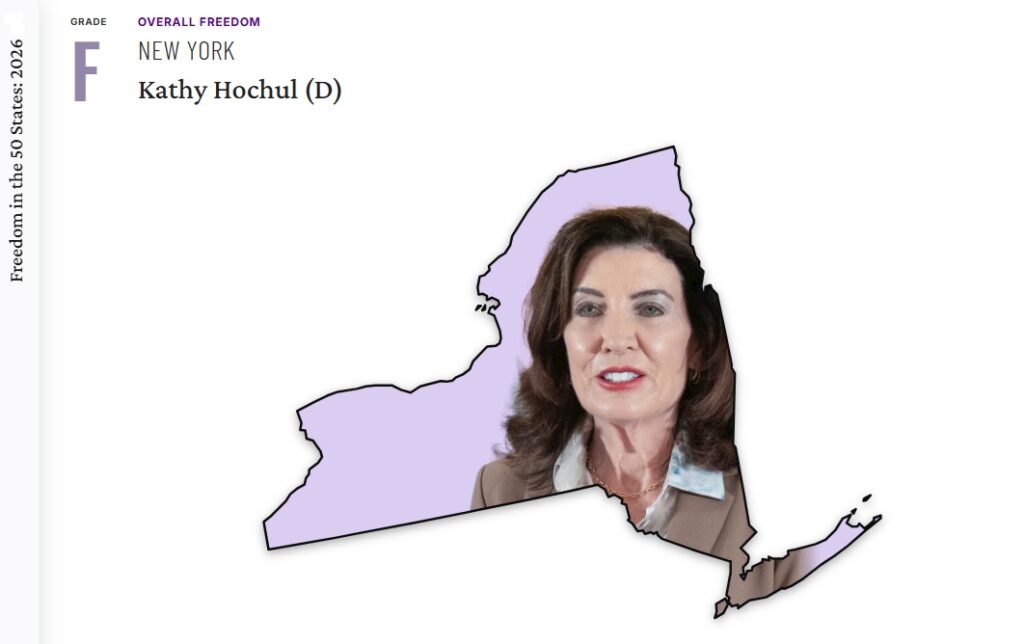 The Cato Institute
First and foremost is to boot Gov. Kathy Hochul from office. The incumbent Democrat governor recalls one of those old Soviet apparatchiks who loitered around the Kremlin until his ticket got called.
“Number 38? Number 38? Yes, it’s your turn to be General Secretary. Good luck, Comrade!”
Likewise, Hochul happened to be lieutenant governor when Democratic Gov. Andrew Cuomo tripped over some skirts and stumbled out of office. Hochul plopped into the governor’s chair, and there she has sat, as bland, uninspiring, and nearly as Left-wing as Konstantin Chernenko when he became the USSR’s top dog in February 1984, after former KGB chief Yuri Andropov kicked the samovar.
Stalinist ideas aside, at least Mamdani is charming, magnetic, and (despite his facial hair) handsome. I hate nearly everything he says, but I cannot peel my eyes off him.
Au contraire, Kathy Hochul is defined as −459.67° Fahrenheit, better known as absolute zero. She is not sharp, engaging, or eloquent. Her words land like bricks tumbling from a crumbling brownstone. She is neither funny, nor stylish, nor interesting. She is as generic as a box of baking soda. Kathy Hochzzzzzzzzzzzzzzzzzzzzzzzzzz.
Sorry! I dozed off while writing her name.
If Blakeman did nothing more than spare New Yorkers four more years of Hochul’s soporific misrule, he would be worshipped from Staten Island to Lake Placid.
The Post said this about Hochul:
Hochul also stands with the far left when it comes to violent illegal immigrants, opting to make New York their “sanctuary.”
And she just can’t stop sucking up to Mayor Zohran Mamdani and his fellow socialists, to the point that some regard him as New York’s real governor.
Not only did Hochul endorse Mamdani; she also handed him a pied-à-terre tax to placate his “tax-the-rich” base along with billions in state support to enable his reckless spending.
Blakeman would cancel the Hochul-Mamdani alliance. His appeal to many New Yorkers doesn’t end there.
“On day one, as governor, I will sign an executive order that we are no longer a sanctuary state,” Blakeman said. Instead, he would help federal officials arrest and deport violent illegal-alien criminals, not least deadly gangs and cartelistas. Under Hochul and Mamdani, they enjoy free-range status.
Blakeman aims to bury cashless bail, which currently speeds arrested lawbreakers back onto the sidewalks of New York, so they swiftly can resume their criminal careers.
Blakeman will push taxes down, rather than up, their default direction in what the late, great New York University professor Herbert I. London called “the Vampire State.” Blakeman would pry the fangs from the necks of single filers who earn up to $50,000 and joint filers who score as much as $100,000. They would pay no state income tax under Blakeman’s proposal. He stresses this point: “I will roll out the biggest middle-class tax cut in the history of New York.”
Blakeman also would halve power bills by unplugging what he calls Hochul’s costly and ineffective “green energy scam” and “science projects that cost billions of dollars.”
Blakeman would junk Hochul’s disastrous congestion-pricing shakedown. It pickpockets motorists who venture below Manhattan’s 60th Street. This force field repels shoppers, diners, and theatergoers who otherwise would drive into town. It also scares away their money.
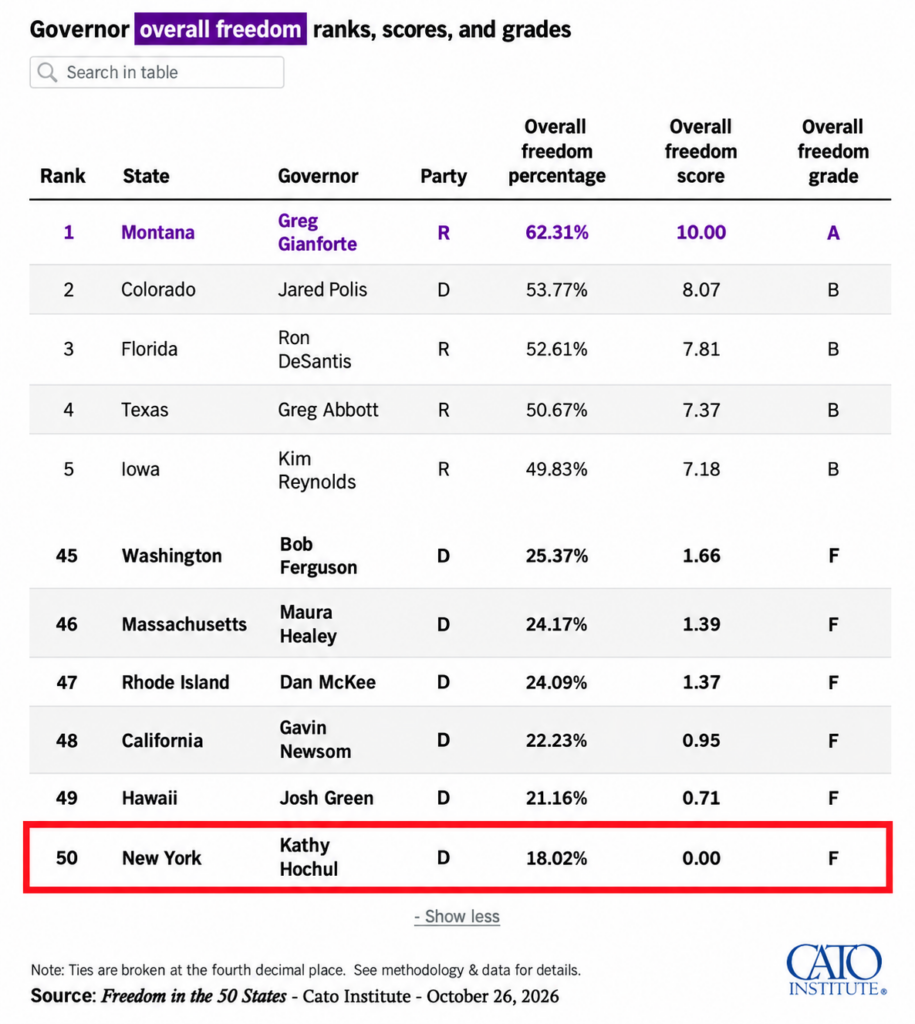 The Cato Institute
 released its Freedom in the 50 States Report Card on Monday. Guess which governor Cato ranked No. 50? Two notches below California’s vacuous Gavin Newsom is none other than Kathy Hochul! America’s worst governor earned an Overall Freedom Grade of F and Overall Freedom Score of 0.00. Once again, Kathy Hochul: Absolute Zero.
You can understand why Blakeman’s supporters think New York state literally has nowhere to go but up.
As for Zohran Mamdani, a Blakeman victory could make the warmly collectivist Wunderkind less a mayor and more a grand marshal.
We publish a variety of perspectives. Nothing written here is to be construed as representing the views of the Daily Signal.
The House Is Restless. It Has Been Before.
Summary
- The midterms may again see the House of Representatives change hands.
- Throughout our history, voters have given a party the keys to the House, only to snatch them back quickly.
- Whoever wins overestimates the mandate given them by voters at their own peril.
PITTSBURGH—In April 1894, a ragged column of unemployed men attempted to come through Pittsburgh on the way to Washington. They called themselves Coxey’s Army. It was a protest march of jobless workers led by Jacob Coxey, an Ohio businessman, and they were marching on the Capitol.
The country was in the second year of a four-year depression, the worst in its history up to that time, and the city, fresh from the violence and lost lives of the Homestead Strike, did not allow the men entrance into the city limits: So they marched on along the Monongahela River.
Seven months later, the country did something the marchers might not have predicted. It voted overwhelmingly for the party of the steel tariff. Democrats lost 125 House seats, still the largest swing in the chamber’s history. In Pennsylvania, they kept two of 30. In Pittsburgh, Republican John Dalzell won with more than three-quarters of the vote.
Pittsburgh hadn’t swung. It had spent two decades becoming the model of the new industrial economy, and the rest of the country was catching up to it. Between 1870 and 1890, the city’s population nearly tripled as mills pulled workers off farms and immigrants off ships. Through those same years, the House changed hands six times, sometimes by a third of its seats, as a country caught between farm and factory lurched from one party to the other with every crash.
It is worth remembering this now, because it is happening again.
The House changed hands in 2006, 2010, 2018, and 2022. Days from now, it may change hands again. If it does, 2026 will be the seventh straight midterm in which one chamber of Congress or the other changed parties. We are inclined to treat this as a symptom of our own era: cable news, social media, polarization, a broken politics. History suggests something else. The country has been here before, and the reasons were less about politics than about the people doing the voting.
That’s why the House is the right place to look. The framers designed it to register the public’s mood. In Federalist 52, [James] Madison wrote that this branch in particular “should have an immediate dependence on, and an intimate sympathy with, the people,” and that “frequent elections are unquestionably the only policy by which this dependence and sympathy can be effectually secured.” Senators serve six years, and until 1913 they weren’t even elected directly by voters. Presidents serve four years. House members face us every two years, in districts small enough that a mill closing or a crop failure can change the result.
So when the House swings hard, it’s worth asking what the country is going through; the first period to look at is the Gilded Age.
In the 1870s and 1880s, Americans were living through the largest economic transformation in the country’s history. In 1870, about one American in four lived in a city. By 1890, it was more than a third. Farmers watched corn fall from 83 cents a bushel in 1881 to 28 cents in 1890 while they paid tariff-protected prices for everything they bought. Mill towns filled with newcomers. Western Pennsylvania was where much of the future was being built: rails in Johnstown, locomotives in Altoona, coke in Connellsville, oil in Butler County, gas in Murrysville, and George Westinghouse’s alternating current in Pittsburgh.
The economy also kept breaking down. The Panic of 1873 produced the 1874 wave. Voters angry about the 1890 McKinley Tariff cost Republicans their House majority that fall and cost McKinley his own congressional House seat. The Panic of 1893 pushed unemployment above 15%. That spring, Westinghouse lit the Chicago World’s Fair with the electric technology of the next century just as the economy underneath it crashed.
The voters of that era weren’t fickle. Turnout often topped 80%, and they rarely split their tickets. What they were telling Washington, through repeated wave elections, was that a country gaining enormous wealth was also losing its sense of security, and they kept looking for a party that understood the difference.
The parallels to today are hard to miss. Western Pennsylvania is again a place where the future is being built. The artificial intelligence boom has roots in a Carnegie Tech program from 1956. Robots are now tested on the old J&L steel site in Hazelwood, and the coal plant at Homer City is being rebuilt to power data centers. And the past 20 years have brought the Great Recession, a pandemic, an inflation surge, and now tariffs and war-driven gas prices.
The anxieties are familiar too. The boilermakers rebuilding Homer City are glad of the work; however, 68% of Pennsylvanians would oppose a data center in their own community. Both views are reasonable, and many people hold both at once. They want the future built here, and they don’t want to pay for it.
The comparison has its limits. Today’s swings are much smaller. In 1894, about a third of House seats changed hands, while the 2010 wave moved about 15%. Fewer than 10% of House races are considered competitive now. Some political scientists would say today’s volatility is a product of a closely divided electorate that votes against the other party more than for its own, and that it says little about our deeper condition. They have a point. But a closely divided country that keeps rejecting whoever is in charge is itself telling us something.
The biggest lesson history offers is the one the winners keep forgetting. A party that wins the House usually believes voters fell in love with its ideas. More often, voters were just angry enough at the other party to hand over the keys.
The Republicans of 1888 are a good example. Benjamin Harrison lost the popular vote that year and won the presidency anyway, and his party took the House with a thin majority.
Emboldened, the Republicans enacted virtually their entire platform. They passed the highest tariff the country had ever had in peacetime, expanded Civil War pensions, bought up silver and spent through a federal surplus. Critics called it the first peacetime “Billion Dollar Congress.” Speaker Thomas Reed answered, “Well, this is a billion-dollar country.”
Voters disagreed, and in 1890 they cut the Republicans down to 86 seats. The Democrats then made the same mistake. They won the House, the Senate, and the White House in 1892 and lost 125 House seats two years later.
We repeat the pattern because both parties keep repeating it. Stanford political scientist Morris Fiorina calls our era one of “unstable majorities.” He argues that close competition now drives the parties to “overreach,” to “strike while the iron is hot” rather than seek the safety of the center. After 2008, Democrats pushed the Affordable Care Act and cap-and-trade climate legislation. Within a year, many voters who thought they had elected a moderate decided they had elected a liberal, and the 2010 wave followed.
George W. Bush made the same mistake on Social Security after 2004. “I may have misread the electoral mandate,” he later admitted.
Fiorina’s judgment is blunt: “The American people rarely give mandates; generally they hire you on probation.”
The voters have been telling the parties this directly. Among independents who lean Republican, according to Pew Research, 55% say a major reason is that Democratic policies are harmful, while only 30% credit Republican policies. Among those who lean Democrat, 51% point to the harm done by Republicans, and only 34% to anything Democrats have done.
Those are the voters who decide who controls the House, and they lean away from one party more than toward the other.
Yet each new majority behaves as though it has been embraced. It grows the government it promised to restrain, spends money it promised to save, or pushes the agenda its base wants over the one swing voters were promised, confident the country is behind it. It isn’t. Those voters were never committed, and they take the keys back as quickly as they handed them over. That is why the next wave tends to come so soon.
That brings us back to what our restlessness says about us. Gilded Age voters were living through a transformation they didn’t fully understand, and they kept firing whoever was in charge because no one had yet shown them that the new economy had a place for them. We are living through another transformation. The future is again being built in Western Pennsylvania, on old mill sites and above old gas fields. Many voters still aren’t sure it’s being built for them.
Next week, the House will tell us what we think, as it always has. Whoever wins should remember that the voters handed them the keys. They didn’t hand them their hearts.
COPYRIGHT 2026 CREATORS.COM
We publish a variety of perspectives. Nothing written here is to be construed as representing the views of the Daily Signal.
President Trump: Cheerleader-in-Chief
In 2014, President Barack Obama, during the last midterm of his presidency, was 53 years old. He did seven rallies, four of which took place in October. In 2022, President Joe Biden, during his only midterm election, was 79 years old. He largely avoided traditional rallies. President Donald Trump, during the last midterm of his presidency, is 80 years old. So far in this month of October, he has held 23 rallies.
Biden was widely criticized for failing to do more campaigning. ABC News’ Jonathan Karl asked Rep. Sean Patrick Maloney, D-N.Y., then-chair of the House Democrats campaign arm, why Biden was not hitting the campaign trail harder. Maloney replied, “I don’t know what you’re talking about.”
Maloney described a Biden campaign stop in his district in Poughkeepsie, New York. Karl was unimpressed: “I recall in 2010 President Obama doing 16 rallies all across the country in the month of October alone.”
As for President Obama, in October 2014, his approval rating was at 40%, according to an ABC/Washington Post poll, the lowest score in that poll since Obama entered office. Two weeks before the 2014 midterms, CNN wrote, “President Barack Obama says his feelings aren’t hurt by Democrats who don’t want to campaign side-by-side with him because those candidates are ‘strong allies and supportive of me’ when casting votes in Congress. … Obama’s remarks could harm endangered red-state Democrats and offer a boost to Republicans who need to capture six seats to gain control of the Senate for the president’s final two years in office.”
After the huge 2014 Democratic congressional losses, the liberal outlet Salon slammed Democrats for distancing themselves from Obama: “Nine times out of 10, if a Democrat runs a race in which she or he is constantly apologizing for being a Democrat, voters will simply opt to elect a Republican. Obama may be deeply unpopular in Kentucky, West Virginia and Alaska, but in a competition over who sticks it to the president more, guess which party will always come out on top.”
This is exactly how Trump sees it.
He confidently tells voters, “Act like I’m on the ballot,” something Democrats, given his poll numbers, are practically giddy to hear. But Trump vigorously defends his record on the economy, the Iran War, crime, the border and on deportations. He denounces the rise of socialism within the Democratic Party and Medicare for All, considered the signature policy issue for many congressional Democrats and Democratic candidates. Even the Washington Post editorial board calls it “taxes for all.”
Trump noted that just days ago, despite the gloomy predictions by economic experts, the consumer confidence index increased in October, and the September index was revised upward. Inflation adjusted median household income in 2025 reached an all-time high. Poverty in 2025 stood at a record low. Despite the dreary headlines, consumers continue to spend. The national average price of a gallon of regular gas remains lower than its peak under Biden.
Market Watch recently wrote:
“The economy is poised to show a growth rate of 3% or more from July to September when the government next week reports gross domestic product for the third quarter. The U.S. might even be on track to post frothy annual growth of 2.5% in 2026. It wasn’t supposed to happen.
“Many economists predicted growth would slow after the spring as spending from large tax refunds dried up and the U.S.-hosted World Cup ended. High oil prices, rising inflation, the lingering effect of tariffs and the ongoing conflict in Iran were expected to depress growth. Instead, consumer spending picked up and businesses boosted investment.”
Trump’s approval rating is lower than that of Obama’s 40% in October 2014, and lower than that of Biden’s 40% in October 2022. The New York Times Presidential Approval Tracker places Trump’s approval at 36%, a record low for his presidency. A recent Reuters/Ipsos poll shows his approval rating at 32%, a 1-point improvement from the previous week’s record low.
Yet, love him or hate him, Trump knows his best campaign surrogate-cheerleader is Trump. His October schedule of rallies, meetings, policy briefings, media appearances and travel is absolutely exhausting.
No matter what happens on Nov. 3, even Trump’s detractors should acknowledge this: The man stood by his record. He did not mail it in.
COPYRIGHT 2026 CREATORS.COM
We publish a variety of perspectives. Nothing written here is to be construed as representing the views of the Daily Signal.