
An Alternative News Aggregator
News of the Day
“Glory to God in the highest heaven, and on earth peace to those on whom his favor rests.”
- Luke 2:14

The Hottest 4th Of July Ever Could Set More Than 300 New Records And The U.S. Wheat Harvest Is Expected To Be The Smallest In 150 Years
 It is supposed to be hot on the 4th of July, but it isn’t supposed to be this hot. Temperatures will be 20 to 30 degrees above average in much of the eastern half of the country. I warned a few days ago that we were going to experience a “4th of July furnace”, and meteorologists are telling us that hundreds of new records could be established. Unfortunately, this entire summer is going to be extremely hot. The “Godzilla El Niño” that has now begun is going to mean the we will experience unusually hot weather, epic storms and severe droughts in key agricultural areas throughout the second half of this year. And that is really bad news, because it is being projected that the amount of wheat produced in the U.S. this year will be the lowest since 1877.
An absolutely gigantic heat dome is going to relentlessly bake half of the nation over the next few days, and CBS News is reporting that “more than 300 records are expected to be set by Saturday”…
This July Fourth could be the hottest on record for millions of Americans as a massive heat wave traps more than half of the United States under a heat dome through the holiday weekend.
Dangerously high temperatures continued to ramp up Thursday from the Midwest to the East Coast, forecasters said. Between daily high temperatures and warm overnight lows — which won’t be low enough to offer much relief — more than 300 records are expected to be set by Saturday.
That is nuts.
When is the last time that we saw over 300 records get set on the 4th of July?
The latest National Weather Service forecast says that in some areas high temperatures will go as high as 105 degrees and the heat index will go as high as 115 degrees…
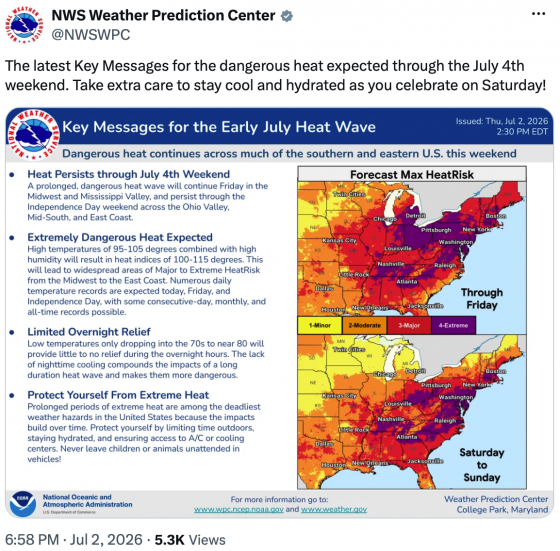
If you live on the east coast, please take this heat wave very seriously.
It is going to be a monster.
Washington D.C., Philadelphia, New York City and Boston are all expected to hit triple digits…
Washington, D.C., is expected to experience its hottest Fourth of July on record, with temperatures reaching 101 degrees. From Thursday through Saturday, the city is forecast to endure its hottest three-day stretch of the year. Philadelphia could reach 104 degrees on Friday, while New York and Boston are also expected to hit 100 degrees.
I think that it is noteworthy that this will be happening at the exact moment when America’s 250th birthday will be celebrated in our nation’s capital.
According to the Washington Post, Washington D.C. will be among “the top 1.1 percent of the planet’s hottest places on Friday”…
What does D.C. have in common with desolate stretches of Africa’s Sahara, deserts in the Middle East and China’s Gobi Desert?
It has lots of hot air, of course.
So much hot air, in fact, that D.C. will find itself in the top 1.1 percent of the planet’s hottest places on Friday, when high temperatures will soar toward 105 degrees.
That is certainly not normal.
In New York, mobile medical vans that contain nurses and paramedics will be roaming the city looking for people to help…
For the first time, New York City is deploying vans staffed with nurses and paramedics who will hand out water, electrolytes and sunscreen, CBS News New York reported. They will also perform wellness checks, transport people to cooling centers and make in-home visits to vulnerable residents. The city is also opening cooling centers throughout the five boroughs.
This crisis will be a real test for Mayor Zohran Mamdani.
He is encouraging New Yorkers to set their air conditioning at 78 degrees to help conserve power…
Socialist Mayor Zohran Mamdani has ignited a GOP firestorm after urging residents to set their air conditioners to a certain temperature to help prevent strain on the city’s power grid.
It comes as New York City braces for a sweltering Fourth of July weekend with temperatures expected to soar into the triple digits.
In a post on X, Mamdani encouraged New Yorkers and business owners to conserve electricity as demand for cooling surges.
‘New York: it’s hot out there, and the power grid is working overtime to keep us cool. Set your AC to 78 degrees, turn off lights/electronics you’re not using, and unplug what you can.’
Needless to say, this suggestion is not going over very well, and a lot of New Yorkers plan to ignore it entirely.
But without a doubt there is going to be enormous stress on our power grids, and an emergency has already been declared for the largest power grid in the country…
With 160 million people in 30 states under alert for extreme temperatures, the U.S. Department of Energy has declared an emergency as a heat wave bears down on a huge part of the nation’s electrical grid.
U.S. Secretary of Energy Chris Wright issued an Energy Emergency Alert, directing officials of the biggest electrical grid, PJM Interconnections in the Mid-Atlantic region, to take action to prevent blackouts and ensure essential operations like hospitals are fully functioning during the heat wave.
“Maintaining affordable, reliable, and secure power in the PJM service territory is non-negotiable,” Wright said in a statement on Tuesday.
When the 4th of July weekend is finally over, the focus will shift to the western half of the nation.
A new heat dome is coming, and it will afflict areas that are already being ravaged by drought and wildfires…
A new heat dome will build between the Rockies and the Pacific coast.
As the jet stream bulges northward in the West, an area of high pressure will build over the region. The setup will allow temperatures to trend upward initially from several degrees Fahrenheit next week to 10-20 degrees above the 30-year average by the middle of July.
The heat dome will bring the highest temperatures of the season so far — even eclipsing the extreme marks set during the spring heat waves in Phoenix, Las Vegas and Palm Springs, California.
When conditions are unusually hot, ticks love it.
And we are being told that this tick season “is expected to be worse than usual”…
This summer tick season is expected to be worse than usual. The Centers for Disease Control and Prevention reports the highest rate of emergency room visits from tick bites since 2017 across most of the country.
“It’s definitely concerning to see new ticks in new areas and then diseases that follow,” said Rebecca Osborn, an epidemiologist for the Wisconsin Department of Health Services.
In a previous article, I discussed the fact that serious diseases that are carried by ticks are spreading like wildfire in many areas of the country.
This year, authorities are particularly concerned about alpha-gal syndrome and the Powassan virus…
“So, warmer temperatures can bring ticks into new areas,” Osborn said.
One type of tick health officials are keeping an eye out for is the lone star tick. It can carry alpha-gal, which can create a red meat allergy in infected people.
They’re also tracking Powassan, a virus that attacks the central nervous system and can lead to memory loss, difficulty speaking and seizures.
Meanwhile, the heat is also having a huge impact on America’s farmers.
Earlier today, I was astounded to learn that the amount of wheat that will be harvested in the United States this year is expected to be the lowest since 1877…
America is expected to harvest its lowest acreage of wheat since 1877, due to drought, scorched crops, high input costs and uncertainty in export markets.
The U.S. Department of Agriculture’s (USDA) National Agricultural Statistics Service released estimates on June 30 that the total area of all wheat planted was 42.7 million acres in 2026, down six percent from the previous year. This was also 1 million acres below the agency’s March forecasts.
In 1877, there were 40 million people living in the United States.
Today, there are 342 million people living in the United States.
We are supposed to be one of the breadbaskets of the world, but the past 12 months have been extremely warm and exceedingly dry…
Over the past year, the U.S. has experienced unusually warm conditions—May 2025 to April 2026 marked the warmest 12-month period on record for America, according to NOAA, and many of the country’s largest wheat farming states were hit with severe drought. Droughts are known to significantly reduce crop yields as the heat and lack of water can damage crops and stunt their growth.
Romulo Lollato, a wheat specialist at Kansas State University, told news outlet High Plains Journal that a lot of the wheat in Kansas—one of the state’s largest wheat producers, alongside Oklahoma and Texas—was “very short,” which he said was a “sign of drought stress.”
Now a “Super El Niño” is here, and the outlook for the months ahead is not promising at all.
For more than a decade I have been warning about so many of the things that are playing out right in front of our eyes right now.
We are witnessing a simultaneous confluence of catastrophic events that is unprecedented in our history.
A “perfect storm” is now upon us, and it is only going to intensify throughout the remainder of this year and beyond.
Michael’s new book entitled “10 Prophetic Events That Are Coming Next” is available in paperback and for the Kindle on Amazon.com, and you can subscribe to his Substack newsletter at michaeltsnyder.substack.com.

About the Author: Michael Snyder’s new book entitled “10 Prophetic Events That Are Coming Next” is available in paperback and for the Kindle on Amazon.com. He has also written nine other books that are available on Amazon.com including “Chaos”, “End Times”, “7 Year Apocalypse”, “Lost Prophecies Of The Future Of America”, “The Beginning Of The End”, and “Living A Life That Really Matters”. When you purchase any of Michael’s books you help to support the work that he is doing. You can also get his articles by email as soon as he publishes them by subscribing to his Substack newsletter. Michael has published thousands of articles on The Economic Collapse Blog, End Of The American Dream and The Most Important News, and he always freely and happily allows others to republish those articles on their own websites. These are such troubled times, and people need hope. John 3:16 tells us about the hope that God has given us through Jesus Christ: “For God so loved the world, that he gave his only begotten Son, that whosoever believeth in him should not perish, but have everlasting life.” If you have not already done so, we strongly urge you to invite Jesus Christ to be your Lord and Savior today.
The post The Hottest 4th Of July Ever Could Set More Than 300 New Records And The U.S. Wheat Harvest Is Expected To Be The Smallest In 150 Years appeared first on The Economic Collapse.
Traffic Through The Strait Of Hormuz Is Way Below Pre-War Levels As Trump Is Briefed On Options For “All-Out War”
 The crisis in the Strait of Hormuz is not even close to being resolved, and global oil supplies continue to get tighter and tighter. The world has been running an “oil deficit” for months, and we have been able to do that by running down commercial oil inventories and strategic national reserves. There was hope that traffic through the Strait of Hormuz would return to pre-war levels before things got really hairy, but that isn’t happening. In fact, in recent days only about 30 to 40 commercial vessels have been traveling through the Strait each day. Before the war, the average was about 120 to 130 commercial vessels per day. The vast majority of the commercial vessels that have been getting through the Strait have been heading away from the Persian Gulf. Very few are headed into the Persian Gulf for understandable reasons. So once the backlog of commercial vessels that have been trapped in the Persian Gulf is finally eliminated, the level of traffic through the Strait of Hormuz will likely drop to depressingly low levels.
So we should be thankful that the price of oil has dropped a bit lower for now, but it won’t stay that way.
And that will especially be true if war with Iran fully erupts again.
We have seen fighting flare up multiple times in recent weeks, and it certainly wouldn’t take much to push things over the edge.
On Wednesday, it was being reported that President Trump has been briefed on options for “a return to all-out war with Iran”…
President Trump has weighed a return to all-out war with Iran, holding multiple conversations in recent days with Defense Secretary Pete Hegseth and Chairman of the Joint Chiefs of Staff Gen. Dan Caine on more strikes, but has decided to stick with diplomatic talks for now, according to U.S. officials familiar with the discussion.
The conversations have centered on whether the U.S. should abandon negotiations and resume full-scale attacks on Iran, the officials said, a move some of them describe as “finishing the job.” While not making a final decision, Trump has told aides he believes another round of full-scale attacks could derail diplomacy and hurt Washington’s chances of ultimately dismantling Iran’s nuclear program.
I was quite surprised when I read that.
I didn’t think that Trump and his team had an appetite for more conflict right now.
Meanwhile, Iranian Foreign Minister Abbas Araghchi just used some very strong language in an extremely inflammatory social media post…
The terms of the Islamabad MoU are crystal clear and public for all to see.
POTUS has committed the U.S. to muzzling its pets in Tel Aviv. If they ignore their master, Iran will school them.
Any threat against our People and Leadership will receive Immediate Powerful Response.
This is a threat to attack Israel.
The Iranians are demanding that the Israelis must withdraw from Lebanon, but the Israelis continue to tell us that this will simply not happen…
Israel’s defense minister said Wednesday that forces would remain “indefinitely” in so-called security zones established in Lebanon, Syria and the Gaza Strip.
“The IDF will not withdraw and will remain in the security zones in Lebanon, Syria, and Gaza – indefinitely – to protect our residents and communities from jihadist elements,” Israel Katz said.
“We are fighting to change reality and bring security to the residents of the north,” he added, referring to communities along Israel’s border with Lebanon from which thousands of people have been evacuated due to the threat posed by Iranian-backed Hezbollah.
The Israelis are absolutely determined to stop the bombardment of their northern communities.
Since early March, Hezbollah has fired “more than 7,000 rockets, missiles and drones” into Israeli territory…
Israeli officials say Hezbollah has launched more than 7,000 rockets, missiles and drones into Israel since early March while embedding military infrastructure inside civilian areas and Christian villages in southern Lebanon.
The claims were made by Israeli Foreign Minister Gideon Sa’ar during MUNI EXPO in Tel Aviv as Israel, Lebanon and the United States continue negotiations aimed at securing Hezbollah’s disarmament and a lasting peace agreement.
“Since March alone, Hezbollah has launched more than 7,000 rockets, missiles and drones from Lebanese territory into Israel,” Sa’ar said. “What country can accept this and not act to restore security to its citizens?”
It is inevitable that Hezbollah will fire more rockets, missiles and drones into northern Israel.
In response, Israel will bomb southern Beirut again.
The Iranians have already told us that if Israel does that again they will fire ballistic missiles at Israel.
And once that occurs, the IDF will strike back extremely hard.
I don’t know what those that are convinced that there will be peace in the Middle East are smoking, but it must be really strong.
When more fighting erupts in the Middle East, traffic through the Strait of Hormuz will drop lower than it is now.
And that is very bad news, because even though the “Memorandum of Understanding” was signed a couple of weeks ago, traffic through the Strait of Hormuz continues to remain at very low levels…
Shipping traffic through the Strait of Hormuz began to rebound Monday following weekend tit-for-tat strikes between the U.S. and Iran.
Reports from the maritime tracking firm Kpler said 40 vessels passed through the critical waterway on Monday, while 24 ships transited the strait on Sunday in addition to 39 ships on Saturday.
Almost all of the commercial vessels that are passing through the Strait are headed out.
Very few are headed in.
And many of the ships that are actually headed in are Iranian.
For now, most shipping companies continue to treat the Strait of Hormuz “as a war zone”…
Unions and shipping employers said in a statement Wednesday they will continue to designate the Strait of Hormuz as a war zone until at least July 9, maintaining double pay for seafarers in the area despite a fragile truce between the U.S. and Iran.
The status only covers ships whose companies are signatories of the International Bargaining Forum’s labor agreements — around 15,000 vessels worldwide, according to the IBF.
Seafarers covered by the agreement working on ships in the Strait of Hormuz and its surrounding waters get paid double, and have the right to refuse to sail into the area and request repatriation at the company’s expense, increasing costs for shipping companies.
This is really bad news for the global economy.
On top of everything else, Ukraine’s endless bombardment of Russian oil facilities has caused gasoline shortages all over Russia…
Fuel shortages across Russia have triggered a new political challenge for President Vladimir Putin, as a relentless Ukrainian drone campaign aimed at the country’s oil refineries has brought the war home for most ordinary Russians.
While Ukraine has targeted Russian energy facilities for years, the quantity and firepower of Ukrainian drones and missiles have risen. This has allowed Kyiv to hit refineries as far as Tyumen, 1,200 miles away in Siberia, and permitted the spectacular raid that broke through thick layers of air defenses and destroyed Moscow’s main refinery on June 18, the turning point of the current crisis.
Some 28% of Russia’s refining capacity was offline as of June 20, estimated Sergey Vakulenko, former head of strategy at Gazprom Neft, a large Russian oil company, and now a senior fellow at the Carnegie Russia Eurasia Center in Berlin.
Russia is one of the largest oil producers on the entire planet.
But now the Russians are being forced to actually import fuel thanks to Ukraine.
Everything that I have shared in this article means that global supplies of oil are going to continue to become tighter and tighter in the weeks and months ahead.
In other words, the stage is being set for a severe global energy crisis and a mammoth global economic meltdown.
For the moment, many investors are still feeling very optimistic about things, but it won’t be too long before they are brutally blindsided by reality.
Michael’s new book entitled “10 Prophetic Events That Are Coming Next” is available in paperback and for the Kindle on Amazon.com, and you can subscribe to his Substack newsletter at michaeltsnyder.substack.com.
About the Author: Michael Snyder’s new book entitled “10 Prophetic Events That Are Coming Next” is available in paperback and for the Kindle on Amazon.com. He has also written nine other books that are available on Amazon.com including “Chaos”, “End Times”, “7 Year Apocalypse”, “Lost Prophecies Of The Future Of America”, “The Beginning Of The End”, and “Living A Life That Really Matters”. When you purchase any of Michael’s books you help to support the work that he is doing. You can also get his articles by email as soon as he publishes them by subscribing to his Substack newsletter. Michael has published thousands of articles on The Economic Collapse Blog, End Of The American Dream and The Most Important News, and he always freely and happily allows others to republish those articles on their own websites. These are such troubled times, and people need hope. John 3:16 tells us about the hope that God has given us through Jesus Christ: “For God so loved the world, that he gave his only begotten Son, that whosoever believeth in him should not perish, but have everlasting life.” If you have not already done so, we strongly urge you to invite Jesus Christ to be your Lord and Savior today.
The post Traffic Through The Strait Of Hormuz Is Way Below Pre-War Levels As Trump Is Briefed On Options For “All-Out War” appeared first on The Economic Collapse.
The AI Jobs Apocalypse Has Begun: We Are Witnessing An Unprecedented Wave Of AI-Related Layoffs In 2026
 We all knew that this would be coming. In 2026, the rate of AI-related layoffs has greatly accelerated, and that means that large numbers of good paying jobs are suddenly disappearing from the economy. This is occurring when we are already facing one major crisis after another, and so the timing could not be worse. Many young people specifically chose a major in college that would prepare them for positions in the tech industry because those were supposed to be the jobs of the future. Unfortunately, the AI jobs apocalypse is wiping out those jobs the fastest.
Let me give you some cold, hard numbers that will clearly demonstrate what I am talking about.
According to Challenger, Gray & Christmas, the number of announced job cuts in the United States last month was the highest that we have seen during the month of May since the peak of the last pandemic…
U.S.-based employers announced 97,006 job cuts in May, up 16% from the 83,387 job cuts recorded in April, and up 3% from the 93,816 announced in the same month last year, according to a report released Thursday from global outplacement and executive coaching firm Challenger, Gray & Christmas.
May’s total is the highest for the month since 2020, when 397,016 job cuts were recorded in May at the height of the pandemic. It also marks the third straight month that cuts have risen, climbing from 48,307 in February to 97,006 in May.
There is no way to spin those numbers to make them look good.
And for the third month in a row, artificial intelligence accounted for more layoffs than any other reason…
In May, Artificial Intelligence (AI) led all reasons for job cuts for the third month in a row, with 38,579 announced cuts. It is the highest monthly total ever recorded for the reason since Challenger began tracking it in 2023, and it accounted for 40% of all cuts announced in May — up from just 7% in January, 25% in March, and 26% in April. For the year, AI has been cited in 87,714 cuts, or 22% of all 2026 layoffs, already far surpassing the 54,836 attributed to the reason in all of 2025.
Read that last sentence again.
The number of AI-related layoffs in 2026 has already surpassed the grand total of AI-related layoffs for the entire year of 2025.
That is how fast things are now moving.
Needless to say, the tech industry is being hit the hardest.
At this point, tech layoffs are running 44 percent faster than last year…
So far this year, there have been an estimated 363 layoffs at tech companies this year, affecting nearly 150,000 people — a pace of about 974 people per day, 44% faster than last year — according to TrueUp, a tech job board and recruiting platform that also runs one of the most widely cited tech layoff trackers.
The trend appears to be accelerating. Tech layoffs hit their highest single month in two years last month, with nearly 40,000 cuts, and AI was the most-cited reason for layoffs across every industry for the third month running, according to outplacement firm Challenger, Gray & Christmas.
There is no long-term loyalty in the tech industry anymore.
The moment that AI can do your work more efficiently than you can, you are in danger of being let go.
Some of you out there have personally experienced this.
During the past six months, we have seen some of the biggest names in tech radically transform their workforces…
Several major tech companies have announced significant workforce reductions this year while simultaneously ramping up investments in artificial intelligence.
Oracle disclosed recently that it has reduced its workforce by roughly 21,000 employees (4) over the past year. Meanwhile, Google has continued trimming staff (5) through performance reviews, buyout programs and reorganizations, with outside estimates suggesting between 1,500 and 3,000 engineering roles have been eliminated in 2026.
Meta also laid off roughly 8,000 employees earlier this year while shifting about 7,000 workers into AI-focused roles, highlighting how some companies are cutting jobs in certain areas while continuing to invest heavily in artificial intelligence.
This is just the beginning.
And it is going to spread to every industry.
If you can believe it, a major tobacco company just announced that it is planning to “cut about 20% of its workforce as it pursues an AI-driven overhaul”…
British American Tobacco (BATS.L), opens new tab plans to cut about 20% of its workforce as it pursues an AI-driven overhaul to lower costs and lift profits amid regulatory challenges and delayed launches.
The maker of Lucky Strike and Dunhill cigarettes said on Monday it would cut around 5,500 jobs and move roughly 3,500 roles to third-party firms, including Accenture . The restructuring would affect around 9,000 employees in total, but excludes the U.S., the company’s biggest market.
BitGo is another firm that is ruthlessly firing employees for AI-related reasons…
BitGo has joined the growing ranks of crypto firms slashing staff numbers as part of a pivot to AI.
The crypto custody and infrastructure company is cutting nearly 15% of its workforce, co-founder and CEO Mike Belshe said Thursday in a tweet that BitGo also filed with the U.S. Securities and Exchange Commission.
A lot of the workers that are hitting the bricks are relatively young.
In the past, it was fairly easy to find another tech industry job, but now that has completely changed.
In fact, it has become so difficult to find a tech job these days that many job seekers have resorted to “spraying and praying”…
To survive this nightmarish job market, candidates are now “spraying and praying,” as one career coach described it — or paying resume services to blast out thousands of CVs per day to game the system and land a gig. However, according to experts in the tech industry who spoke with SFGATE, this is only creating a vicious cycle of inefficiency that hurts both workers and companies.
According to a recent survey conducted by Robert Half, a Bay Area talent and business solutions firm, over 50% of hiring managers said that AI-generated resumes are “flooding the market,” making it difficult to weed out candidates who are actually qualified for roles. To combat this torrent of resumes, 33% of hiring managers are now using AI-detection tools and spending more time training employees on how to spot ones that feel authentic.
“Many hiring managers tell us it’s becoming harder to distinguish between applicants because AI-generated resumes often use similar language, formatting and keywords,” Terah Brossart Daniels, a technology jobs expert with Robert Half, said. “Another issue is authenticity. A resume may look impressive on paper, but employers are spending more time validating whether a candidate’s experience, accomplishments and technical skills hold up throughout the interview process.”
If conditions are this bad now, what will the employment market look like once things really start falling apart in this country?
We were promised that AI would unleash a new golden age of peace and prosperity for our society.
Obviously that is not what is actually happening.
AI technology will continue to advance at an exponential rate, and soon millions more human workers will become obsolete.
This story is not going to end well, but most of you have already figured that out.
Michael’s new book entitled “10 Prophetic Events That Are Coming Next” is available in paperback and for the Kindle on Amazon.com, and you can subscribe to his Substack newsletter at michaeltsnyder.substack.com.
About the Author: Michael Snyder’s new book entitled “10 Prophetic Events That Are Coming Next” is available in paperback and for the Kindle on Amazon.com. He has also written nine other books that are available on Amazon.com including “Chaos”, “End Times”, “7 Year Apocalypse”, “Lost Prophecies Of The Future Of America”, “The Beginning Of The End”, and “Living A Life That Really Matters”. When you purchase any of Michael’s books you help to support the work that he is doing. You can also get his articles by email as soon as he publishes them by subscribing to his Substack newsletter. Michael has published thousands of articles on The Economic Collapse Blog, End Of The American Dream and The Most Important News, and he always freely and happily allows others to republish those articles on their own websites. These are such troubled times, and people need hope. John 3:16 tells us about the hope that God has given us through Jesus Christ: “For God so loved the world, that he gave his only begotten Son, that whosoever believeth in him should not perish, but have everlasting life.” If you have not already done so, we strongly urge you to invite Jesus Christ to be your Lord and Savior today.
The post The AI Jobs Apocalypse Has Begun: We Are Witnessing An Unprecedented Wave Of AI-Related Layoffs In 2026 appeared first on The Economic Collapse.
The Earthquakes Just Won’t Stop: The New Madrid Fault And The Cascadia Subduction Zone Both Get Shaken As The Warnings Continue
 How much shaking is it going to take before most of the population starts paying attention? The ground underneath our feet just keeps shaking. Nobody can deny this. As you will see below, there has been a long list of large earthquakes that have hit our planet over the past week, and this is something that I have been writing about a lot in recent days. What we are experiencing is not normal, and many believe that all of this shaking is just a preview of what is to come.
On Monday morning, a magnitude 5.5 earthquake suddenly struck approximately 140 miles off the coast of Oregon…
The Pacific’s notorious ‘Ring of Fire’ has delivered another jolt amid a recent burst of seismic activity around the globe’s most earthquake-prone region. The US Geological Survey detected a magnitude 5.5 earthquake roughly 140 miles west of the Oregon coast at around 7:35am ET Monday. The earthquake struck deep beneath the Pacific Ocean and there were no immediate reports of damage or injuries. No tsunami warning was issued, although residents in Salem and Rockaway Beach reported feeling the shaking.
The reason why this was such a noteworthy quake is because it occurred along the Cascadia Subduction Zone…
The quake occurred along a tectonically active stretch of the Pacific coastline, part of the broader Cascadia Subduction Zone known for producing both frequent moderate events and the potential for far larger ones.
This is one of the most dangerous fault zones in the entire world.
It sits on the Pacific Ring of Fire, and it has the potential to cause seismic events of cataclysmic proportions.
Scientists assure us that it is just a matter of time before a gigantic earthquake occurs along the Cascadia Subduction Zone, and I have repeatedly warned about what this will mean for those living near the coasts of Oregon and Washington once this happens…
Someday, an absolutely gigantic earthquake along the Cascadia Subduction Zone will send a colossal wall of water toward the west coast of the United States. We are talking about a disaster that would be greater than anything we have ever experienced in the entire history of our country so far, and scientists are openly warning us that it is just a matter of time before such a disaster happens. It is being projected that the wall of water could be up to 100 feet tall, and it will cause extreme devastation. Tall buildings will be instantly flattened, vehicles will be picked up and tossed around like toys, and countless numbers of people will instantly go to their watery graves. If you are directly in the path of such a tsunami, there will be no escape.
Do you remember the huge tsunami that hit Japan in 2011?
The tsunami that will eventually hit the west coast will absolutely dwarf that.
This latest earthquake off the coast of Oregon comes just days after a magnitude 5.6 earthquake hit Northern California and a pair of very large earthquakes caused catastrophic damage in Venezuela…
This comes after a 5.6 magnitude earthquake rattled Northern California and major back-to-back earthquakes struck Venezuela last Wednesday.
Days later, heightened seismic activity across the Pacific Ring of Fire brought earthquakes to Japan, the Philippines, and Nicaragua on Friday.
It is almost as if something has just suddenly snapped.
Over the past 7 days, we have witnessed a very long list of large earthquakes all over the world…
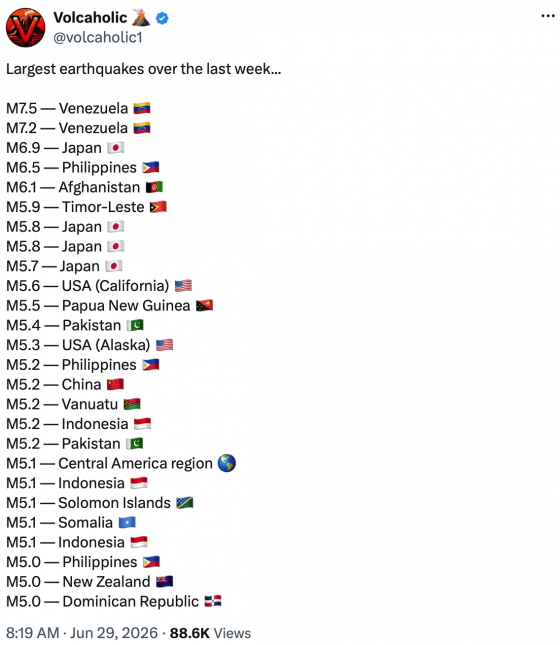
That is a stunning list.
And the shaking just won’t stop.
In fact, Venezuela just got hit by some more very big aftershocks…
Strong aftershocks have struck Venezuela’s capital as rescuers continue to search for tens of thousands of civilians who are still missing in the aftermath of two violent earthquakes.
The aftershock was felt shortly after 7.00am (11.00am GMT) in Caracas and La Guaira on Monday, as the search continues for survivors of last Wednesday’s quakes that have already claimed at least 1,450 lives.
It would be difficult to overstate the scale of the tragedy that we are witnessing in Venezuela.
At this stage, nearly 70,000 people have been reported missing…
The death toll from Venezuela’s twin earthquakes has risen to 1,430, with families reporting at least 68,900 people missing. The toll continued to climb even after the 72-hour window for rescuing survivors alive closed Saturday, while anger over the government’s response intensified in some of the hardest-hit areas.
I have a feeling that the vast majority of those that have been reported missing were killed by the earthquakes.
Many of them will never be found.
As our planet continues to become even more unstable, there will be even larger earthquakes.
One of the biggest danger zones is right in the middle of the United States, and very early on Monday a magnitude 3.5 earthquake rattled southern Illinois…
According to the U.S. Geological Survey (USGS), a magnitude 3.5 earthquake registered at 1:05 a.m. in northwest Edwards County, just south of the Richland County line.
This is close to the Illinois-Indiana border.
USGS reports the epicenter was 3.7 miles northeast of West Salem and measured 11.8 miles deep.
I asked Google if West Salem is close to the New Madrid Fault Zone, and this is what I was told…
Yes, West Salem, Illinois, is in a region considered at risk from the New Madrid Seismic Zone and the nearby Wabash Valley Seismic Zone.
I believe that this was another warning.
This earthquake caused so much shaking that it was actually felt in St. Louis and Louisville…
So far, the USGS says hundreds of people have reported feeling shaking across a wide stretch as far west as St. Louis, Missouri, as north as Effingham, Illinois, as south as Evansville, Indiana and as east as Louisville, Kentucky.
The largest earthquakes in the history of the continental United States occurred along the New Madrid Fault Zone.
Now the New Madrid Fault Zone is waking up again.
One of these days, a colossal earthquake will literally rip the country in half from north to south. The scar that will be created in the middle of the nation will be so deep that the Great Lakes will actually flow into the Gulf of Mexico. Since all of the existing bridges will be destroyed, you will actually need to take a boat ride or a flight if you want to travel from the eastern half of the country to the western half of the country.
But most of the population is not alarmed by the shaking that we are currently witnessing at all.
They have been assured that all of this shaking is just temporary and that things will soon return to normal.
Of course the truth is that there will be no return to normal.
Chaos is erupting all over the planet, and I believe that the second half of this year will be even more chaotic than the first half.
Michael’s new book entitled “10 Prophetic Events That Are Coming Next” is available in paperback and for the Kindle on Amazon.com, and you can subscribe to his Substack newsletter at michaeltsnyder.substack.com.
About the Author: Michael Snyder’s new book entitled “10 Prophetic Events That Are Coming Next” is available in paperback and for the Kindle on Amazon.com. He has also written nine other books that are available on Amazon.com including “Chaos”, “End Times”, “7 Year Apocalypse”, “Lost Prophecies Of The Future Of America”, “The Beginning Of The End”, and “Living A Life That Really Matters”. When you purchase any of Michael’s books you help to support the work that he is doing. You can also get his articles by email as soon as he publishes them by subscribing to his Substack newsletter. Michael has published thousands of articles on The Economic Collapse Blog, End Of The American Dream and The Most Important News, and he always freely and happily allows others to republish those articles on their own websites. These are such troubled times, and people need hope. John 3:16 tells us about the hope that God has given us through Jesus Christ: “For God so loved the world, that he gave his only begotten Son, that whosoever believeth in him should not perish, but have everlasting life.” If you have not already done so, we strongly urge you to invite Jesus Christ to be your Lord and Savior today.
The post The Earthquakes Just Won’t Stop: The New Madrid Fault And The Cascadia Subduction Zone Both Get Shaken As The Warnings Continue appeared first on The Economic Collapse.
We Are Entering The Most Dangerous Chapter Of World War III That We Have Experienced So Far As The Agreement With Iran Collapses
 A lot of people out there still don’t realize that we are literally watching World War III play out right in front of our eyes. The war between Russia and Ukraine is already longer than World War I was, and every single ceasefire in the Middle East that has been agreed to since October 7th, 2023 has ultimately collapsed. Just a couple of weeks ago, the world was celebrating because the U.S. had signed a “Memorandum of Understanding” with Iran and we were being told that we were finally going to have permanent peace in the Middle East. So how did that work out? I feel like a broken record when I keep saying that there isn’t going to be peace in the Middle East, but it is the truth.
At the end of last week, the Iranians attacked a commercial vessel that was traveling through the Strait of Hormuz using a route that they did not authorize, and the U.S. responded by bombing several Iranian military targets. This is something that I covered in an article for my core supporters on Friday.
Then on Saturday, the same cycle repeated again.
Iran attacked another commercial vessel that was attempting to slip through the Strait of Hormuz along an “unauthorized” route, and in response the U.S. conducted an even larger wave of strikes…
U.S. Central Command said its forces had carried out the new strikes after a Panama-flagged tanker was attacked by an Iranian drone on Saturday.
“Iran was given a chance to honor the ceasefire agreement but elected not to,” Central Command said in a statement.
U.S. strikes were “in direct response to continued Iranian aggression against commercial shipping” and targeted Iranian military surveillance, communications, air defence, drone storage and mine-laying facilities, it said.
Following that wave of strikes, President Trump warned that there “may come a point” when the U.S. must hit Iran so hard that it “will no longer exist”…
“United States aircraft just struck Iranian missile and drone storage locations, and coastal radar sites, for violating the Cease Fire Agreement, AGAIN!” Mr. Trump said in a Truth Social post.
The president issued an aggressive threat in the post, saying it was possible Iran “may never learn.”
“There may come a point when we are no longer able to be reasonable, and will be forced to militarily complete the job that we very successfully started,” the president said. “If that happens, the Islamic Republic of Iran will no longer exist!”
That is very strong language.
Needless to say, conventional weapons would not be able to accomplish that goal.
In response to the latest wave of U.S. strikes, the IRGC launched missiles and drones at U.S. facilities in Kuwait and Bahrain…
Iran’s Islamic Revolutionary Guard Corps said in a statement its navy and air forces had launched missile and drone operations targeting U.S. military sites in Kuwait and Bahrain.
The Guards said U.S. strikes had violated the ceasefire and “will result in the complete halt of all diplomatic processes”, state-run Press TV said. The IRGC navy command said American bases in the region “will experience hell in the coming days”.
Most of the missiles and drones were intercepted, but significant damage was done to a residential building in Bahrain.
This is not what a ceasefire is supposed to look like.
I know that there was so much hope that the negotiations which were initiated once the Memorandum of Understanding was signed would finally resolve the central issues that the U.S. and Iran have been fighting about, but those negotiations have now been put on hold…
Talks to end the U.S. war with Iran are on hold after the U.S. struck Iranian military targets in retaliation for Tehran’s latest strikes on shipping vessels in the Strait of Hormuz.
A Pakistani source involved in the negotiations to settle the conflict between the U.S. and Iran told MS NOW that while the talks are now on hold, all sides are maintaining representatives in Switzerland to restart discussions when given the go-ahead.
The source did not make clear to MS NOW which side decided to pause negotiations.
Sadly, the reality of the matter is that these negotiations were doomed anyway.
Iran is never going to make the nuclear concessions that the Trump administration is seeking.
And Iran is never going to agree to allow commercial traffic to flow freely through the Strait of Hormuz the way that it did before the war…
The Iranian parliament’s national security committee spokesperson on Sunday said the Strait of Hormuz would not return to its pre-war state and that other countries would have no choice but to comply with Iran’s orders in the waterway.
“We firmly support the action of the ever-victorious Guards in a crushing confrontation with the American enemy and in asserting Iranian sovereignty over the Strait of Hormuz,” Ebrahim Rezaei wrote on X. “The Strait of Hormuz will not return to its previous state, and others have no choice but to comply with Iran’s orders in the strait.”
The crisis in the Middle East is not going to have a happy ending.
I believe that we will witness some absolutely shocking escalations in the months ahead, and there are some Iranians that are convinced that now is the time to greatly accelerate their nuclear program…
Iran has “no choice” but to develop a nuclear bomb, a media outlet linked to the Islamic Revolutionary Guard Corps said — the latest threat to the peace deal.
The article, titled “No choice but to build the atomic bomb,” claims that Iran must negotiate with its enemies from a position of strength, and was published by Iranian state news outlet Fars on Sunday.
“To achieve the peace and calm that Iran needs, it must absolutely reach nuclear deterrence to ensure that the rest of the issues can be resolved through negotiation,” thunders the piece, before comparing Iran’s situation with the US to that of China in the 1970s.
Of course the Iranians are also furious about the fighting that has been going on in Lebanon.
The latest ceasefire with Hezbollah has already collapsed, and the IDF conducted even more strikes in Lebanon on Sunday…
Israel renewed its strikes on Lebanon on Sunday, Lebanese state media reported, two days after an agreement was signed by the two countries, which a Hezbollah lawmaker warned would lead to “internal conflict”.
The strikes come a day after one person was killed in an Israeli strike on the south, according to Lebanon’s health ministry, with the Israeli military saying it targeted Hezbollah members near its self-proclaimed “security zone”, which reaches 10 kilometres (6 miles) into Lebanon.
Lebanon’s state-run National News Agency reported several strikes on Sunday.
There will never be permanent peace between Israel and Hezbollah.
Anyone that believes otherwise is just being delusional.
Meanwhile, the war in Ukraine just continues to intensify.
In recent days, the Ukrainians have been conducting a series of stunning long-range attacks deep inside Russian territory…
Ukraine kept up its heavy drone assault on Russia, setting fire to a major oil refinery in the south and killing at least two people, Russian authorities said Sunday, as President Vladimir Putin acknowledged his country is going through a “difficult period.”
Ukraine has markedly stepped up its long-range attacks on Russian military industries and energy facilities in recent months, aiming to cut Moscow’s revenue for its invasion — now in its fifth year — and make Russians feel the consequences.
Russian leaders are running out of patience, and it would not surprise me at all if they decide to use tactical nukes at some point.
But for now, they continue to absolutely pummel Ukrainian cities with conventional weapons…
President Volodymyr Zelensky stated on Saturday, June 27, that Russian forces deployed approximately 1,400 attack drones, 1,500 guided aerial bombs, and 19 missiles of various types, including ballistic missiles, against Ukraine over the past week.
In a statement published on Telegram, Zelensky noted that 15 Ukrainian regions were subjected to Russian attacks during the seven-day period. He highlighted that the cities of Kherson, Zaporizhzhia, Kharkiv, and Sumy faced near-daily bombardment.
No matter how much the politicians have talked about peace, nothing has been able to stop the war in Ukraine.
And no matter how much the politicians have talked about peace, nothing has been able to stop the war in the Middle East.
We really are living at a time of “wars and rumors of wars”, and the truth is that this is just the beginning.
We are going to witness death and destruction on a scale that most people cannot imagine, and the world is simply not prepared for what is coming next.
Michael’s new book entitled “10 Prophetic Events That Are Coming Next” is available in paperback and for the Kindle on Amazon.com, and you can subscribe to his Substack newsletter at michaeltsnyder.substack.com.
About the Author: Michael Snyder’s new book entitled “10 Prophetic Events That Are Coming Next” is available in paperback and for the Kindle on Amazon.com. He has also written nine other books that are available on Amazon.com including “Chaos”, “End Times”, “7 Year Apocalypse”, “Lost Prophecies Of The Future Of America”, “The Beginning Of The End”, and “Living A Life That Really Matters”. When you purchase any of Michael’s books you help to support the work that he is doing. You can also get his articles by email as soon as he publishes them by subscribing to his Substack newsletter. Michael has published thousands of articles on The Economic Collapse Blog, End Of The American Dream and The Most Important News, and he always freely and happily allows others to republish those articles on their own websites. These are such troubled times, and people need hope. John 3:16 tells us about the hope that God has given us through Jesus Christ: “For God so loved the world, that he gave his only begotten Son, that whosoever believeth in him should not perish, but have everlasting life.” If you have not already done so, we strongly urge you to invite Jesus Christ to be your Lord and Savior today.
The post We Are Entering The Most Dangerous Chapter Of World War III That We Have Experienced So Far As The Agreement With Iran Collapses appeared first on The Economic Collapse.